 Nathaniel Fetalvero · · 4 min read
Here’s what I learned from attending a hackathon

What do you think of when you hear the word “hackathon”?
If you’re picturing a scene like the one in The Social Network, where contestants down shots of tequila as they furiously type lines of code to obtain root access into a server amid the cheers of an adoring audience, you’re not alone.

Hackathons don’t usually play out like this
I was assigned earlier this year to cover the IoT Hackathon: a joint collaboration by Singtel and Microsoft where participants were tasked to develop internet-of-things solutions to address modern retail problems. I thought I’d encounter the same chaotic mess depicted in the movie. The scene that greeted me instead, though, was much better lit than Hollywood’s depiction – and it was a lot more productive.
Not all hackathons involve breaking into a server. In fact, most of them have more to do with building than breaking.
Solving modern problems
At the IoT Hackathon, five teams competed for cash prizes worth up to US$2,200 to fund the development of their products.
Participants used Microsoft’s Azure platform to develop their proposed IoT solutions. Their objective was to improve the sales and productivity of brick-and-mortar retail stores, enabling businesses to address the challenge of consumers shifting toward ecommerce.
“In the last few years, retail stores in Singapore have been struggling as a result of rising costs and declines in sales,” says Mark Koh, execution and delivery director of IoT at Singtel. “This digital disruption doesn’t signal the end of brick-and-mortar stores, but rather a move toward a ‘brick-and-click’ model, where retailers must find a balance between online and offline channels.”
Developing viable solutions
While hackathons can spur the creation of exciting products, the fanciest solutions aren’t always the best, says Veljko Vasic, CEO of CreITive, the digital consulting partner for the IoT Hackathon.
“It’s not just about reinventing the wheel and using technologies that are new and fancy,” he says. “We’re looking for ways to make the retail industry more innovative by using technology that are already there, like the Azure platform.”
Prototypes developed in hackathons must also pass certain requirements to be considered viable. In the case of the IoT Hackathon, organizers looked for relevant solutions that are innovative and technically feasible to achieve, on top of being able to meet market needs. Sometimes, this can be the biggest challenge to participants.
It’s not just about reinventing the wheel and using technologies that are new and fancy.
“The retail industry is very conservative and a lot of people are sometimes scared to invest in technology,” says Navin Dhananshan, leader of Quantum, one of the participating teams in the hackathon.
To address that potential resistance to technological adoption, Quantum developed a smart screen that could be placed on shelves to display details ranging from comprehensive product information to the amount of stock available for each particular item. According to Dhananshan, the screen, which makes the buying experience easier and more efficient for shoppers, “can be assembled for less than US$100.”
The end of the hackathon
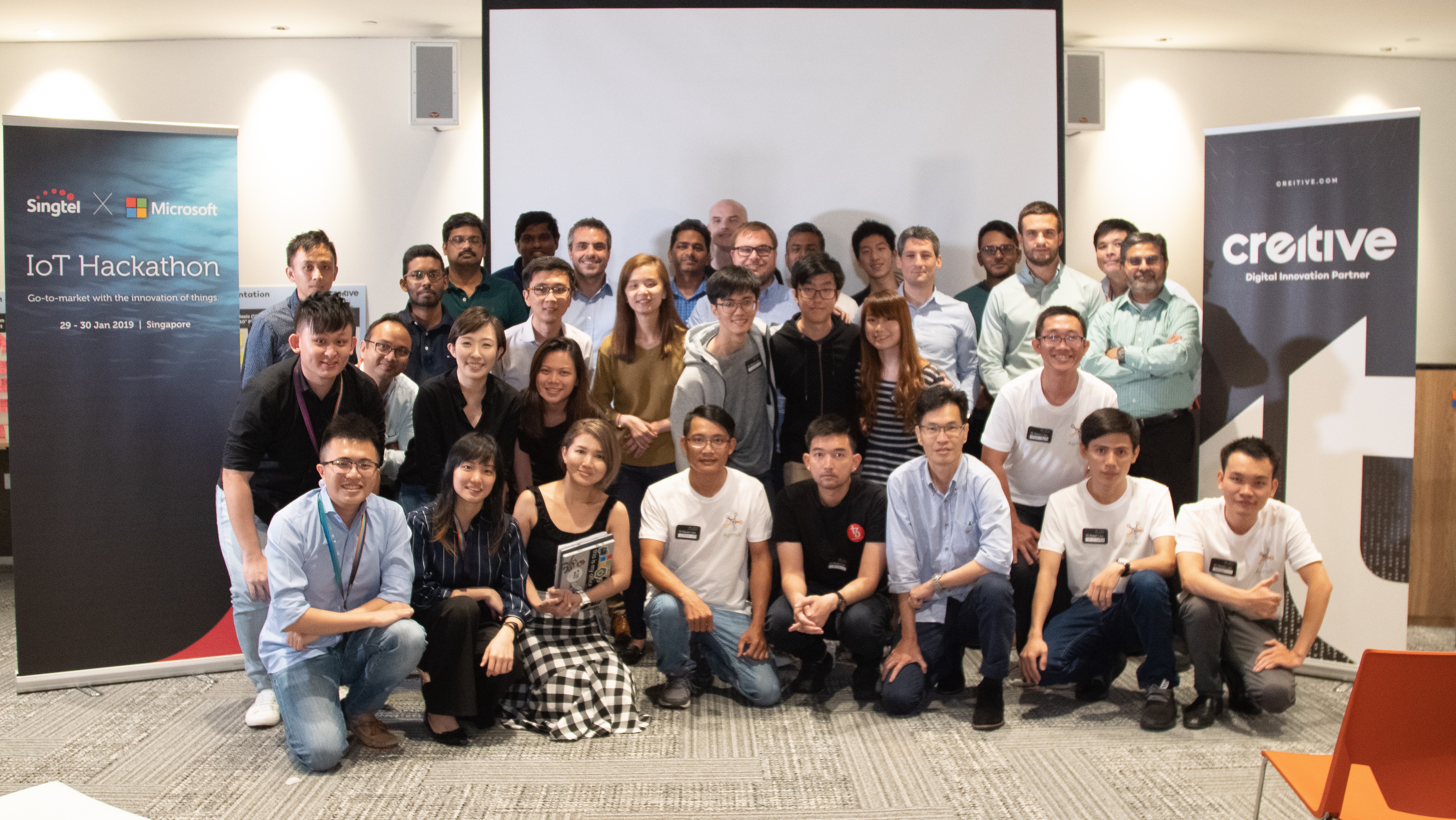
Participants and organizers at the end of the Singtel x Microsoft IoT Hackathon / Photo credit: Microsoft
Vietnamese team AgrHub won the IoT Hackathon with a prototype inspired by an acquaintance: a manager of a jewelry store in their home country.
“She kept complaining about how it’s very difficult for her to change the price tags [of displayed products], and that it takes about seven employees and two days to update over 1,000 price tags,” said AgrHub’s chief financial officer Minh Truong, who represented the team during the pitch at the end of the hackathon.
AgrHub’s solution? Electronic price tags that can easily be updated through a retail management platform that users can access through their smartphones. On top of changing product price and information, retailers can also push sales promotions through the tags.
Products like AgrHub’s smart tags, which optimize customer engagement, are the future of the retail industry, according to Andrés Ortola, Microsoft Singapore’s Enterprise Commercial director. “I believe the future of retail is going to revolve around hyper-customization of services and getting those services right at the edge when the customer interaction happens,” he says.
With plans to further develop the software behind the smart tags and conquer Vietnam’s retail industry, Truong shares that the AgrHub team won’t forget the “sublime” emotions they felt when they were announced the hackathon winner.
“We felt very emotional receiving applause from the board of judges and the audience [after the pitch],” he says. “It was amazing.”
The Singtel x Microsoft IoT Hackathon tasked participants to leverage Microsoft’s Azure platform to develop innovative internet-of-things solutions that address the challenges brick-and-mortar retail stores face with the growing consumer shift toward ecommerce.
To learn more about the Azure platform and how Microsoft can empower startups to scale, visit Microsoft’s website.
Stay updated on the go with our mobile app.
Get latest insights with smoother, more personalized experience through TIA mobile app.
Recommended reads
 Indonesian AI startup goes global
 Forrest Li on scaling Sea, building smarter bots, and founder grit
 An AI assistant that joins sales calls and scores team skills
 Beyond the check: Why VCs need more than capital
 SGX’s CEO says it doesn’t need a unicorn to win
 SMEs want AI too, but not the kind Big Tech is selling
 Oatside’s alt-milk rise hits a profitable gear
 Alibaba’s financial health in 12 charts
 Asia’s telcos bundle AI into mobile plans. Will it pay off?
 M-Daq chases bigger clients as revenue falls, losses grow





Editing by Dante Gagelonia and Eileen C. Ang
(And yes, we’re serious about ethics and transparency. More information here.)



