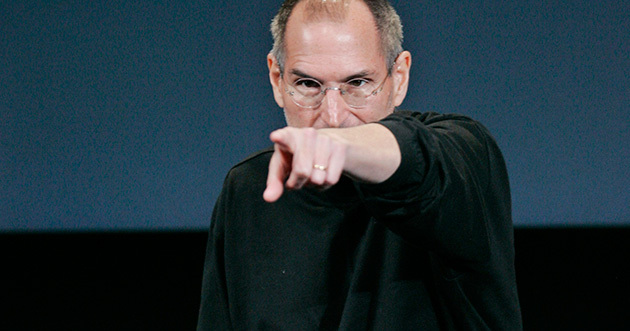
Apple co-found Steve Jobs
The following is an edited excerpt from Steve Jobs, Walter Isaacson’s biography of the Apple co-founder. The excerpt was provided by Simon & Schuster. You can buy a copy of the book here.
I think the real lessons from Steve Jobs have to be drawn from looking at what he actually accomplished. Here are what I consider the keys to his success.
Focus
When Jobs returned to Apple in 1997, it was producing a random array of computers and peripherals, including a dozen different versions of the Macintosh. After a few weeks of product review sessions, he’d finally had enough. “Stop!” he shouted. “This is crazy.” He grabbed a Magic Marker, padded in his bare feet to a whiteboard, and drew a two-by-two grid. “Here’s what we need,” he declared. Atop the two columns, he wrote “Consumer” and “Pro.” He labeled the two rows “Desktop” and “Portable.” Their job, he told his team members, was to focus on four great products, one for each quadrant. All other products should be canceled.
But by getting Apple to focus on making just four computers, he saved the company. “Deciding what not to do is as important as deciding what to do,” he told me. “That’s true for companies, and it’s true for products.”
Simplify
Jobs’s zen-like ability to focus was accompanied by the related instinct to simplify things by zeroing in on their essence and eliminating unnecessary components. “Simplicity is the ultimate sophistication,” declared Apple’s first marketing brochure. To see what that means, compare any Apple software with, say, Microsoft Word, which keeps getting uglier and more cluttered with non-intuitive navigational ribbons and intrusive features. It is a reminder of the glory of Apple’s quest for simplicity.
His love of simplicity in design was refined at design conferences he attended at the Aspen Institute in the late 1970s on a campus built in the Bauhaus style, which emphasized clean lines and functional design devoid of frills or distractions. When Jobs visited Xerox’s Palo Alto Research Center and saw the plans for a computer that had a graphical user interface and a mouse, he set about making the design both more intuitive (his team enabled the user to drag and drop documents and folders on a virtual desktop) and simpler.
Take responsibility end-to-end
Jobs knew that the best way to achieve simplicity was to make sure that hardware, software, and peripheral devices were seamlessly integrated. An Apple ecosystem – an iPod connected to a Mac with iTunes software, for example – allowed devices to be simpler, syncing to be smoother, and glitches to be rarer. The more complex tasks, such as making new playlists, could be done on the computer, allowing the iPod to have fewer functions and buttons. Jobs and Apple took end-to-end responsibility for the user experience – something too few companies do.
When behind, leapfrog
The mark of an innovative company is not only that it comes up with new ideas first. It also knows how to leapfrog when it finds itself behind. That happened when Jobs built the original iMac. He focused on making it useful for managing a user’s photos and videos, but it was left behind when dealing with music. People with PCs were downloading and swapping music and then ripping and burning their own CDs. The iMac’s slot drive couldn’t burn CDs. “I felt like a dope,” he said. “I thought we had missed it.”
But instead of merely catching up by upgrading the iMac’s CD drive, he decided to create an integrated system that would transform the music industry. The result was the combination of iTunes, the iTunes Store, and the iPod, which allowed users to buy, share, manage, store, and play music better than they could with any other devices. After the iPod became a huge success, Jobs spent little time relishing it. Instead he began to worry about what might endanger it. One possibility was that mobile phone makers would start adding music players to their handsets. So he cannibalized iPod sales by creating the iPhone. “If we don’t cannibalize ourselves, someone else will,” he said.
Products first
When Jobs and his small team designed the original Macintosh, in the early 1980s, his injunction was to make it “insanely great.” He never spoke of profit maximization or cost trade-offs. “Don’t worry about price, just specify the computer’s abilities,” he told the original team leader. At his first retreat with the Macintosh team, he began by writing a maxim on his whiteboard: “Don’t compromise.” The machine that resulted cost too much and led to Jobs’s ouster from Apple. But the Macintosh also “put a dent in the universe,” as he said, by accelerating the home computer revolution. And in the long run he got the balance right: Focus on making the product great and the profits will follow.
Don’t be a slave to focus groups
When Jobs took his original Macintosh team on its first retreat, one member asked whether they should do some market research to see what customers wanted. “No,” Jobs replied, “because customers don’t know what they want until we’ve shown them.” He invoked Henry Ford’s line “If I’d asked customers what they wanted, they would have told me, ‘A faster horse!’” Caring deeply about what customers want is much different from continually asking them what they want; it requires intuition and instinct about desires that have not yet formed.
Bend reality
Jobs’s (in)famous ability to push people to do the impossible was dubbed by colleagues his Reality Distortion Field, after an episode of Star Trek in which aliens create a convincing alternative reality through sheer mental force.
One day Jobs marched into the cubicle of Larry Kenyon, the engineer who was working on the Macintosh operating system, and complained that it was taking too long to boot up. Kenyon started to explain why reducing the boot-up time wasn’t possible, but Jobs cut him off. “If it would save a person’s life, could you find a way to shave 10 seconds off the boot time?” he asked. Kenyon allowed that he probably could. Jobs went to a whiteboard and showed that if five million people were using the Mac and it took 10 seconds extra to turn it on every day, that added up to 300 million or so hours a year – the equivalent of at least 100 lifetimes a year. After a few weeks, Kenyon had the machine booting up 28 seconds faster.
Impute
Push for perfection
Tolerate only “A” players
Engage face-to-face
Know both big picture and details
Combine the humanities with the sciences
Stay hungry, stay foolish





Stay updated on the go with our mobile app.
Get latest insights with smoother, more personalized experience through TIA mobile app.









📅 Upcoming Events
22 October 2026
Payoneer x CSPN Summit 2026