- Insights This article was written by a TIA community member. Insights pieces undergo the same rigorous editorial process that newsroom-produced articles have.
 Ashley Collie · · 4 min read
This Chinese co-founder went from having nothing to eat to bootstrapping a successful business
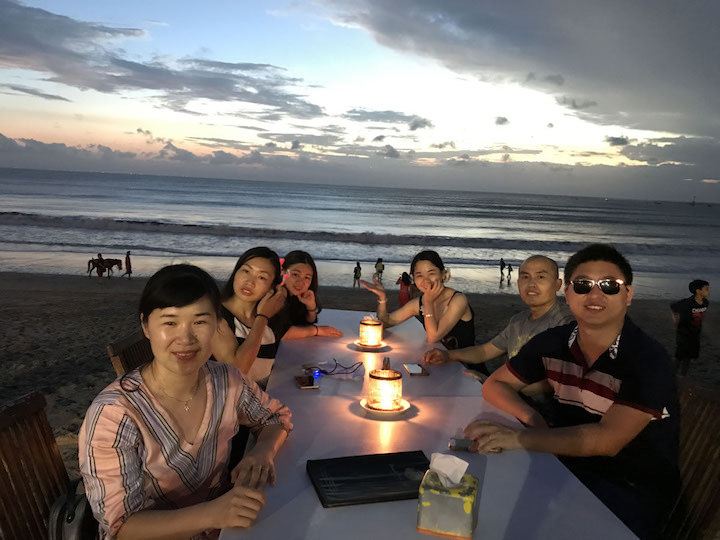
SWI co-founder Luke Liu (second from right) with the company’s sales team in a team building activity in Bali, Indonesia.
How’s this for a showcase of burning desire: going from growing up poor, where your only dream was to have a meal to eat, to co-founding your own company, with your father’s entrepreneurial spirit as your driving fuel?
This is the gist of Luke Liu’s story. He’s a co-founder of Shineworld Innovations (SWI), a display technology developer based in Dongguan City, China.
SWI’s products include small OLED/LCD modules that are customized for various devices including wearables, check-in machines, fiscal processors, intelligent home solutions, and industrial equipment. Its Soulaca product line includes waterproof and vanishing TVs that look like sci-fi gadgets. They also enable you to watch your favorite TV shows.
Liu represents the growing entrepreneurial spirit in China that often manifests in the lives of ordinary people like him who were born outside a big metropolis. A Forbes article writes that “over the past two decades, entrepreneurship in China has grown at an exponential rate.” And while the state economy or “state capitalism” continues to play a key role in the Chinese economy, the rise of vibrant entrepreneurs is increasingly playing a dynamic part in the nation’s economy.
My research for an article I was writing led me to Liu’s company and his story. Here’s my Q&A with him.
How did your father, a former soldier who tried to be an entrepreneur, inspire you?
My father’s desire to better his own family’s circumstances, even though he unsuccessfully tried his hand at his own business, helped motivate me. […] At first, our only dream was having a meal to eat and maybe getting new clothes [for] the Chinese New Year.
But seeing my father’s effort, my long-term goal was to fly out of our poor village to get the ultimate job. But […] I kept the dream of continuing my father’s entrepreneurial aspiration since he got cancer after his own factory [went bankrupt] in 1999. He asked me to never give up and […] bow to fate. That was the fuel of my entrepreneur’s dream. So, I studied crazy hard and finally opened the door to the Hefei University of Technology.
Apart from your father, who else inspired you growing up?
My older brother, Hong, left school early to […] support me […] and help get me into Hefei University. Hong now owns a successful design and construction business in Shanghai.
It all started with our father, and I feel [we] represent the new breed of entrepreneurs in China who show unrelenting ambition and forward-looking optimism in the face of some really daunting challenges. Like Walt Disney said, it really is about thinking, believing, dreaming, and then daring to do.
What did your early career experience give you?
I graduated with a degree in electronics and got my fantasy job in the big city, working for Foxconn in Shenzhen, and then Liteon and Dupont after that. I was totally driven to succeed, and I managed to work on projects for a variety of leading high-tech companies including IBM, Dell, HP, Panasonic, and Sony. But after 10 great years of working with these multinational companies, I felt that entrepreneurial itch.
My associate, Norman Clark Shicker, who had studied the Chinese market and business for 30 years, and I had been working together for an American company. But when they decided to move the China branch, Norman asked, “Luke, are you interested in starting your own business after they move this branch? If yes, let’s do it together.” Then we did it and put all the money we had into the foundation and operation [of the business].
In 2009, we founded Shineworld Innovations in Dongguan. We didn’t do any fundraising, as we really didn’t know how much possibility this display technology business had to become successful. It was ultimate bootstrapping, relying on our own resources. Plus, we didn’t want other people to pay for our failures, so we funded it ourselves.
Like most of the newly established companies, the beginning is always tough […]. In order to save costs, we spent each cent very carefully, and Norman and [I] didn’t take any salary. It wasn’t easy to [get potential customers to believe in us] (laughs). Norman and I even argued a couple of times about the target, operation, and outgoing expenses. But we persisted, and, shortly after, we acquired two factories that had been in the manufacturing business since 2003, so we had built-in continuity.
What was the turning point for you to get involved in new-technology televisions?
What’s the potential for the display technology business now?





Stay updated on the go with our mobile app.
Get latest insights with smoother, more personalized experience through TIA mobile app.