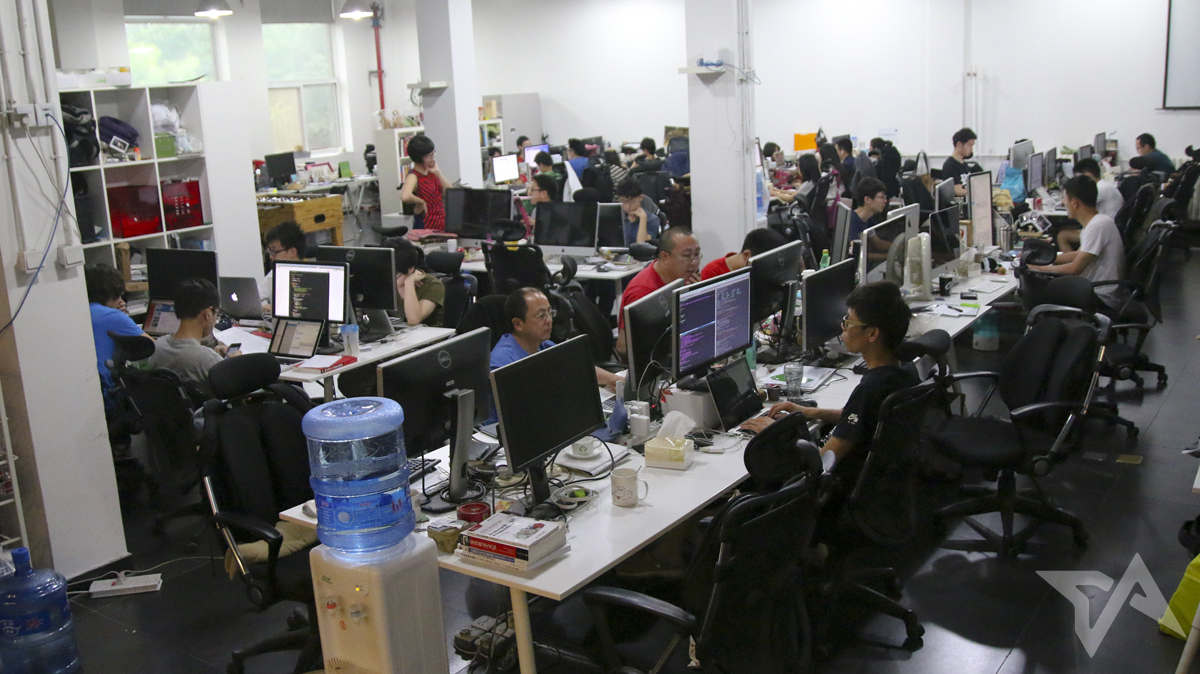
A startup’s office in Beijing. Hey, where’s the foosball table?
There are secrets that are broken; there are secrets taken to the grave; there are state secrets for which people are hanged for betraying – and then there are the valuations of Chinese startups. While valuations are flaunted in Silicon Valley, Chinese startups are much more discreet on this topic. A more accurate adjective might be cautious, because China’s tech businesses know the kind of quick-to-copy, fast-to-roll-out industry they’re in, so their secrets are guarded closely even when they’re celebrating major new funding rounds.
An exception is Xiaomi, the disruptive phone maker that launched its first model in only 2011, and is on course to sell 60 million this year – and then 100 million by 2015. In August 2013, Xiaomi founder Lei Jun took to social media to announce another milestone, saying that a new round of financing effectively valued his company at US$10 billion. A month later, Microsoft bought Nokia, which has been making phones since 1982, for less than Xiaomi’s valuation, paying out $7.2 billion for the struggling Finnish handset business.
But the rest of China’s startup ecosystem is more circumspect, realizing that if you’re far from having Xiaomi’s impact on the market, then you need to keep the cards closer to your chest. To gather the valuations of what we believe might be China’s top 15 most valuable startups, we’ve had to delve into rumors on reasonably reliable Chinese tech media.
“Very few startup companies are above a billion in value,” says William Bao Bean, a partner at SOS Ventures, managing director of Chinaccelerator, and an eight-year veteran as a VC in China’s startup landscape. “The issue with startups that are north of a billion is generally they haven’t been able to get their IPO done which calls into questions their billion-dollar valuation in the first place.”
That certainly seems to be the case with everyone below Xiaomi.
So that we focus on proper startups, we’re only looking at privately-held web companies that haven’t been acquired by a publicly-listed tech giant. So UCWeb is excluded because it’s now owned by Alibaba; JD is out of contention after its recent IPO; Sogou is discounted because it’s a subsidiary of a larger firm. And so on. That leaves us with younger, fresher companies still seeing soaring growth and possibly looking for venture capital funding during times of high expenditure to gain market share. We might see a few of those startups go to IPO in years to come, but don’t expect them to be greeted with huge enthusiasm by investors, as all have a number of extremely strong competitors doing virtually the same thing within China. That’s the kind of high-attrition market it is.
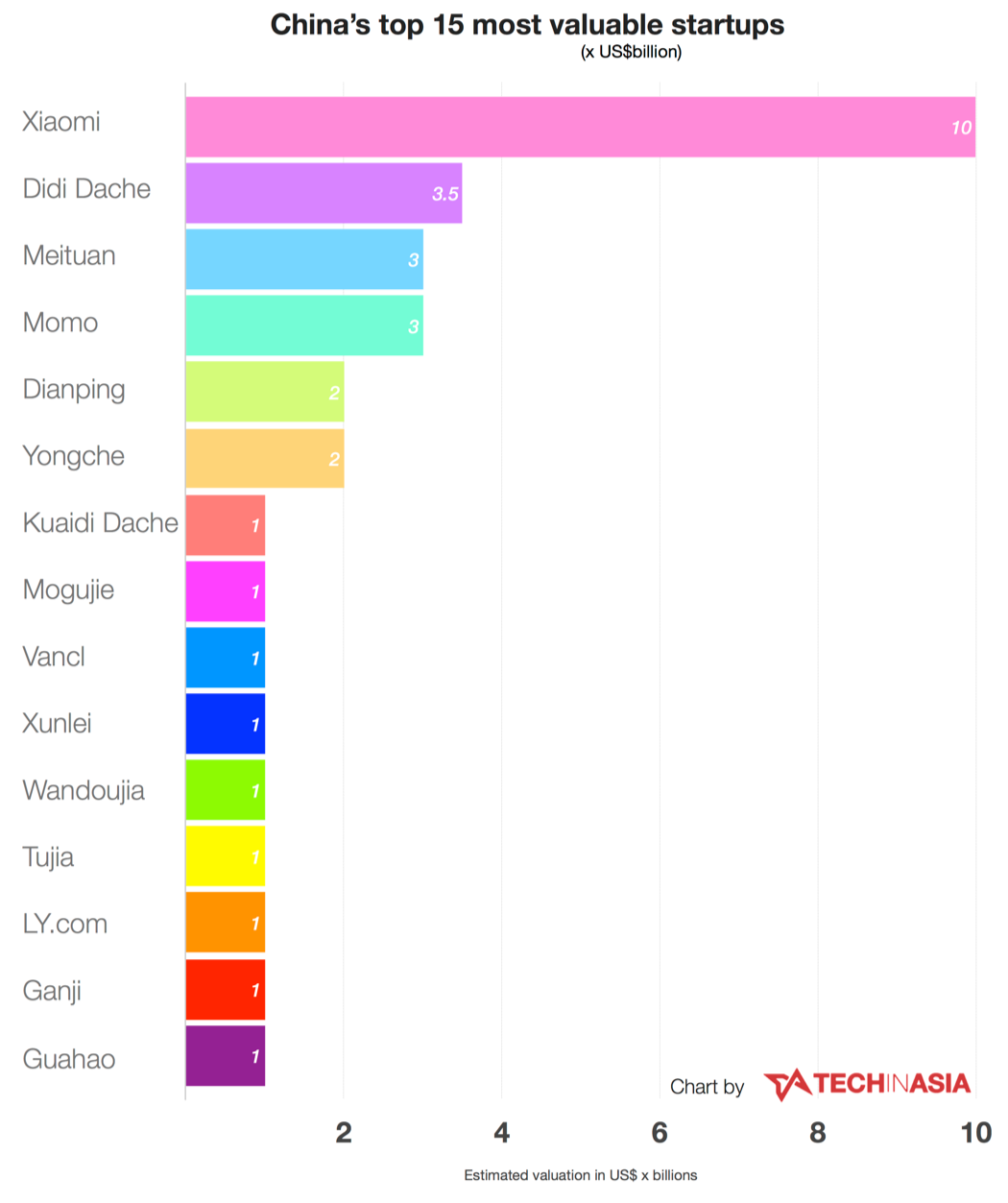
Here’s our chart of China’s highest value startups. Read below for a summary of each startup.
See: China’s hottest homegrown smartphones redefine what you get for just $300
Xiaomi / $10 billion valuation in August 2013 / raised $350 million funding
Xiaomi has already beaten Apple in China and, by the end of this year, it might prove to be China’s top smartphone company if it manages to surpass Samsung’s lead. It has done this by making premium-feel smartphones for RMB 2,000 (US$325), starting a new wave of high-power but low-cost smartphones that are stealing customers away from pricier offerings from HTC, Samsung, and Apple.
$10 billion puts Xiaomi on par with the valuations of US startups such as Airbnb, Dropbox, and Snapchat.
Didi Dache / rumored $3.5 billion valuation in April 2014 / raised $120 million funding
Meituan / rumored $3 billion valuation in May 2014 / raised $320 million funding
Momo / rumored $3 billion valuation in September 2014 / raised $42 million funding
Dianping / rumored $2 billion valuation in February 2014 / raised $550 million funding
Yongche / rumored $2 billion valuation in September 2014 / raised $90 million funding
Kuaidi Dache / rumored $1 billion valuation in April 2014 / undisclosed funding
Mogujie / rumored $1 billion valuation in June 2014 / raised $220 million funding
Xunlei / $1 billion valuation in May 2014 / raised $330 million funding
Vancl / rumored $1 billion valuation in June 2014 / raised $620 million funding
Wandoujia / rumored $1 billion valuation in June 2014 / raised $130 million funding
Tujia / estimated near $1 billion valuation / raised $155 million funding
LY.com / estimated near $1 billion valuation / raised $200 million funding
Ganji / estimated near $1 billion valuation / raised $290 million funding
Guahao / estimated near $1 billion valuation / raised $100 million funding





Stay updated on the go with our mobile app.
Get latest insights with smoother, more personalized experience through TIA mobile app.