- Premium Content It takes our newsroom weeks - if not months - to investigate and produce stories for our premium content. You can’t find them anywhere else.
 Yong Jun Yuan · · 6 min read
Singapore’s data center crunch could drive sector’s AI focus
The limited capacity in the data center sector is likely to push the local data center industry toward higher-value AI use cases.
Kiran Karunakaran, partner at Bain & Company, expects the city-state to take the lead in the region to convert existing data center capacity to AI-enabled facilities.
He estimates that firms operating large-scale cloud platforms, such as Google and Amazon, account for 70% of data center usage in the country. These companies will likely leverage their presence in Singapore for AI workloads while shifting more traditional workloads to Malaysia and Indonesia.
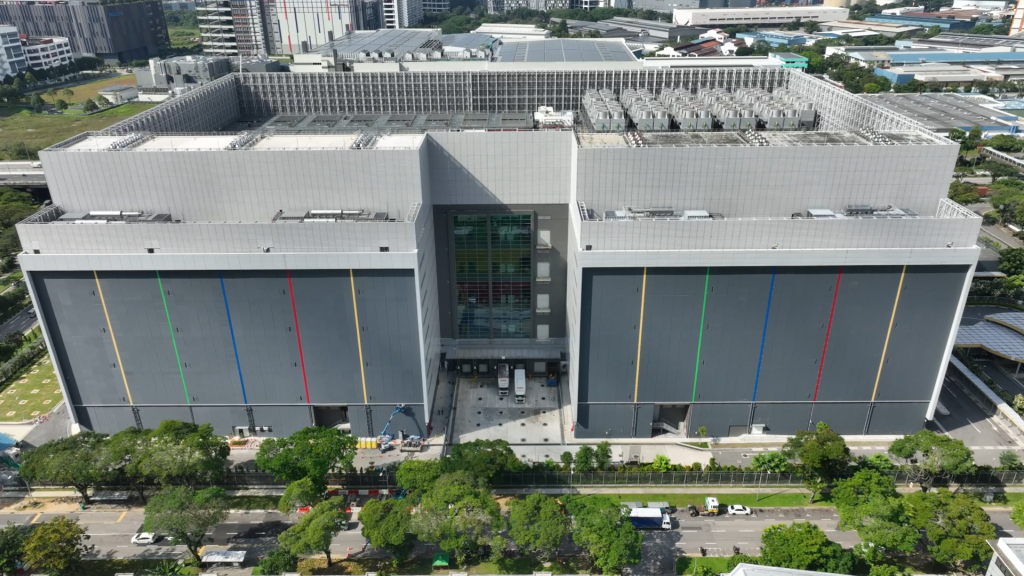
One of Google’s data centers in Singapore / Photo credit: Google
“Many of the data centers in Singapore have already started thinking about AI workloads, says Karunakaran. He adds that in terms of readiness, they are “already ahead” when it comes to availability of graphics processing units – semiconductor chips used to train and run AI models – as well as conversion of existing Tier 4 data centers to AI-enabled ones.
Even with Singapore’s move to increase allocated capacity to the industry, the sector still faces energy and water constraints. In May, Singapore said that it will provide at least 300 megawatts (MW) of additional capacity for data centers in the near term.
Janil Puthucheary, the country’s senior minister of state for communications and information, said in a speech in May that another 200 MW or more could be made available to operators who tap green energy.
Singapore currently has more than 70 data centers, which have a total of 1.4 gigawatts of capacity.
Even with the expected shift toward AI-enabled facilities, Niccolo Lombatti, media and telecoms analyst at BMI technology, says that the types of AI workloads executed in Singapore also matters.
Currently, there is a lot of focus on training and improving AI models, such as OpenAI’s ChatGPT and AI Singapore’s Sea-Lion large language model. But Lombatti says that the nation will not have sufficient capacity to train such models, noting that the average data center development in the US already takes up 200 MW.
“I think that the 300 MW may be better used – and I think that will be the plan – in AI inference, which requires less power density but requires being much closer to the user,” he adds.
AI inference refers to the process in which AI models generate their own results after being trained on data sets. For instance, AI inference for autonomous driving could be done locally in Singapore for optimal performance and safety.
Another factor supporting the growth of AI in the country is its connectivity, according to Serene Nah, managing director and head of Asia Pacific at Digital Realty. She believes that Singapore can retain critical workloads, and remain a key connectivity hub in the region by providing a range of connectivity options.
“Singapore’s world-class connectivity makes it a prime location for deploying cutting-edge AI. Co-locating AI with global networks in Singapore allows for seamless data processing across vast distances and access to a wide range of customers,” Nah explains.
Local readiness for AI
Competition from the region
Stay ahead in Asia’s tech landscape
This is premium content. Subscribe to read the full story.
Tech firms will likely leverage their presence in Singapore for AI workloads while shifting more traditional workloads to Malaysia and Indonesia.
We know this is not ideal. ⌛ Sign up in 20 seconds. Cancel anytime.
Our subscriber community includes professionals from these companies:





Stay updated on the go with our mobile app.
Get latest insights with smoother, more personalized experience through TIA mobile app.