- Premium Content It takes our newsroom weeks - if not months - to investigate and produce stories for our premium content. You can’t find them anywhere else.
 Scott Shuey · · 8 min read
Who’s afraid of a big, bad AI bubble in 2026?
Will the AI bubble pop in 2026? It’s one of the hottest questions going into the new year.
The implications are enormous for Southeast Asia and India, with governments and companies in these regions investing heavily in the tech across software, enterprise platforms, robotics, and infrastructure.

Image credit: Arsal Ysfin
In Southeast Asia, AI startups raised over US$2.3 billion as of June 2025. Money has been pouring into data centers and infrastructure projects: For instance, Malaysia alone saw almost US$2.7 billion in infrastructure investments in the first half of 2025.
In the US, however, the stakes are higher. AI-related stocks accounted for roughly 44% of the S&P 500’s value, which corresponds to about US$25.5 trillion in market value.
Tech in Asia reached out to founders and investors to ask about the possibility of a bubble bursting in 2026. While most were concerned, few thought that any fallout from a downturn in AI would be catastrophic, and none of them believe that artificial intelligence is a passing fad.
The concerns focused on a few common themes: expectations running ahead of reality, costs rising faster than revenue, and a growing dependence on capital markets to keep the system afloat.
At the same time, most also see reasons for optimism, especially in Southeast Asia. If a global AI bubble does deflate, they believe the region may feel the impact later and less violently than the US. As a result, Southeast Asia will emerge with a more disciplined industry focused on execution rather than hype.
Does it exist?
Is there even a bubble to begin with?
It depends on how you define a bubble and which component of the AI stack you look at. There’s the model layer, which refers to the large, general-purpose AI systems that require massive amounts of computing power to train and operate. Then there’s the application layer, which comprises the products and services built on top of AI models.
At the application level, though, we’re still barely scratching the surface of real use cases.
“The question is not whether these models are valuable – they clearly are – but how many years the capital markets can continue subsidizing this cost structure,” says Karl Chan, founder and CEO of Sourcy, an agentic AI firm that helps companies source products.
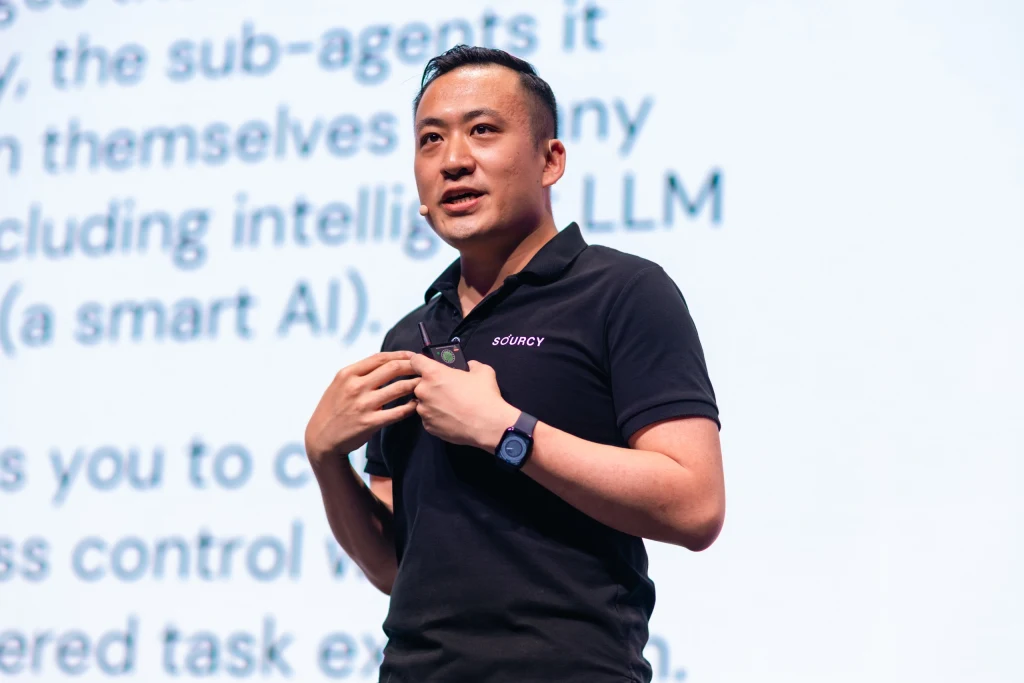
Karl Chan, CEO and founder of Sourcy / Photo credit: Sourcy
Expectations and reality
How a correction could start
Southeast Asia’s position
The AI aftermath
Stay ahead in Asia’s tech landscape
This is premium content. Subscribe to read the full story.
Founders and investors warn that AI hype is outpacing delivery. A bubble may be forming, but Southeast Asia could emerge stronger after a correction.
We know this is not ideal. ⌛ Sign up in 20 seconds. Cancel anytime.
Our subscriber community includes professionals from these companies:





Stay updated on the go with our mobile app.
Get latest insights with smoother, more personalized experience through TIA mobile app.










📅 Upcoming Events
22 October 2026
Payoneer x CSPN Summit 2026