 Winston Zhang · · 6 min read
3 key insights echoing the pulse of Indonesia’s VC scene

Summary:
- The Indonesian startup ecosystem is undergoing a significant cooling period, following a five-year downward trend in funding and a global slump in private capital.
- Investors are moving away from high-risk bets to prioritize “cautious optimism,” focusing more on the quality and execution capability of founding teams than just compelling pitch decks.
- Twenty-seven key stakeholders of the ecosystem convened to discuss these – among other hurdles – and propose recommendations for a better future.
- Download the full report to get in-depth insights that surfaced at Investor Luncheon: Rewriting the Future of Indonesia’s VC Investment
The Indonesian startup ecosystem, once the darling of the Southeast Asian VC community, is currently facing a reality check.
After a decade of breakneck growth, a combination of global macroeconomic shifts and localized “shocks” has led to a noticeable cooling period. But this isn’t a dead end – just a “constructive pause,” according to leaders from the Ministry of Communications and Digital Affairs (Komdigi), the Indonesian Venture Capital and Startup Association, and top-tier venture firms.
This sentiment, along with other insights, was shared at Investor Luncheon: Rewriting the Future of Indonesia’s VC Investment held on October 22, 2025. Hosted by Komdigi and Tech in Asia, the event brought together 27 key stakeholders to discuss how to turn current challenges into a foundation for a more mature, transparent, and resilient digital economy.
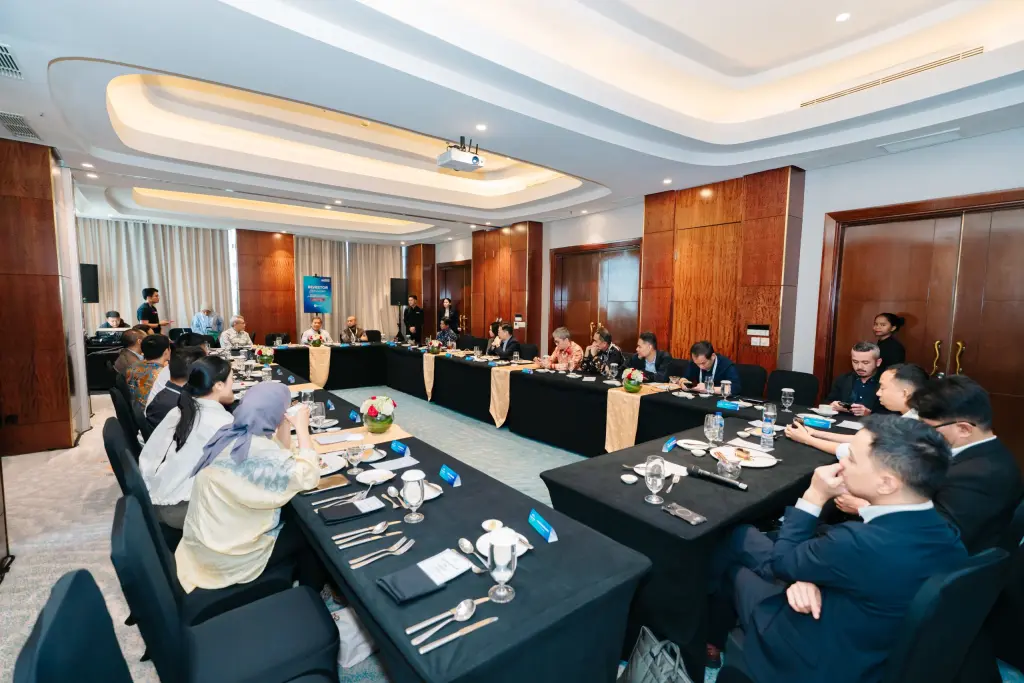
Photo credit: Tech in Asia
The key insights and recommendations from the gathering have been collated into a report, and you can have a glimpse of it here.
A winter across all territories
The numbers tell a sobering story. Global private capital fundraising fell by 23% in 2024, Tech in Asia data shows. In the Asia-Pacific region, specifically, fundraising from limited partners dropped in the same year to US$74 billion, which is 43% lower than the five-year average.
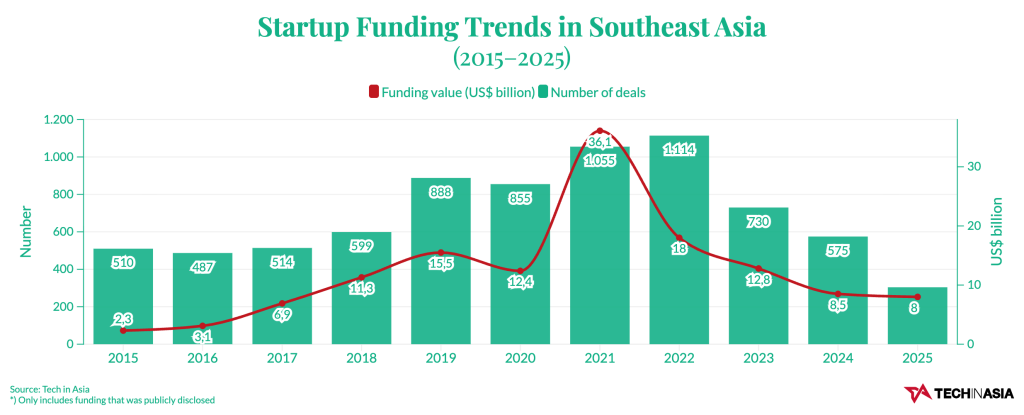
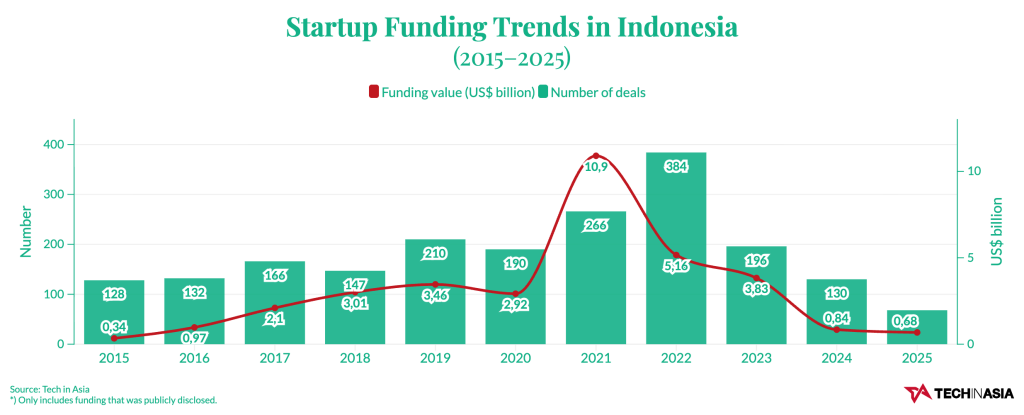
Indonesia hasn’t been immune to this downturn, with investment in the archipelago’s startups going on a downward trend for five years. As of November 2025, year-to-date funding sat at US$685 million across 64 deals, a sharp decline from the US$846 million seen across 131 deals in the full year of 2024.
In the face of these figures, the mood at the luncheon was one of “cautious optimism.” A quick poll of attendees yielded a score of 3.7 out of 5 for the five-year outlook on innovation. However, the immediate future remains “wait and see.”
Abraham Hidayat, managing partner at Skystar Capital, offered a blunt analogy: The ecosystem is like a “patient in the ICU.” He argued that Indonesia should emulate China, which successfully developed its domestic startup ecosystem with sustainable R&D that involved universities and academics.
Other leaders, like Ronald Simorangkir of Mandiri Capital Indonesia and Rizki Mirzy Ramadhana of Telkomsel Ventures, said their firms are currently “playing it safe,” prioritizing strategic synergies with parent companies over high-risk new bets.
The dialogue then shifted to more specific aspects of the Indonesian ecosystem. Here are three highlights – along with a recommendation for each – that emerged at the event.
1. The growing importance of founder quality and leadership
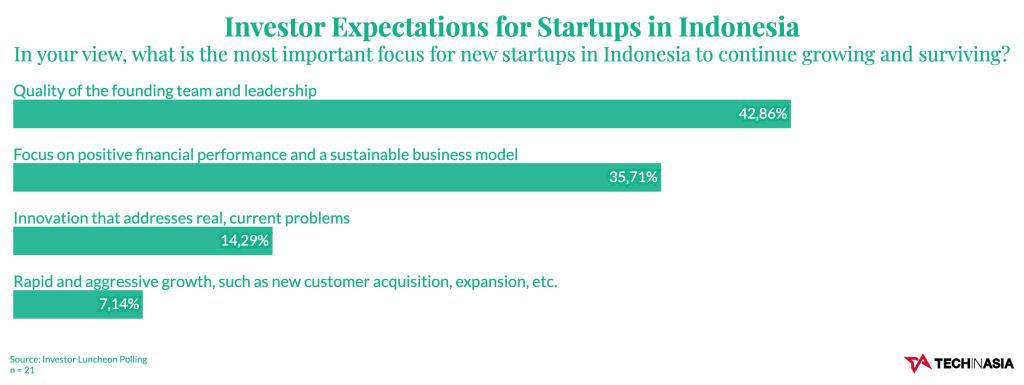
Above other factors like rapid growth plans or even solutions to pressing problems, a majority of the event’s attendees (42.86%) thought the quality and leadership of a startup’s founding team, including execution capability and vision, should be prioritized by new ventures in Indonesia to continue growing and surviving.
“In the past, startup founders could come in with just a pitch deck and still secure funding,” said Amir Karimuddin, managing partner at DS/X Ventures. “Today, no matter how compelling the conversation is, if they can’t show traction or prove they have the capability to execute their ideas, it’s unlikely that any investor will be interested.”
Attendees recommended that, to nurture the right kind of entrepreneurs, a grassroots approach should be taken. They also think that founder development programs should be created in collaboration with universities, industry players, and associations.
2. Setbacks affecting investment momentum
Several attendees from the VC community pointed out that there are several obstacles making investing difficult. These range from inadequate infrastructure that doesn’t support sustainable innovation to regulatory governance perceived as unfavorable to “sophisticated investors” such as VC firms.
The attendees also brought up a hindering factor: the Draft Bill on the Development and Strengthening of the Financial Sector (P2SK Law). It includes provisions to strengthen the House of Representatives’ (DPR) oversight of Bank Indonesia, the Financial Services Authority, and the Indonesia Deposit Insurance Corporation, according to Indonesian newspaper Kompas.
Such measures could undermine the independence and decision-making authority of financial regulators, economists have warned. There are concerns that this intervention may limit the autonomy of financial authorities and subject them to the DPR’s political interests.
Separately, several investors also identified other key challenges. Among them is a weakening exit window – which includes IPOs, M&As, and the secondary market – that was cited by 35% of participants.
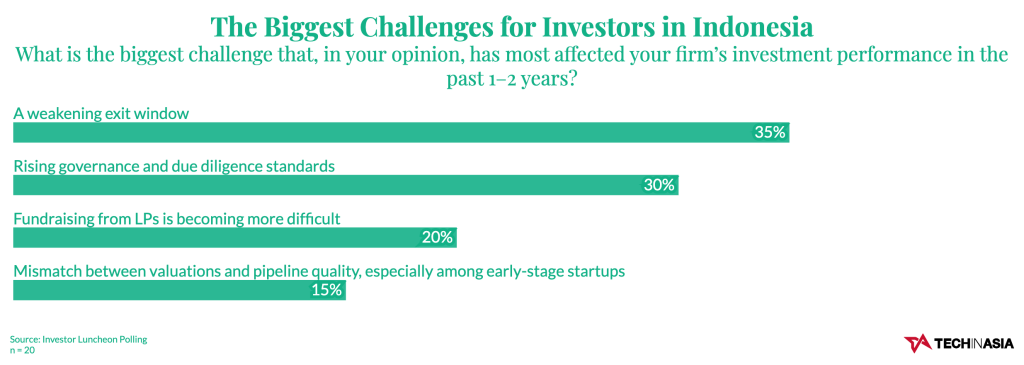
Attendees offered some recommendations they believe can help address these challenges, including simplifying IPO and M&A processes, providing clarity on capital gains tax, and fostering collaboration among exchanges, regulators, and industry players to strengthen liquidity pathways for growth-stage startups.
3. Regulators’ importance in creating a healthier investment landscape
Participants rated regulators’ role in driving positive and sustainable change in Indonesia’s investment climate – particularly in the tech and startup sector – with an average score of 4 out of 5.
To that end, participants mentioned the importance of aligning processes with long-term goals.
“Many people talk about AI, but where is the infrastructure? We don’t even have a National Data Center at the moment,” said a special staff member from a government institution. “So what I mean is that there’s a lot we need to fix internally.”
“Coordination is indeed the most important thing, but the execution of that coordination ultimately comes down to each ministry and agency,” the special staff member added. “In the end, this all boils down to bureaucratic and political issues.”
Attendees then recommended that, on top of establishing a National Data Center, an official database that records all startup funding activities in Indonesia should be created. This would help keep track of investment flows, which are a fundamental part of building a measurable ecosystem.
Toward a healthier Indonesian startup ecosystem
The event provided a platform where key figures in the startup ecosystem could voice their concerns and recommendations. Hopefully, it would be the first step in reviving one of the most vibrant startup ecosystems in Southeast Asia.
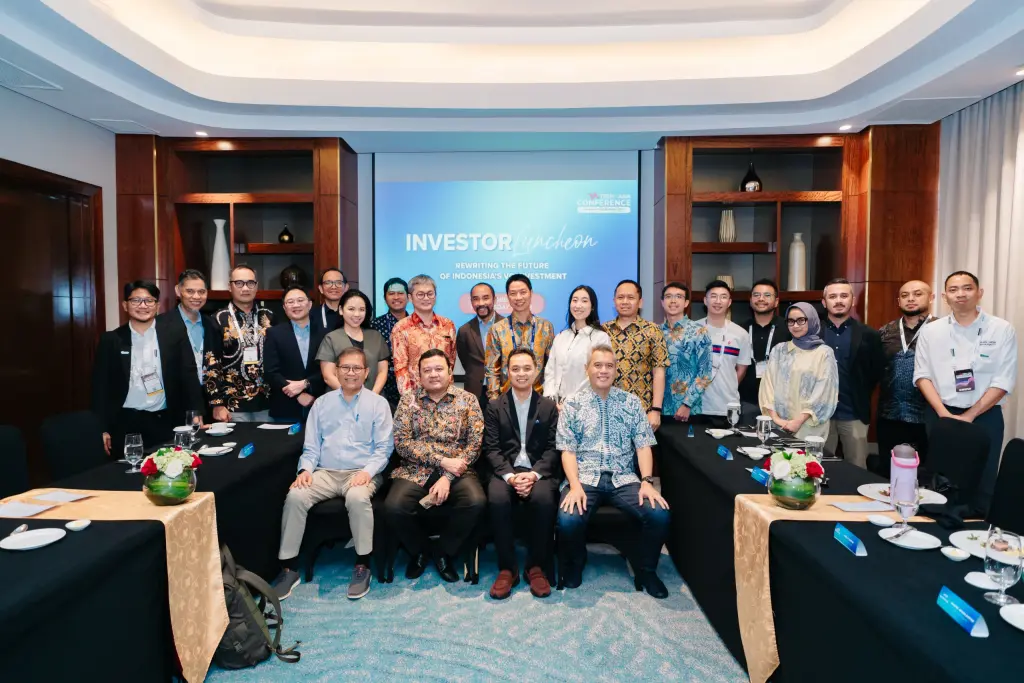
Photo credit: Tech in Asia
The Indonesian government, through the Directorate General of Digital Ecosystems, is signaling a shift in its role. As mentioned by Edwin Hidayat Abdullah, director general of digital ecosystems at Komdigi, the ministry aims to be a “partner of growth,” not just a regulator.
Therefore, the “constructive pause” is a chance to trim the fat and build a foundation of integrity. If Indonesia can align its regulations, empower high-quality founders, and provide clear paths to liquidity, the next chapter of its digital economy will be its most resilient yet.
Komdigi strives to foster meaningful, inclusive digital connectivity, as well as create an empowering digital ecosystem and a secure and sovereign digital space.
Download the full report to dive deep into all the conversations and insights brought up at Investor Luncheon: Rewriting the Future of Indonesia’s VC Investment.
This content was produced by Tech in Asia Studios, which connects brands with Asia’s tech community. Learn more about partnering with Tech in Asia Studios.
Stay updated on the go with our mobile app.
Get latest insights with smoother, more personalized experience through TIA mobile app.
Recommended reads
 The Nadiem effect on investors, talent, and Indonesia
 Stop the spray and pray and why VC investors need real training
 Early founder tips from General Catalyst managing director
 Looking for the next Manus? Start here
 Spot the similarities: startup edition
 VC founder outlines why he’s doubling down on Indian deeptech
 Investors jitter as Dubai faces geopolitical strain
 Banks crash wealthtech’s investing party
 Can the Philippines avoid a second-tier tech board trap?
 The new venture capital edge isn’t capital, it’s attention





Editing by Stefanie Yeo and Mina Deocareza
(And yes, we’re serious about ethics and transparency. More information here.)



📅 Upcoming Events
22 October 2026
Payoneer x CSPN Summit 2026