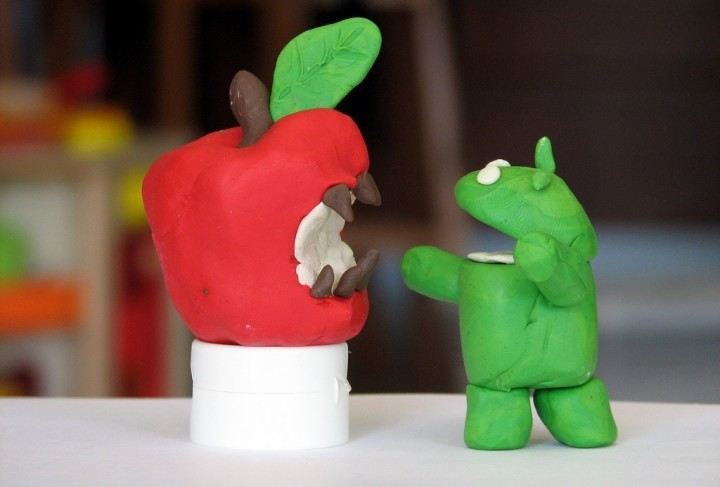
Image credit: Tsahi Levent-Levi
2015 was a great year for Chinese smartphone makers. Sure, there were some disappointments, but the big picture is still pretty good. As of Q4 2015, three of the top five global smartphone brands are Chinese (Xiaomi, Huawei, and Lenovo). That’s an impressive accomplishment when you consider that as recently as 2012, not a single Chinese brand was in the global top five.
Still, there’s a pretty sizeable gap. Here’s the global smartphone market by percent of marketshare according to IDC. You’ll find it hard not to notice a pretty steep cliff here:
So yes, Chinese handset makers did quite well in 2015. But can they climb that cliff? Could they actually beat out Apple?
No. At least not in the sense of eating into Apple’s specific chunk of the market.
Why? For one, they don’t share a clear target market with Apple. Say what you will about Apple – and I’ve said some bad things in the very recent past – but it knows its market. And so do you, probably. Quick, picture an iPhone user. You’re probably picturing somebody young-ish, urban. Somebody who likes a simple user experience that doesn’t change much from model to model. Somebody who admires good industrial design, and who has the money to fit a $600-$800 phone into their budget.
Now, picture a Huawei user. It’s much harder because they’re all over the place. The prices range quite a bit, and the company offers dozens of different handset models. Lenovo is pretty similar. Even once-simple Xiaomi now offers three different major product lines with a confusing assortment of models in each line (do I want the Mi 4 or the Mi 4i or the Mi 4c?).
That’s not to say that none of these devices have clear target markets, of course, but none of them really overlap with the iPhone market. All three companies offer lower-priced devices, and because of their split focus they really can’t hope to compete with Apple’s single-minded focus when it comes to the iPhone market. They may be able to boost their numbers by picking up more users in developing regions, but none of the three is likely poaching any of Apple’s market anytime soon.
Plus, they’re not competing in the same ecosystem. Technologically speaking, there’s nothing on the iPhone that you can’t get on a dozen Android handsets except for one thing: iOS. And while I’ve argued that a lot of the native iOS apps are getting worse, there’s still no doubt that once a user buys into an ecosystem, it’s difficult to get them out of it. So even if Xiaomi (for example) could build a handset that tempted iPhone fans, it would also have to somehow convince them to abandon iOS for Xiaomi’s MIUI Android ROM.
Personally, I love Android and I liked MIUI quite a bit the last time I used it, but there’s no denying that’s a tough sell. People have their entire lives tangled up in the cloud these days, and if you’re an Apple user that probably means Apple’s cloud products. Switching from one ecosystem to another is a pain, and whether or not users are willing to do it depends on factors that OEMs like Xiaomi, Lenovo, and Huawei simply cannot control (like core OS feature sets, app availability, etc.).
None of this means a Chinese OEM couldn’t outsell Apple, of course. But they’ll have to target other sections of the market, or open up new ones in developing regions like Africa. Apple’s not going to lose out on its market share except by way of injuring itself (by releasing a sub-par product, for example).





Stay updated on the go with our mobile app.
Get latest insights with smoother, more personalized experience through TIA mobile app.