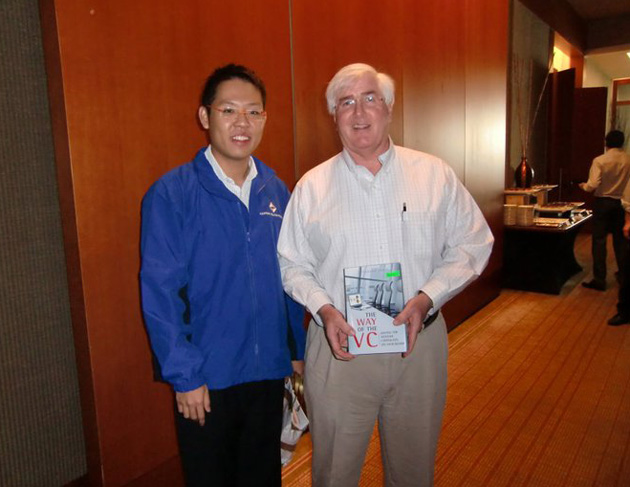
With Ron Conway
Yinglan is a member of the World Economic Forum’s Global Agenda Council on Fostering Entrepreneurship, a Kauffman Fellow, a founder of 3i Venturelab China, and teaches the Masters program in Technopreneurship & Innovation. He now works with the Singapore Government to enhance the innovation and enterprise landscape in Singapore. He blogs here and tweets here.
A large part of my job involves meeting entrepreneurs, which I love. I meet with a staggering number of them each week. Some you can tell are lemons after five minutes, but a special few make my day (the best part of my day). I recently wondered whether there were any common traits amongst those entrepreneurs who were great.
The wonderful thing about venture investing is that it is a science where your experience is cumulative. Similar to Malcolm Gladwell’s 10,000 hour rule, if you’ve seen 10,000 business plans and met with 10,000 entrepreneurs, you develop pattern recognition – and it gets better the older you get, like a well-aged wine.
The great VCs – I’d name Michael Moritz and Don Valentine here; both of whom I have met personally, spoken with at length, and admire greatly (you can read more in The Way Of The VC) – all have this perceptible quality. It’s what industry veterans call ‘the smell.’
Some of the filters I have developed for assessing entrepreneurs:
- Thoughtful listening. Does s/he watch customers and how they behave? What is the input-output ratio?
- Do they iterate rapidly?
- Are they good at mental arithmetic?
- Do they validate the user-base of the product? i.e. measure high-quality repeat users or the net promoter score?
- Do they measure figure metrics which reflect both the quality of the business and factors which they can influence?
- Is s/he able to convey a complex business in very simple terms? (The test is to explain it to your mom and see whether she understands. If she can’t understand it, it is too complicated.)
- Would they ‘throw a turd in the punch bowl’ and disrupt the industry?
- Can s/he imagine doing anything with his/her life other than the chosen service or product? (Correct answer is no)
- Do they refer to a ‘museum of mistakes’ and avoid them?





Stay updated on the go with our mobile app.
Get latest insights with smoother, more personalized experience through TIA mobile app.