- Insights This article was written by a TIA community member. Insights pieces undergo the same rigorous editorial process that newsroom-produced articles have.
 Preetish Panda · · 5 min read
Here are all the implications of machine learning on marketing automation
Google Trends shows that search interest related to Machine Learning (ML) has been consistently increasing over the past years. At present, ML is being applied to find solutions for many real-world problems — medical diagnosis, speech recognition, and fraud prevention. Earlier this year, we also witnessed how AlphaGo (a computer program developed by Google DeepMind) played the game “Go” and defeated the world champion.
The past and present of ML
Essentially, ML combines data and computer programming to develop intelligent algorithms that can improve the predictive capability of computers as they continue to consume more data. That being said, ML techniques are not brand new; they date back to the 1950s.
The most relatable examples of ML would be our spelling and grammar checking tools. These tools have been built on the fundamental principles of ML (i.e., using data sets to recognize errors).
Traditionally, the two most important hurdles in the application of ML have been the lack of adequate data and software libraries for software engineers.
But in the last few years, the adoption of ML techniques has gained momentum with the advent of big data and the proliferation of commercial grade machine learning frameworks. Companies have also begun recognizing the value of analytics and placing it at the center of their decision-making process.
One application of ML is Google’s RankBrain system — the third-most important factor for ranking web pages. When the search engine encounters an unfamiliar search query, RankBrain interprets the keywords, matches them with similar phrases, and presents the best possible result page to the user.
Over time, this system will learn language semantics and upgrade itself by recording the real meaning behind search queries without having to rely on human intervention for pre-programming.
Here is an example:
I entered “what is the name of the robot character in the movie on artificial intelligence and Turing test” as a search query, which can be quite complex for a machine.
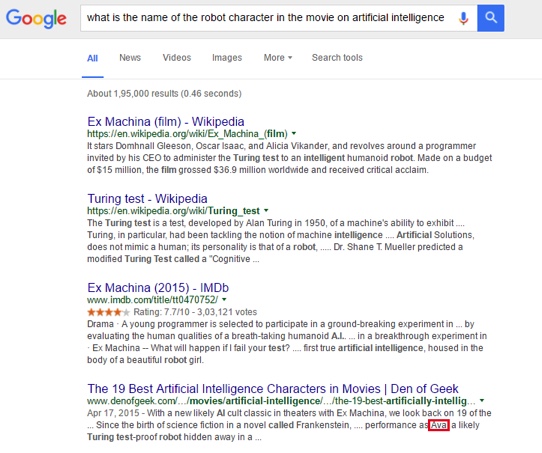
The Google results page for the Author’s query.
Google did a remarkable job of recognizing my query and displayed the movie name. The exact name of the robot character (Ava) can be located in the fourth link. Try out the same search on Bing to spot the difference!
Of course with better accessibility to ML, an exponential growth in data and data storage, and the advancement of ML tools, larger companies have begun applying ML to sales and marketing automation as well.
Implication of ML on marketing automation
Leave the marketers alone; it’s human nature to seek convenience. When marketers had to perform repetitive and predictable tasks, marketing automation came into play. Now, automation applies to various facets of marketing — social media management, rule-based drip campaigns, analytics, data management, and more.
Bottom line





Stay updated on the go with our mobile app.
Get latest insights with smoother, more personalized experience through TIA mobile app.