 Sumit Chakraberty · · 2 min read
Half the work people do can be automated: McKinsey

Softbank’s Pepper. Photo credit: Wikimedia
Here’s a scary thought or a reason to rejoice, depending on which side of the equation you belong. Half the work people do in their jobs can be automated, shows a McKinsey Global Institute study released today.
Instead of assessing the impact of automation on specific jobs, the study went to a more granular level by looking at the activities involved in various jobs. The logic is that every occupation has a range of activities, each with varying potential for automation.
McKinsey found that 49 percent of the activities people are paid to do in the global economy can be automated with “currently demonstrated technology.” That involves US$15.8 trillion in wages and touches 1.1 billion people.
The study encompassed 45 countries and 80 percent of the world’s workers. China, India, Japan, and the US accounted for half of the total wages and employees. Not surprisingly, the two most populous countries, China and India, could see the largest impact of automation, potentially affecting 600 million workers – which is twice the population of the US.
See: Hopes and fears over AI alliance of Google, Microsoft, Amazon, Facebook, IBM
Degrees of automation
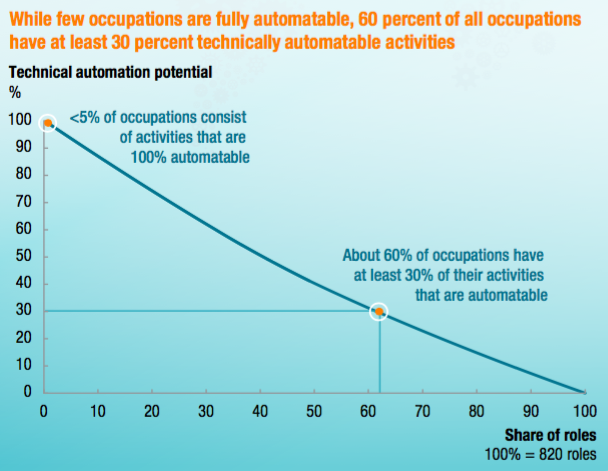
Each job has different potential for automation, depending on the activities involved in it. Physical activities in structured environments as well as data collection and processing are most susceptible to automation. These are to be found mostly in manufacturing, retail, food, and hotel businesses.
The study says that less than 5 percent of jobs can be fully automated. But at least 30 percent of the activities can be automated in 60 percent of jobs.
In other words, it’s not just low-skilled workers who will be affected by automation to some degree, but also highly skilled and well-paying jobs. Many could lose their jobs, but for many others it will free up time for higher value work.
Businesses stand to get performance benefits not only from substitution of labor, but also from higher productivity and quality of work. But the pace of automation will vary from sector to sector as well as country to country, depending on the workforce, policies, and many other factors.
See: McKinsey finds it’s all talk and little action with data analytics
The McKinsey study pointed out that in the US, the share of farm employment fell from 60 percent in 1900 to 2 percent in 2000, while manufacturing roles fell from 25 percent in 1950 to 10 percent in 2010.





Stay updated on the go with our mobile app.
Get latest insights with smoother, more personalized experience through TIA mobile app.








📅 Upcoming Events
22 October 2026
Payoneer x CSPN Summit 2026