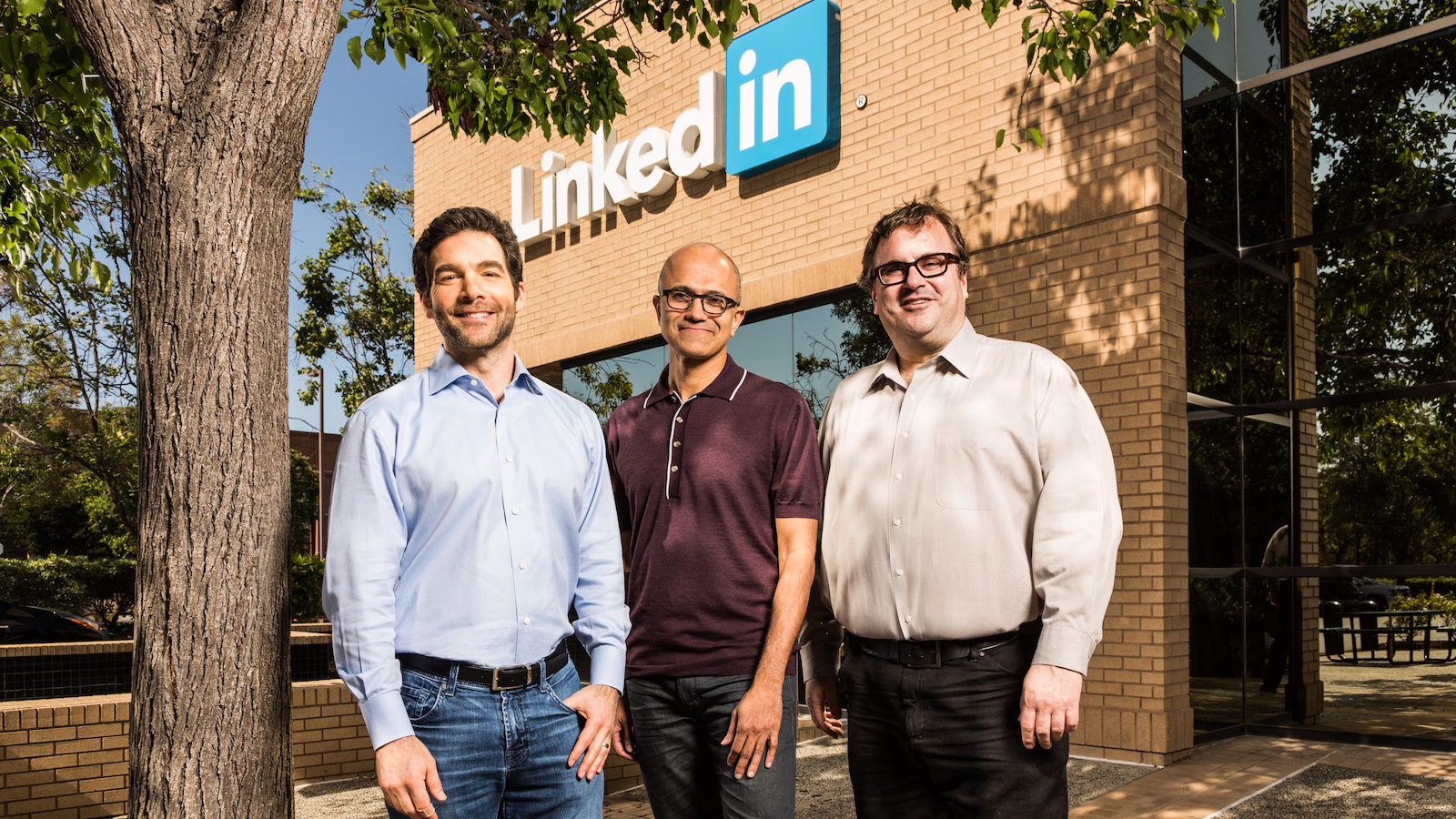
L to R: Jeff Weiner, Satya Nadella, Reid Hoffman. Image credit: Microsoft.
Microsoft’s US$26.2 billion acquisition of LinkedIn is monumental. There’s the eye-popping number. There’s the fact that it could cement Microsoft’s dominance in cloud services for professionals (if you work in a corporation, you most likely use Windows, Office, and Outlook).
Look past the soaring rhetoric and spin though, and you may realize how this merger may eventually land with a thud. Before we go into that, let’s look at why this deal may make sense.
They’re complementary
Microsoft provides cloud productivity tools to professionals. LinkedIn is a social network for professionals. There’s some overlap, but not much. And yet they’re after the same customers. If you’re using Office, you’re probably job-hunting on LinkedIn. Merging increases the attention Microsoft captures with each customer, and that unlocks a ton of possibilities.
Microsoft gains an edge on Google and Facebook
Google is a giant in office productivity, but Google+ was a failure. Facebook has the social graph, but barely began its entry into the workplace. By acquiring LinkedIn, Microsoft now owns some of the world’s leading workplace tools, and also a sizable social network. This move further entrenches Microsoft as a leading enterprise software player.
It’s a big win when it comes to customer data
Microsoft has a lot of data on us. A lot. It knows what we’re doing on Windows. It knows about our meetings and emails. It knows our work habits via Office 365. Now pair that with LinkedIn’s extensive dossier on our professional connections, the companies we work for, as well as our jobs, interests, and reading preferences.
In summary, Microsoft will know a hell lot more about us, and that will reap dividends when it comes to artificial intelligence and machine learning. More data means more insights.
The combined data creates what LinkedIn CEO Jeff Weiner calls an “economic graph.” Microsoft is doing to our professional networks what Facebook is doing with our social lives.
More data may lead to better products
Microsoft CEO Satya Nadella painted a picture in a conference call of how this “economic graph” could enhance products at both Microsoft and LinkedIn:

What if Cortana knows your entire professional network?
- The LinkedIn news feed could factor in your calendar meetings and the projects you’re working on to give better recommendations.
- Cortana (Microsoft’s version of Siri) could brief you about the people you’re about to meet at your next appointment.
- Bing could serve up search results based on your LinkedIn data.
- You may be able to look up contacts in Outlook and see their LinkedIn data.
- You may take online courses (via LinkedIn Learning) directly within Office.
- LinkedIn’s Sales Navigator could integrate with Microsoft’s Dynamics (a sales and ERP tool), resulting in more comprehensive sales analytics.
LinkedIn gains a massive sales and marketing channel
There are over one billion devices running Windows. Outlook has over 400 million active users, and Bing has a 20 percent share of the US market.
All that amounts to a great opportunity for LinkedIn to increase its engagement through product integrations. A larger funnel leads to more conversions.
Microsoft may have acquired a sinking ship
LinkedIn may be overvalued
Product integration may not lead to positive results
One word: Skype





Stay updated on the go with our mobile app.
Get latest insights with smoother, more personalized experience through TIA mobile app.