 Vanessa Tan · · 5 min read
A Chinese Perspective: Why Foreign Companies Fail, and How To Succeed In China
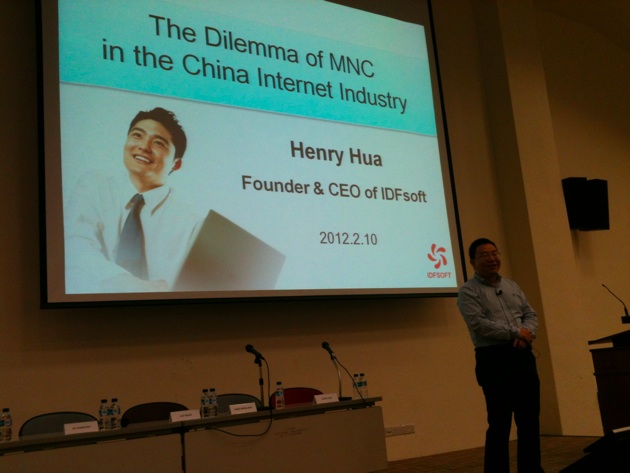
Henry Hua, founder and CEO of IDFsoft, a startup company focusing on mobile gaming and gamification, took to the stage at the National University of Singapore (NUS) School of Computing (SoC) last Friday and shared with us certain insights as to how foreign entrepreneurs should go about entering the Chinese market.
As most of us are well aware, many foreign Internet giants tend to lose their foothold in the Chinese Internet industry. That is the sad reality, but why is it happening and why are the subsequent players not learning from the previous failures?
One famous example he cited was Google China, which ultimately came down to – quite apart from the hacking controversy that so soured relations between it and authorities – a very different view of how to let people access the web. Unfortunately, this has resulted in Google losing its market share in China and it is currently struggling to fight for its online mapping license in the country.
Similar cases do happen to other Internet giants such as eBay, Amazon, Yahoo, MySpace, and Groupon. So what are the various factors that contribute to all their failures? Mr. Hua, in his talk, identified these seven areas:
Government and Policies Makes Foreign Entry Impossible
Henry shared that especially for the Internet industry, almost no sole foreign investor – without a joint-venture (JV) partner; more on that later – is able to obtain the mandatory Internet Content Provider (ICP) license. These tend to be restricted so as to prevent Chinese citizens viewing some ‘sensitive’ material from foreign websites.
Hence, one of the most common approaches done by most foreign entrants is partnerships, such as Groupon did with Tencent.
On top of which, one would need many business licenses in order to operate in China. Additional business licenses are very high barriers themselves because one would need to understand which license is required for which side of the business operations. In Henry’s opinion, the reason why such licenses are being set up is (partly) to raise the barriers to entry for foreigners.
Protection for Innovation and Intellectual Property is Weak
In China, there is hardly any protection for innovation and intellectual property (IP). In fact, you would find that there is no protection for business models and user interfaces in the Internet businesses. We’ve seen a couple of cloning examples and undoubtedly the Internet has better facilitated the cloning process, where source codes could be easily ripped and copied from pages and apps.
So-called ‘copy-to-China’ is still the main business model of the China Internet market. If there is a successful site or service in the West, it would be replicated, built, and localized in China. With such a well-oiled process in place, it makes it pointless for foreign companies to enter when their business models could be easily replicated in China.
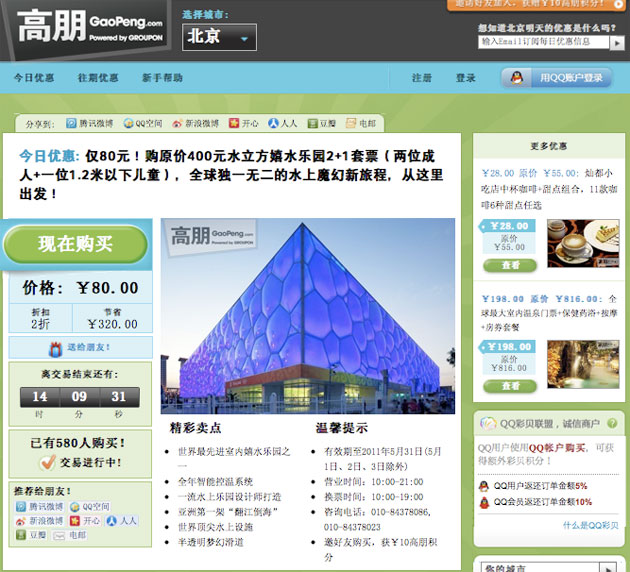
Some say the JV between Groupon and Tencent - called Gaopeng - is an example of a poor partnership: Tencent has its own rival daily deals site, and little reason to want Groupon's effort to succeed.





Stay updated on the go with our mobile app.
Get latest insights with smoother, more personalized experience through TIA mobile app.








📅 Upcoming Events
22 October 2026
Payoneer x CSPN Summit 2026