Daniel Tay · · 4 min read
This startup is using chatbots to push the boundaries of automation
These days, it’s hard to tell if the person you’re communicating with online is an actual, real-life human being or just a bunch of code. For instance, it took several email correspondences with companies using Evie, an email-based AI scheduling assistant, before I realized that these companies weren’t all sharing the same (human) personal assistant.
Innovations in artificial intelligence and automation are relatively new to the Singapore market. However, with the belief that “over 70 percent of issues can be covered by 10 to 20 responses,” three Singaporean entrepreneurs decided to found a company called KeyReply. Their goal: to help companies identify key insights from customer conversations and automate customer engagement and support using Facebook Messenger bots.

KeyReply co-founders (L-R) Max Xu, Carylyne Chan, and Spencer Yang.
I’ll be the first to admit that I was skeptical whether chatbots would be truly useful. Most of the chatbots I’ve interacted with typically have a very limited vocabulary—say something beyond the scope of their programming and they won’t know what you mean.
As KeyReply co-founder and COO Carylyne Chan puts it: Nobody likes a chatbot that keeps saying, “Sorry, I didn’t understand your question. Can you rephrase?”
Still, many companies see chatbots as “an entry point […] to start adopting software automation in their workflow and customer interactions,” Spencer Yang, the company’s co-founder and CEO, tells me.
To date, their clients include companies like SGAG, Ninja Van, Tech in Asia, and even the Singapore government’s one-stop portal for government information, Gov.sg.
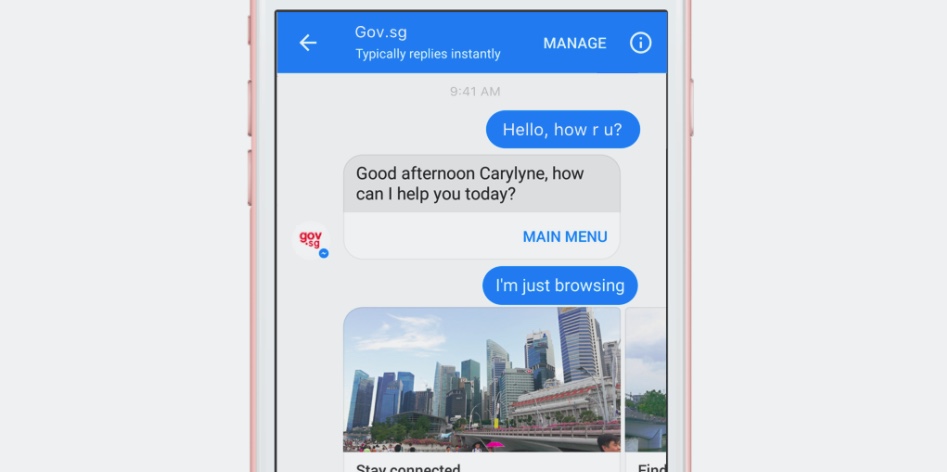
“The use cases of chatbots range from proactive user engagement to reactive support and answering of frequently asked questions,” he explains. “For instance, you can search for any public civil officer’s email on the Gov.sg chatbot, or ask if there’s going to be haze that day.”
Building the bot
One would expect the process of creating a chatbot for a government agency and a tech startup to be very different. According to Spencer, however, the process is surprisingly similar.
Together with the company’s account manager, each client goes through the same five steps, namely:
- Scoping and sketching dialog
- Training with knowledge
- Interaction iteration and integrations
- Testing and optimization
- Launch and learn
“For each of the steps, it’s really important to get everything right and ensure that customers are able to use the platform and work with the account manager to adopt the best practices,” he says.
What the future holds





Stay updated on the go with our mobile app.
Get latest insights with smoother, more personalized experience through TIA mobile app.