Kylee McIntyre · · 4 min read
Horrified by their electricity bills, these geeks created a PC stick for your TV
In 2010, when the lights in Bangalore turned off, Davide Cali and Ambuj Kumar’s turned on.
Davide and Ambuj were working in the city together on a natural language artificial intelligence project. Ambuj was also working on supercomputing, which required several computer processors and servers to be running at once. Power outages were a constant problem for them – just as for many across India.
“The grid went down all the time,” Davide explains. “All the IT companies there [in Bangalore] have electric generators, but they can’t last that long because there is a limited supply of power.”
That led Ambuj to ask why they needed so many computers and so much power to do what he considered to be a small amount of work. Meanwhile, their electric bill was skyrocketing due to the energy consumption. Inspired by Ambuj’s idea, they decided to build something for themselves – a low-cost, low-consumption computer. Selling it didn’t occur to them until someone questioned them about the device and asked why they didn’t build it for other people. Meanwhile, the startup grew to six people – Ambuj and his brother Niraj, Davide, brothers Naresh and Sai B Chintala, and Abhishek Kumar.
Most people were asking for Windows. But their gizmo was using Linux.
By 2013, they had a prototype, and Davide claims that was the year they took the product to an exhibition and got a thousand orders. Still, the business partners had a problem. “Most people were asking for Windows.” But their gizmo was using Linux.
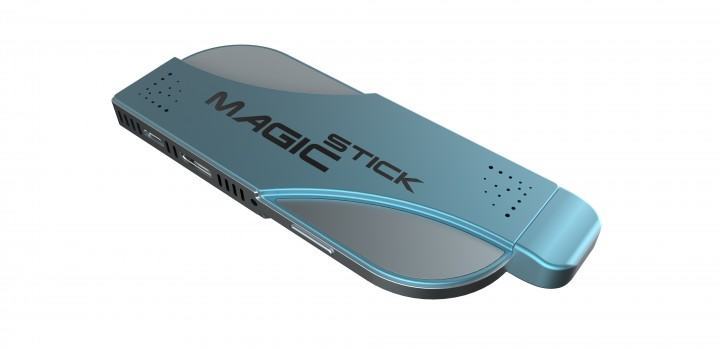
They brought a fully-realized product, the palm-sized MagicStick, to the market last summer, with two key features. First, it runs Windows (but still remains fully Linux compatible). Second – something that Davide is particularly happy about – the PC stick uses Intel’s low-power Cherry Trail processing chip. Intel, associated mostly with computer processors, also uses Cherry Trail in its own line of low-power computing sticks. Chinese company Meegopad, MagicStick’s other big competitor, also uses it.
MagicStick offers 8GB of memory and can be plugged into a USB port to run like a PC on another PC, a Mac, a television, or a projector. It costs US$139 or US$499, depending on the model you want. But you’ll need to supply your own keyboard and mouse.
Unlike an emulator, it’s fully geared to run on other systems. Used with a free control app, it also works for mobile phones and tablets, and it runs on a mere 5 watts of power. Much like a USB drive, it’s much less prone to breaking for people who chronically drop their electronics.
If you’d rather have Android than Windows, another alternative is the Remix Mini.
See: These 3 guys quit Google, but their new startup shows they still love Android
Stick in the mud

Sticking the landing





Stay updated on the go with our mobile app.
Get latest insights with smoother, more personalized experience through TIA mobile app.