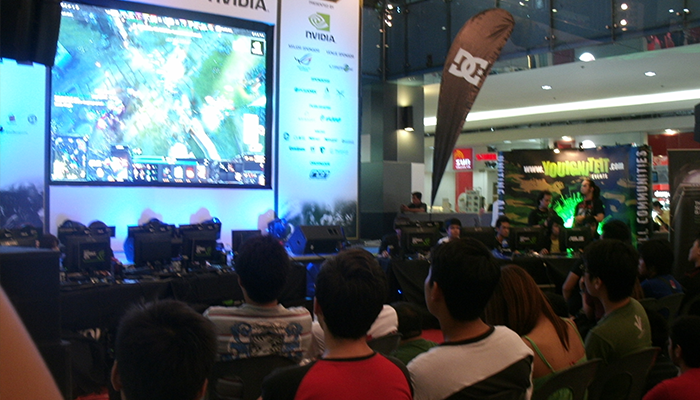
I’m not sure about every other country in Southeast Asia, but in the Philippines, if you ask a random person about eSports, you will likely get a blank, puzzled response. But don’t get the wrong impression that there isn’t an eSports scene in the Philippines, because there is. We have gaming organizations. We have pro players. We have sponsors. We have gaming events ranging from local computer café competitions to the nationwide tournaments. We even have the Philippine eSports Organizaiton and the recently formed National Electronic Sports Commission. It may not be as big as in China, but it exists nonetheless.
However, in the Philippines, when one expresses the intent to be a professional gamer, it isn’t always met positively. Unlike joining a collegiate basketball team or a sports club outside school, having a professional gaming team is an entirely different story. There are many ways that people in the Philippines see professional gaming and it sometimes makes it difficult for aspiring pro-gamers and even game casters or game managers to get into the pro scene.
1. “It’s just a game”. Not.
A big hindrance to understanding eSports properly is that most people in the Philippines see computer and video games as nothing more than a game, which therefore should not be taken seriously. This is why I am taking this chance to say it now: Computer and video games are games, but once competitive, they are not just games.
Gamers don’t just sit there and magically become professional gamers much like how playing basketball all day won’t land you a spot in the NBA. Like professional athletes, competitive gamers actually have to train and follow a schedule that often drains not only the body, but also the mind. And when I say train, it’s not always about sitting there playing games all day and all night. It includes studying statistics, watching replays, analyzing enemy teams, improving play mechanics, tracking game changes, criticizing one’s own gameplay, finding new ways to adapt and devising strategies to name a few. So, no, it’s not just a game.
2. Career options are limited
More often than not, professional gamers in the Philippines today are usually teenagers or those who are in their twenties. Other people their age are usually still either in high school or in college. Most, if not all, universities and colleges don’t offer eSports-related programs. That means if a student would like to partake in eSports or become a professional gamer, he or she will do this outside of school. And your professional gaming record isn’t actually something that will land you a regular office job. This usually worries the parents and understandably so. They often ask, “If my son/daughter becomes a professional gamer, what are the career options for him/her?” or “Is pro gaming a stable source of income?”
I can’t really blame them for worrying about their child. It’s not that they hate eSports, but any parent would prefer their child to have a secure and stable future. And currently, sad to say, eSports not only in the Philippines, but also in many parts of the world doesn’t actually provide that kind of stability. Unlike China where a $60,000-prize pool tournament is possible for professional teams, eSports is not that big and glamorous in the Philippines. I’m not saying it won’t or can’t be, but right now, it isn’t. Pro players may get salaries depending on the sponsor or organization, but they will only pick you up once you’ve proven something. Until then, you will only get your profit from tournament winnings and the biggest prize pools in the Philippines may be around P27,000 ($675 USD).
3. Gaming has little to no benefits
One of the biggest misconceptions about gaming is that it has no other benefits aside from fun and possible winnings. Actually, as mentioned earlier, being a pro gamer requires discipline and dedication. It also trains a person’s eye-hand coordination and quick thinking as well as probability and decision-making skills. Team games also require coordination and synergy, and unlike sports such as basketball, there is no body language to read. In fact, there has been a university study about the benefits of gaming ranging from improved creativity and decision-making to boosting night driving ability. An article on a psychology website even mentions benefits such as improved memory and critical thinking skills.
4. The general idea that gaming is bad
The general idea that gaming is a bad influence affects how people in the Philippines react to professional gaming. After all, making money out of something that’s bad is something you should not be proud of. And it’s not just about these players becoming violent. It’s also about learning how to trash talk other players and also partaking in gambling. In the Philippines, bet matches are a common and popular thing in computer shops. Players place bets on their games to make it interesting and exciting. These bets range from a bottle of soda to several thousand Philippine pesos. The largest bet in my area that I know of was around Php 15,000 ($375) per team and there are possibly bigger bets placed in matches in Manila and other cities.
However, gaming is just like any other form of entertainment. It has its target audience. Take Call of Duty for instance. It is labeled with a ‘teen rating symbol by the Entertainment Software Rating Board (ESRB) because of blood and violence. That means it is only suited for players who are aged 13 and up – so buying it for an eight-year old is a bad idea. In a chat I had with Alvin Juban, the president of the Game Development Association of the Philippines, one of the things I asked was about the misconception about the negative effects of PC and video games. He replied:
Saying that people should not play or make video games because there are violent games is like saying people should not become actors because there are violent movies.
In the end, there is no easy way to make people easily understand or accept eSports in the Philippines, as there are many other factors that affect it. Although it’s true that Philippine eSports is experiencing various obstacles, the positive side here is that there are people who are doing something about it. And as I mentioned earlier, it may not be as big as the industry in China and South Korea for now, but no one’s to say we’re not getting there someday.
(Edited by Minh and Steven)





Stay updated on the go with our mobile app.
Get latest insights with smoother, more personalized experience through TIA mobile app.