 Stefanie Yeo · · 5 min read
4 misconceptions about growth that could hold your startup back
Growth is the lifeblood of any startup. Paul Graham, co-founder of leading accelerator Y Combinator, goes as far as saying that “startups = growth” – they are companies specifically designed to grow fast.
While growth is crucial for startups, it’s a concept that’s often misunderstood. It can mean different things to the different stakeholders within an organization and involves many aspects of the business, making it easy to lose sight of the forest for the trees.

Image credit: Tech in Asia
In March, Tech in Asia School will be running its Growth Bootcamp. We aim to help startup founders as well as product and marketing leaders get to the heart of how to develop great growth strategies and build traction for their businesses.
Ahead of the bootcamp, we’re unpacking some common misconceptions about what startup growth really means, drawing on the experiences of the Tech in Asia School team from working with businesses across Southeast Asia.
Here are four things people often get wrong about growth strategies:
1. Growth is just “something else”
One of the biggest misunderstandings people have about growth is that they think it’s linked to a single thing that a startup does. Some folks think that growth is just search engine marketing or optimization. Others think that growth solely refers to user acquisition, while there may be some that believe that growth is the work of the marketing or product teams.
However, growth encompasses all of these factors – and so much more. It requires a holistic view of the business where you have to look at the entire funnel, from awareness right down to retention and referrals. How is your paid ads strategy getting people on board? Is there friction in the onboarding process? How can the product be improved to help people move through the growth funnel?
A great example of this is Facebook. When it started expanding globally, the social media firm had to explore new channels beyond what was commonly used in North America to connect with potential users. It also had to make changes to its user registration flow in order to accommodate mobile-only users who didn’t have email addresses. These couldn’t have been accomplished by just the marketing team or product team alone – it had to be a company-wide effort.
2. Growth is one-and-done
Another common misunderstanding people have around growth is that it’s something you can set in stone. You sit down, develop your growth strategy, and then follow that framework toward success.
Unfortunately, that’s not the case. Growth is a constant cycle of iteration, experimenting, and trying new things. It is an ongoing process of learning and making incremental tweaks and adjustments to make the customer journey better at all stages of your funnel.
“There’s no one-size-fits-all advice: Your growth strategy should fit where you are in the moment,” said Brian Rothenberg, partner at Defy.vc and former vice president of growth at Eventbrite, in this article from First Round Review.
As a company goes from being a seed-stage startup to preparing for an IPO, its growth strategies will have to evolve in line with its priorities and demands. A new startup may be focused on top-of-funnel challenges like making the leap from awareness to acquisition, but an older company with more resources may be able to run experiments across different areas.
3. There’s a “magic formula” to growth
The third thing people get wrong about growth is that there is a strategy, formula, or hack out there that they can just take and apply to their own businesses.
There isn’t an all-in-one solution to growth. Every company is different and exists at a unique position.
For example, PayPal “hacked” its way onto eBay by writing a bot that bid on low-value auctions, which then messaged the seller to ask if they accepted PayPal, leading to more sign-ups. This worked for the fintech major back then but it’s not a strategy that would apply to all businesses – or something that would work today.
There’s no silver bullet for growth, but there is a process that can help you find your silver bullet for your company. What is crucial, therefore, is the spirit of experimentation to figure out what works for your customers and your business.
4. Growth is too complex and messy to track properly
This one is something the Tech in Asia School team hears all too often. Many people share that they find growth too complicated to cleanly manage because there are too many factors and they don’t know how to track it – why bother if you can’t do so successfully?
However, growth is only too complex and messy if you let it be. Sure, it is a complicated process and there are many different stakeholders and factors involved, but that’s where experimentation and planning comes in.
You need to sit down and properly identify the key metrics you need to track that lead toward your North Star metric. In addition, you should develop the right steps to support these goals. With proper planning, growth is no harder to track than anything else you do with your business.
Supercharge your startup’s growth
Growth is a topic that’s often misunderstood and that makes it even more daunting. But we can’t emphasize how important it is for a startup – the right growth strategies can make all the difference in taking a business from zero to hero.
If you’re keen on learning about great growth strategies and product-led traction for your company, join us at Tech in Asia School’s upcoming Growth Bootcamp. We’re condensing our six-week long Growth Program into three intensive sessions that will take you through all the nitty gritty of what it really means to grow your business.
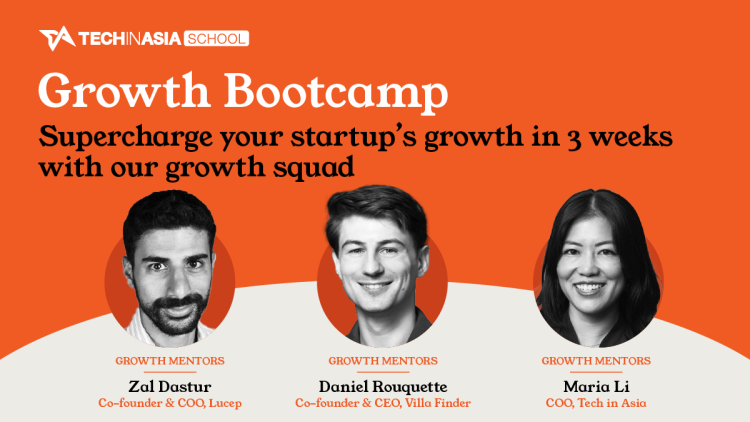
Addressing everything from what metrics you should focus on to identifying the right channels, this is your chance to learn and apply growth strategies that have worked for Southeast Asia’s top startups like Grab, Lazada, and Carousell.
The Growth Bootcamp will cost US$399 and run over three Saturdays from March 4 to March 18, 10 a.m. to 12 p.m. SGT. Whether you’re a founder, business leader, product lead, marketing manager, or just someone interested in learning about startup growth, this bootcamp is for you.
Registrations for the bootcamp have closed.
Stay updated on the go with our mobile app.
Get latest insights with smoother, more personalized experience through TIA mobile app.
Recommended reads
 A platform digitizing supply chains for Bangladesh’s small retailers
 This startup makes durian season last all year with freeze tech
 5 key takeaways from Meta’s report for D2C startups
 ‘Proudly Indonesian’ brands are venturing into the global market
 Vietnamese B2B platform bags $1m in Touchstone-led seed round
 SEA food delivery spending tops $16.3b in 2022: report
 Runway? Check. Users? Check. I still killed my startup
 How a Singapore D2C firm used infomercials to build profitable $28m business
 Exclusive: RedDoorz breaks even in Indonesia, Philippines
 SoftBank-backed Swiggy to shed 380 employees





Editing by Lorenzo Kyle Subido
(And yes, we’re serious about ethics and transparency. More information here.)



📅 Upcoming Events
22 October 2026
Payoneer x CSPN Summit 2026