Apoorva Dutt · · 5 min read
A Facebook app raised $50m and then got sold for $2m. Here’s what went wrong
The following is an edited excerpt from Hacking Growth: How Today’s Fastest-Growing Companies Drive Breakout Success by Morgan Brown and Sean Ellis. The excerpt was provided by Virgin Digital Publishing. You can buy a copy here.
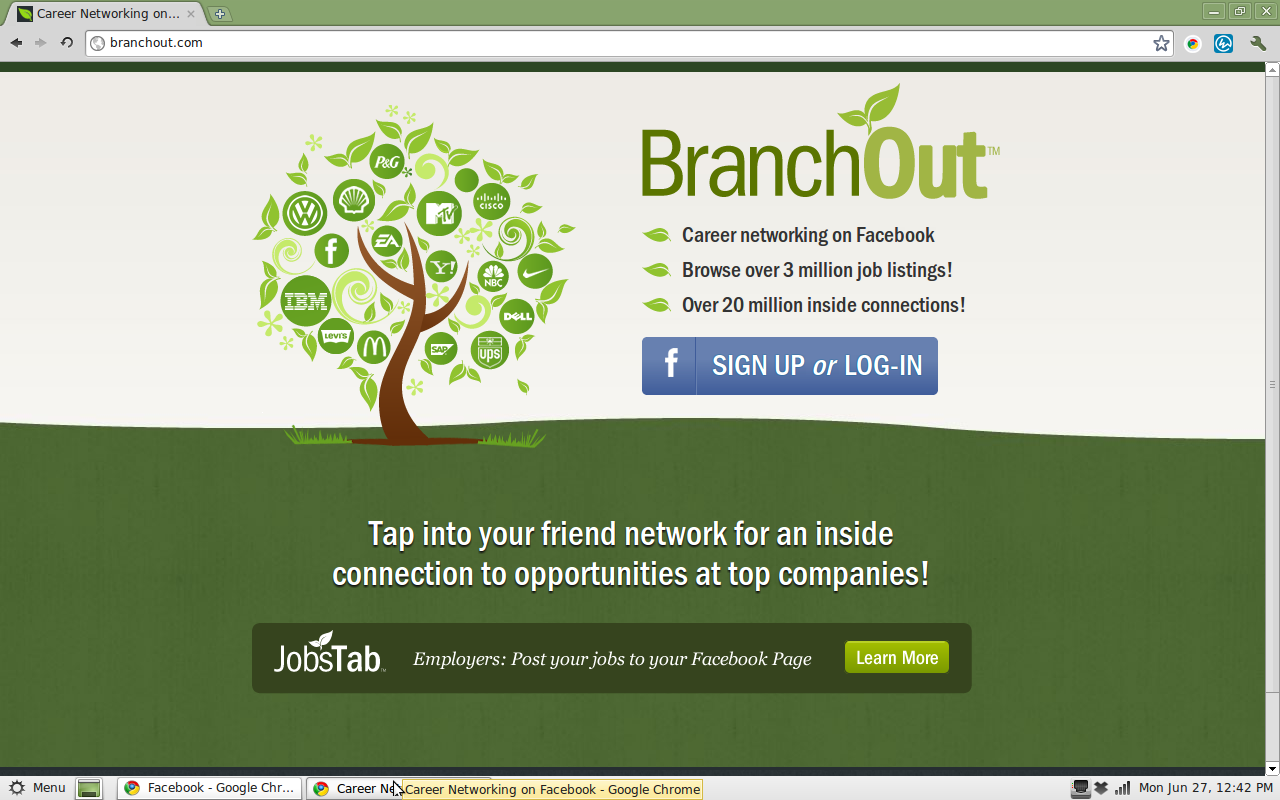
Founded in 2010, and designed to let Facebook users build up a professional network on the site by connecting them with business contacts, BranchOut was hailed in the press as a LinkedIn killer. After all, the pundits posited, once you had your professional network in place on Facebook, what would you need LinkedIn for? To hasten the app’s viral growth, the team, led by Zack Onisko, devised a brilliant hack of Facebook’s invite system to get more users to share the app with their Facebook friends.
At the time, Facebook allowed users who installed a new app to invite other friends to use it, too (in fact, many of the apps that grew virally on Facebook took advantage of this mechanism, such as the wildly popular game Farmville). But the base invite mechanism in Facebook only allowed you to invite a maximum of 50 friends at once, and the BranchOut team knew that the conversion rate for Facebook invites was extremely low. The only sure way to drive viral growth, they decided, was simply to prompt users to send more invites.
Onisko says they tried hundreds of experiments for how to do so, until they “stumbled upon” a solution. The team had figured out how to allow users to overcome the 50-invite limitation by repeatedly clicking the Next button in a specially designed window, which triggered Facebook’s invite system to suggest another 50 of the user’s friends, and then yet another 50. The tactic supercharged referrals, and BranchOut grew from four million users to twenty-five million in about three months.
The only problem was, it turned out that when people tried to use the app, they were generally disappointed to find that there wasn’t much they could do with it. Pretty soon, the tidal wave of new users turned – turned, that is, into an equally rapid deluge of users leaving. At one point, the app was losing more than 4 percent of its monthly active users every day, prompting ERE Media, a recruiting intelligence publication, to describe the app as nothing more than a digital Ponzi scheme.
BranchOut’s founder, Rick Marini, conceded in a 2012 talk that the company had erred in trying to rush user acquisition without delivering on the product experience. “Often, people think there’s a silver bullet to getting traffic and going viral,” he said. “What we’ve learned is that there are times when you can get some spike of virality, but if you really want that long-term major user growth it’s got to start with a good product. We realized, OK, we’ve got to really enhance the product and get users back every day. Don’t be an episodic utility, be a community. And now we’ve got to make that shift.”
But that desire to shift turned out to be little more than wishful thinking. Despite raising nearly $50 million in venture capital, BranchOut never became more than a viral one-hit wonder. Its wild ride ended in a resounding thud when the company sold its assets to a relatively obscure human resources company, 1-Page, for $2 million in cash and some stock.
Many other products that achieved rocket-like growth by pushing too hard too soon for adoption have flamed out in similarly spectacular fashion. Which is why all growth hackers must always keep in mind that, as the growth team at Airbnb says, “love creates growth, not the other way around.” And for there to be love, there needs to be that aha moment.
What is the ‘aha’ moment?
This is the moment that the utility of the product really clicks for the users; when the users really get the core value – what the product is for, why they need it, and what benefit they derive from using it. Or in other words, why that product is a “must-have.” This experience is what turns early adopters into power users and evangelists. For Yelp, that experience was the ability to discover promising local restaurants and businesses through trusted community reviews. For eBay, the aha moment was finding and winning one-of-a-kind items at auction from people all over the world. For Facebook, it was instantly seeing photos and updates from friends and family and sharing what you were up to. For Dropbox, it was the concept of easy file sharing and unlimited file storage. Or take Uber’s aha moment, which Uber co-founder and CEO Travis Kalanick explained as, “You push a button and a black car comes up. Who’s the baller? It was a baller move to get a black car to arrive in eight minutes.”
An aha experience is a necessary ingredient of sustainable growth because it is one that is simply too remarkable not to value, to return to often, and to share. Thus the key to knowing when it’s time to start the high-tempo push for growth is simple: Can you identify an aha moment that users love? New products are generally built on the premise of delivering an aha experience that customers will find irresistible and that fills a meaningful need for a big audience. Sometimes things are going very much according to plan, and as soon as people begin using a product, they have the aha moment and then they tell two friends, and word of mouth takes off from there.
But many times, delivering a standout aha experience takes extra work beyond just offering the product and hoping for the best. Sometimes a product isn’t yet offering a true aha experience and more product development is needed to create it. But in others, the product already has what it needs to give people an aha experience, and the work is in leading them more effectively to it. Often, people have to use a product a certain amount of time before they truly have this experience with it, or perhaps they have to use a certain feature to really get the full-force aha hit.
For example, Twitter struggled to sustain growth in its early days until it learned (from doing extensive analysis of its user data) that users who quickly started following at least 30 other users were much more engaged and likely to continue using the service. Digging into why following 30 people seemed to be the tipping point, the Twitter growth team found that getting a steady stream of news and updates from people they were interested in was the aha moment for people. Following 30 people created a stream of updates that made the service a “must-have.”
Editing by Eileen C. Ang





Stay updated on the go with our mobile app.
Get latest insights with smoother, more personalized experience through TIA mobile app.