Leighton Cosseboom · · 6 min read
O2-oh-no! Why Indonesia is a super tough market for on-demand startups

There’s a trend emerging in Southeast Asia in the form of an “Uber for everything” business model. Some of that interest might stem from the hype around Magic in the US, a service that does anything you want via SMS request, so long as it’s legal.
Last we heard, our friends at TechCrunch reported that Y Combinator-backed Magic was raising US$12 million from Sequoia Capital at a US$40 million valuation. We think Magic’s business model is perfect for Asia. While this may hold true for developed markets like China and Japan, for Southeast Asia a more pragmatic approach is probably necessary. (Disclosure: Y Combinator invests in Tech in Asia. See our ethics page.)
In recent weeks, we’ve seen startups like Seekmi and YesBoss emerge in Indonesia. YesBoss is trying to execute the same thing as Magic – acting as a convenience layer between the user and the service provider by micromanaging each experience. It adds value by hunting for information and answering questions on-demand, even handling pointless trivia to keep the user engaged. This is something that arguably doesn’t scale. However, when there’s value and will, there’s a way forward – perhaps crowdsourcing virtual assistants.
Seekmi, on the other hand, takes a more practical approach by simply linking up users with service providers in its curated database, bypassing the SMS middleman stage altogether. Co-founder Nayoko Wicaksono says his startup is inspired by Thumbtack in the US.
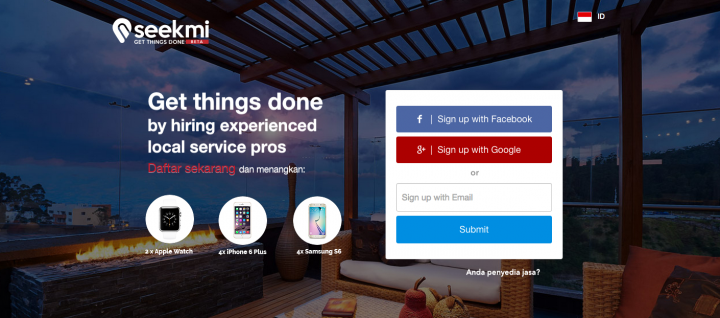
See: Finally, a startup that can take the pain out of hiring service providers in Indonesia
In Vietnam, the most successful player in this area is Việc Nhà, an Uber-style mobile app that sends personnel like maids and plumbers to your house. This model is also attractive to entrepreneurs in Malaysia, with startups like Kaodim and ServisHero cropping up – firms that would directly compete with Seekmi should they decide to enter Indonesia.
ServisHero claims it will arrive in Indonesia soon. Karl Loo, CEO of the Kuala Lumpur-based company, recently said his firm is working to improve the state of the service industry in Asia. But before Southeast Asia’s on-demand services market can become more sophisticated as a whole, problems in its largest market Indonesia will need to be addressed.
Infrastructure
How can an on-demand services provider ensure timely execution from its vendors in a place that has the world’s worst traffic conditions? One could argue that firms like Go-Jek and GrabBike are ideally placed to tackle on-demand services. The reason is that each firm already has a back-end from which they route orders to motorcycle riders. This same back-end could also be readily applied to other service providers. Should the provider not be able to cope with traffic, Go-Jek or GrabBike could simply pick them up and chauffeur them to the client (small and nimble motorcycles win over cars in Jakarta traffic, hands down). Go-Jek offers several instant services already and it’s entirely conceivable that founder Nadiem Makarim is sizing up the broader market potential.
There are other problems in Indonesia. A lack of formal businesses that have high service standards, reliable hours, and expert employees is one such roadblock. A couple of weeks ago, I used YesBoss to have a door delivered and installed at my apartment in Jakarta. The startup hooked me up with an “independent contractor,” who essentially, was just a guy and his buddy who said they were handymen.
They had no uniforms, no business cards, asked for payment upfront, disappeared for a day, asked for more money, then disappeared for another day (claiming traffic was the reason for their absence). The whole task took about one week to complete and I have no idea whether the guy ripped me off or not. I think he did a little bit, but I live in Jakarta and that’s how things roll. Overall, I was quick to praise YesBoss because my problem got solved. But a fussier customer would’ve surely been intolerant of the vendor’s subpar standards.
The problem occurs because often in Indonesia when you need something done at a reasonable price, the standard operating procedure is to call your “guy who knows a guy.” It can be a really informal endeavour.
Hard-to-find tech talent
Good news: winning Indonesia makes you a legend





Stay updated on the go with our mobile app.
Get latest insights with smoother, more personalized experience through TIA mobile app.