- Premium Content It takes our newsroom weeks - if not months - to investigate and produce stories for our premium content. You can’t find them anywhere else.
 Paige Lim · · 5 min read
This Singapore aquafarm takes to AI like fish to water
Faced with space constraints and rising costs, Singapore-based aquaculture company The Fish Farmer is using sensors and artificial intelligence to farm fish more efficiently.
“It’s very challenging to grow fish in Singapore as there are many competing uses for sea space,” says founder and CEO Malcolm Ong in an interview with The Business Times. “So if you have limited space, then you have to think of innovative ways of growing fish using technology.”
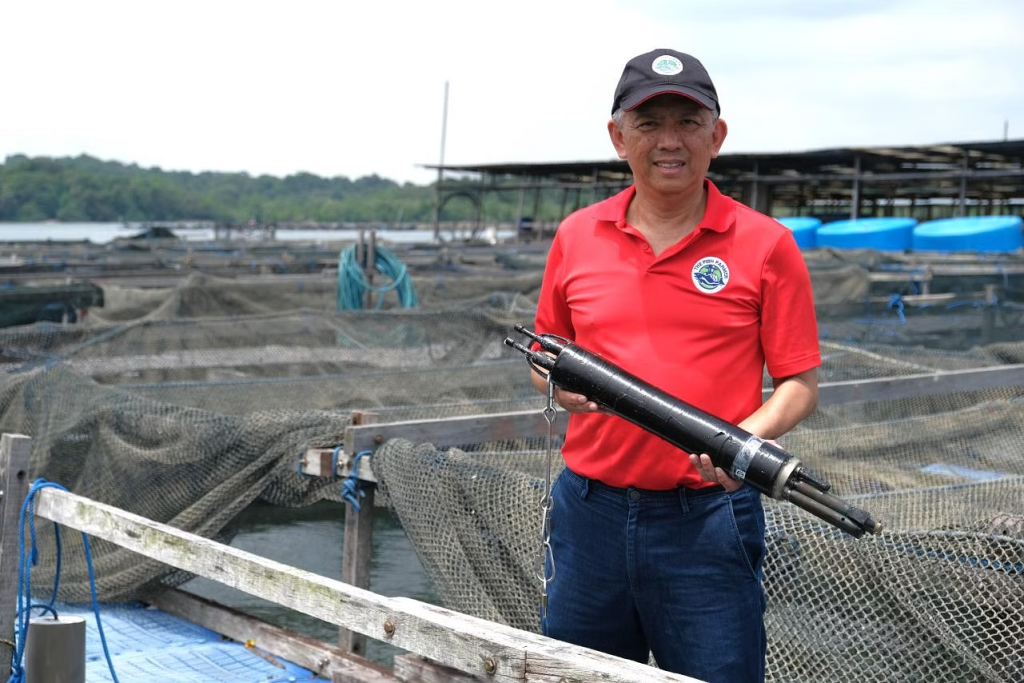
Malcolm Ong, founder and CEO of The Fish Farmer, with a water quality monitoring sensor that detects changes in water conditions on his farms / Photo credit: The Fish Farmer
Established in 2007, The Fish Farmer operates four farms located in the waters off Changi and Lim Chu Kang. It produces about 1,000 tonnes of fish annually, including species such as milkfish, garoupa, and red snapper.
The rising costs of fish farming have fueled the need for productivity improvements, says Ong.
Compared to pre-pandemic times, overall fish farming costs have gone up by about 25%, according to the CEO. These include the cost of labor, raw materials, transport, feed and baby fish fry.
Tracking fish inventory accurately
While industries such as manufacturing can turn to automation and robotics to improve productivity, this is out of the question for fish farms based in the sea, says Ong.
“Seawater is very corrosive, so things don’t last. Even if you put in a lot of equipment, something will fail after three months,” he explains.
Any form of technology being used on a farm would also need to have low energy consumption and be able to run off a battery or a similar standalone power source, as sea-based farms are not connected to any electricity source, he adds.
With these considerations in mind, Ong spent the last decade developing an IoT farm management software for The Fish Farmer.
This was done with help from information technology solutions provider Metropolitan Wireless International (MWI) – a separate company that Ong founded in 2009 but does not manage.
The IoT software, which runs on the cloud, is linked to physical sensors located in his four farms. The sensors run on solar power and thus do not need to be connected to the power grid.
Each sensor monitors different aspects of the farm environment, from the water quality in the tanks of live fish to the temperature of cold rooms and chiller facilities where harvested fish are stored.
Real-time data captured by these sensors is fed back to a central digital dashboard, giving farm employees a comprehensive overview of the conditions in each farm at any given point in time.
Keeping tabs on water conditions
Stay ahead in Asia’s tech landscape
This is premium content. Subscribe to read the full story.
The Fish Farmer uses AI and sensor tech to monitor different aspects of its four farms, such as water quality, temperature, and fish count.
We know this is not ideal. ⌛ Sign up in 20 seconds. Cancel anytime.
Our subscriber community includes professionals from these companies:





Stay updated on the go with our mobile app.
Get latest insights with smoother, more personalized experience through TIA mobile app.