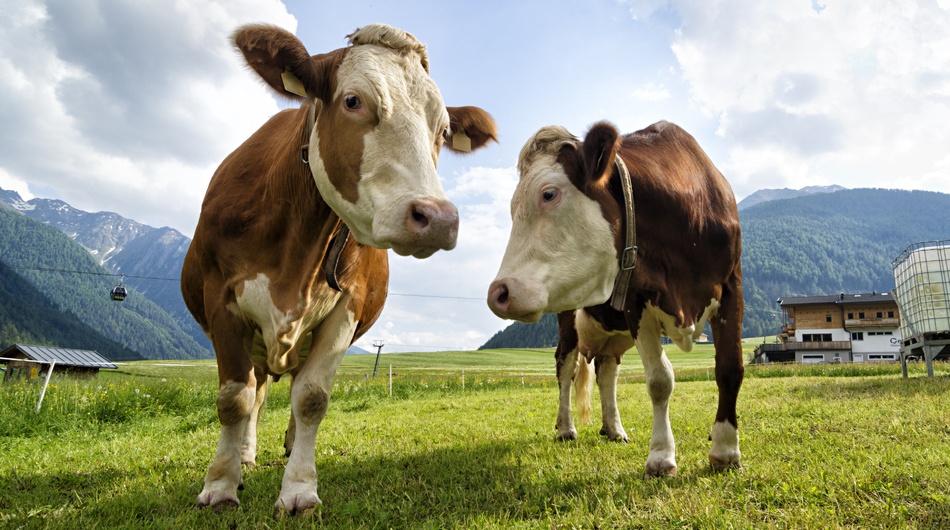
A couple of not so smart cows. Photo credit: mnyjhee / 123RF.
When the Raspberry Pi came out in 2012, it gave tech enthusiasts an affordable, powerful, and customizable piece of hardware to build all kinds of cool stuff with, like the PiPhone and Erica the Rhino.
Annabelle Kwok knows that mindset well, herself a dedicated maker-tinkerer. So she wanted to apply it to a more demanding challenge: artificial intelligence. That’s why she built what she envisions as the “Raspberry Pi for AI.”
This is not the device’s actual name, which is too bad because it rhymes so well. But it’s definitely the intent behind its creation: a low-cost, powerful computing device that can take on complex processes like computer vision and deep learning. The hardware, made by Kwok’s startup, Smartcow, is actually called Tera.
Right now, computer vision and deep learning applications usually rely on cloud computing, Kwok says. The idea is, you send your data to a server operator somewhere, like AWS, computations are made, results come back. That’s costly and, for all the security features cloud services promise, it means you don’t have complete control of your data. Local server infrastructure, meanwhile, is expensive to set up and maintain.
Her approach to the problem is edge computing, an alternative to cloud computing that places processing equipment near the location where the data is gathered. For example, a camera in a retail store will relay data to be processed on a device nearby, rather than beam it to a data center somewhere else.
Tera serves this exact purpose: to be a device that’s easy to set up and use but powerful enough to process and store oodles of data.
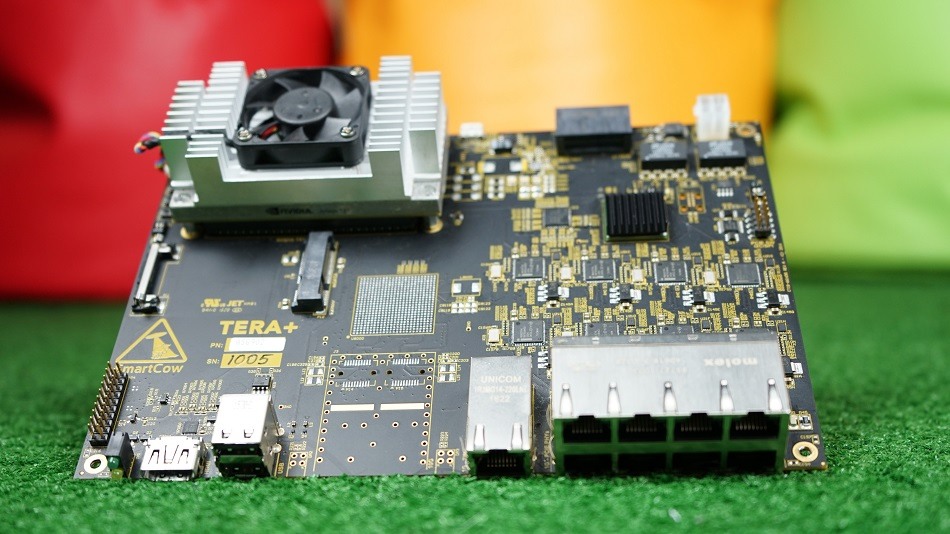
The Tera+ board by Smartcow. Photo credit: Smartcow.
Juggling different roles
Singapore-based Smartcow has an office at SGInnovate’s space, which is where I meet Kwok. The first thing I notice during our conversation is her enthusiasm, which almost takes me aback.
At 24, Kwok clearly takes pride in what she and her co-founder, Ravi Kiran, have created, and isn’t afraid to let it show. It’s the kind of pride that seems to stem from the conviction they’re working on something really cool.
Kwok is a math graduate from Singapore’s Nanyang Technological University. She finished her courses in three years instead of the required four, one of only four or five students in her school to do so. “I would cram my modules together so that I would graduate faster,” she says.
It powered thermal cameras in the sewers of Singapore to study rat movements.
But she hadn’t applied for an accelerated three-and-a-half-year course so she couldn’t graduate early. That left her with a lot of free time and no university degree with which to look for a job in the meantime.
On board
AI for the people





Stay updated on the go with our mobile app.
Get latest insights with smoother, more personalized experience through TIA mobile app.