Minion Rush has undoubtedly taken over Candy Crush’s place as the king of games on my iPhone since the day Gameloft China country manager Eric Tan introduced the game to me. But how are the makers of this cute minion game doing in China? What is the current situation and the upcoming plans for Gameloft China?
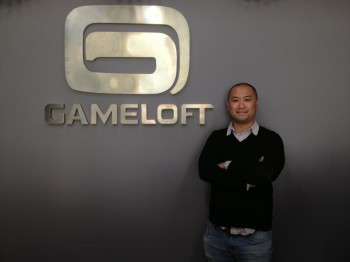 To find out, we tracked down Eric (pictured right), who took on the role of Gameloft’s China country manager last May. In the interview with Tech in Asia, he revealed that the company’s iPhone business in China has experienced a 70 percent year-on-year growth rate with its Dungeon Hunter game as its best-selling title. Its Ironman 3 game, on top of doubling download records, has racked up a total number of gameplay hours that add up to over seven years, although it was only released at the end of April.
Apart from opening a self-publishing platform, the company has since signed on five exclusive distribution deals, up from the original one when Eric first joined. The headcount for the business development team has also tripled, and there are currently 500 staff in Gameloft’s three China offices in Beijing, Chengdu, and Shenzhen.
Prior and before the interview, Eric also kindly gave a tour around his office and described it as an “internet gaming cafe”, and probably a dream workplace for most gamers too. Here’s the full text of our interview:
What’s the situation for Gameloft in China right now?
Eric: The business is now mainly comprised of two parts. The first one would be our Apple iOS platform, which is doing extremely well. We get a good feature on our premium games, such as Mortal Combat or casual title Ice Age Village, from the Apple store almost every month, which goes to show how well we are doing on this platform. Also, thanks to Apple’s support and the branding of Marvel, Iron Man 3 has topped the download numbers in China, doubling Gameloft’s last best-performing title.
And the second part, is the Android distribution. It is rather challenging because there is no Google Play here in China. To complicate matters further, there are over a hundred android stores, where we would have to prioritize our resources. Our strategy in combating that is to have two distribution streams. One is that we are going to work on exclusive distribution with key publishers in China, and another method is that we publish directly.
Two Android distribution streams?
Eric: With exclusive distributors, we would license to Chinese publishers. This could be UCWeb, Tencent, or iDreamSky. They will give us financial incentives with minimum guarantees. We will let them do the selling to the market, which is very attractive because we have cash upfront, and they will do most of the work. But of course, there are limitations – you cannot control the distribution as well as the branding.
So apart from working with Chinese publishers, we do self-publishing too. It is a lot of heavy lifting work. We will publish the games direct and billing code from China China Mobile, China Unicom, and China Telecom. Our studio in Chengdu will then pack up the game and we will have to account manage it ourselves. We do not account manage 100 stores; but we will select the top 10 and sell direct, in the hope that they will give us a good feature.
These are the two streams we are currently doing on the Android platform – both exclusive distribution and self publishing. Going forward, we have no idea which one we will be leaning towards nor do we know who is going to win.
How are things going on iOS?
Eric: What we are seeing right now is that our revenues are shifting from the iPhone to the iPad. In terms of the platform’s portfolio of games, the tablet is going to become an important revenue driver. This is simply because our games are of high quality and tend to slant towards the hardcore side, as opposed to the casual games in the market.
What are the challenges navigating the China market?





Stay updated on the go with our mobile app.
Get latest insights with smoother, more personalized experience through TIA mobile app.