- Premium Content It takes our newsroom weeks - if not months - to investigate and produce stories for our premium content. You can’t find them anywhere else.
 Tan Nai Lun · · 6 min read
Makeup war unfolds in SEA as China takes on South Korea’s throne
Once a loyalist of South Korean beauty (K-beauty) products, 30-year-old civil servant Aurelia Teo has diversified to cheaper China-branded options. And she is far from alone.
“I used to be quite loyal to K-beauty, but as I learned more about skincare ingredients, I realized that different countries do different things well. So I started being more open to trying other brands,” says Teo, who first tried Chinese products in 2023.
Digital-first marketing has helped the Chinese beauty (C-beauty) industry gain traction in recent years, particularly in Southeast Asia. The region is a key market for many C-beauty brands due to its geographical proximity, similarities in culture, and young population.
Consumers, meanwhile, appreciate the lower prices. Teo notes C-beauty eyebrow pencils cost a fraction of their South Korean equivalents.
With rapid launches, lower prices, and aggressive marketing, C-beauty is expected to maintain its regional growth momentum and challenge the dominance of K-beauty products.
A prime market
In October 2025, makeup brands Judydoll and Joocyee opened their first physical retail outlets outside mainland China in Singapore.
The region accounted for more than 300 million yuan (US$43.4 million) in retail sales for Joy Group, the company behind the two brands, last year. This was about half the group’s total overseas business.
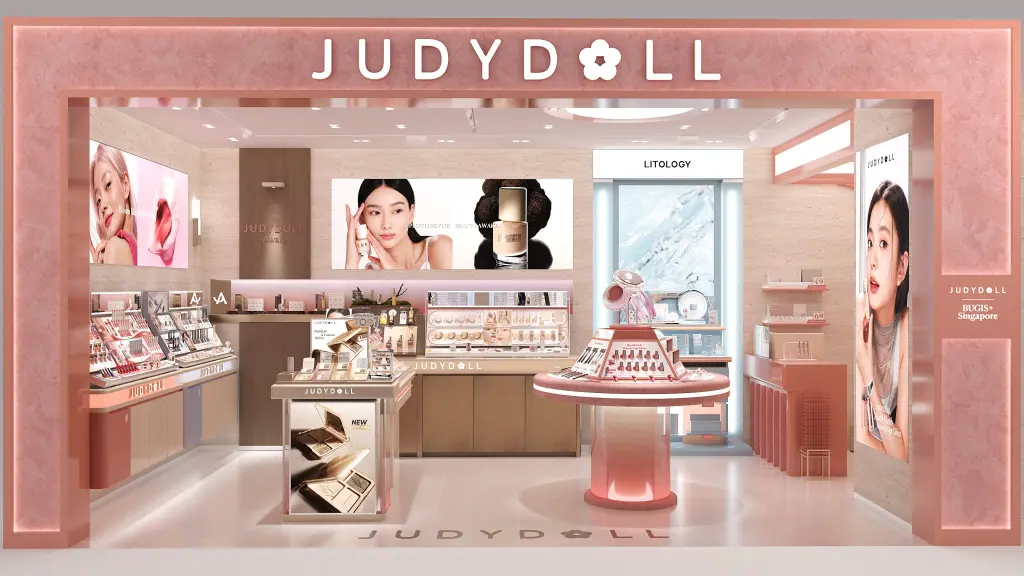
Judydoll’s first overseas offline boutique opened in Singapore’s Bugis district in October 2025./ Photo credit: Joy Group.
Granted, this was still a small percentage of the group’s operations. In 2024, total sales came to about US$607.9 million. But the brands’ growth rate in Southeast Asia currently exceeds their growth in China, notes Kong Fanqi, general manager of international business at Joy Group.
See also: Private equity giants touch up portfolios with K-beauty deals
According to a report by Euromonitor International, Southeast Asia’s young population and rising disposable income make the region a prime market for C-beauty brands looking to expand overseas.
The report states that Chinese companies bring well-established marketing strategies tailored to local preferences. This is reinforced by the similarities between Chinese and Southeast Asian ecommerce platforms.
In 2024, the ASEAN region’s personal-care imports from mainland China exceeded 216,000 tonnes, according to data from research firm BMI. This represents an average annual growth rate of 15% between 2021 and 2024.
Going abroad
Wong Teng Ian, insights manager at venture outfit Momentum Works, says that C-beauty’s recent popularity is supported by the growth of TikTok merchants in regions outside mainland China.
C or K
Challenges
Betting on C-beauty
Stay ahead in Asia’s tech landscape
This is premium content. Subscribe to read the full story.
Chinese beauty brands pair sharp pricing with social media precision in Southeast Asia. The shift is testing K-beauty’s dominance.
We know this is not ideal. ⌛ Sign up in 20 seconds. Cancel anytime.
Our subscriber community includes professionals from these companies:





Stay updated on the go with our mobile app.
Get latest insights with smoother, more personalized experience through TIA mobile app.