J.T. Quigley · · 9 min read
This Japanese startup has 14 million reasons why the business card isn’t dead
Thanks to the rise of social networks and smartphones, business cards don’t quite hold the same cachet that they used to. In Western markets, some people refuse to carry more than one card to networking events (lest they appear desperate), while others proclaim that the age of the business card is flat-out over. For professionals across Asia, however, the humble business card remains a vital tool for introductions and a jumping-off point for future networking.
In Japan, where people often introduce their company name before their own (“I’m Company A’s Sato,” not, “I’m Sato with Company A”) the business card is essential – there’s even a specific way to present them, receive them, and store them. Writing on a business card or stuffing it in your pocket just moments after the exchange would be a major cultural faux pas.
As Chika Terada puts it, business cards act as “paper proof of a business transaction.” Terada is the founder and CEO of Sansan, a freemium contact sharing service that transcribes business cards and stores them in the cloud. The Tokyo-based startup isn’t attempting to replace the business card – it is simply bringing the 400-year-old paper rectangles up to speed with our digital world.
Eight years in the making
Prior to establishing Sansan in 2007, Terada worked at Mitsui & Co. – one of Japan’s largest trading firms. Even before becoming a trader, Terada knew that he would eventually start his own company:
When I worked for Mitsui, I knew that the goal would be promotion to the executive level. When I imagined the future, that I would become the CEO of Mitsui, I thought, ‘that position can be replaced by anybody.’ I want to create something different, I want to change the world. That’s the ultimate goal that I always have in mind, so it was a natural choice for me to found a startup after eight years there.
Terada’s experience inside Japan’s corporate machine made the problem with business cards clear.
“Everyone uses business cards, especially in Asian countries, and it’s troublesome to deal with so many of them,” he says. “Once you receive them, it becomes difficult to keep track. There was a problem and and an opportunity presented to us, so I decided to pick this theme. There are said to be 10 billion business cards exchanged a year, so it’s a huge, huge business realm.”

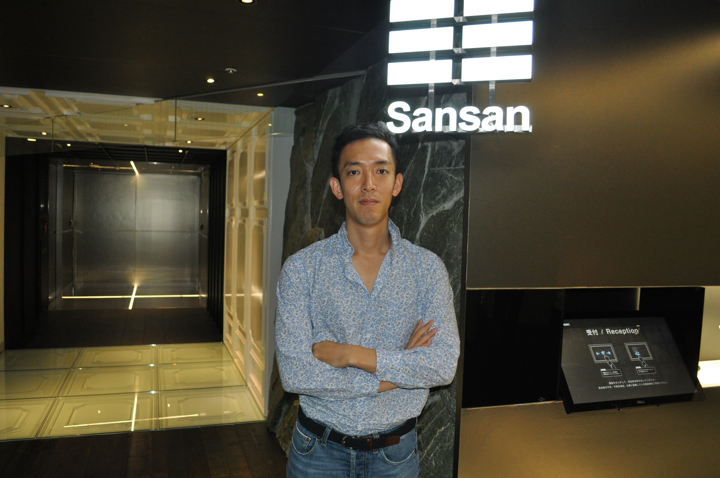
Sansan headquarters in Tokyo.
Overseas expansion
Terada’s company offers two main contact sharing services: Sansan and Eight. Sansan is tailored for businesses while Eight was designed for individuals. For each, users simply download an app and take photos of the cards they receive. Sansan clients also have the option of renting scanners, for about US$100 a month, that can scan 30 two-sided cards per minute.
Sansan recently received US$14 million in series B funding, led by Silicon Valley-based investment firm DCM. The money will be spent partly on Sansan’s US expansion. The service officially launched in the US market on May 29 – a move that might sound contradictory for a company that relies on the Asian attitude toward business cards. Terada explains why:
First, the US market is the biggest and their investment size – their corporate investment in systems – is five times bigger than in Japan. Secondly, they use business cards. The number they use might be smaller than what we use in Japan, but they still use them. The executives in the US market, they just let their assistant enter all of their business cards into their Blackberry or Exchange or whatever, so they are already managing business cards, in a sense. Third, I think US companies would like to share their business cards contacts with team members, but there is no way to achieve that. You can use Salesforce.com to manage opportunities and business, but you cannot manage all of the connections that your team has. Our business cloud could be the key to sharing those contacts.
Human transcription
Escaping the “salaryman” lifestyle
As essential as a copy machine





Stay updated on the go with our mobile app.
Get latest insights with smoother, more personalized experience through TIA mobile app.