 Steven Millward · · 6 min read
Is Google and its Android Partners a Mafia Mob Out to Kill China’s Aliyun OS?

With apologies to Matt Groenig.
So, you’ve heard the Google smackdown on Acer’s planned partnership with China’s Alibaba to make its latest flagship Aliyun OS phone. Where does that leave the cloud-oriented, Linux-based Aliyun mobile OS now?
In further comments on this saga, the SVP of mobile at Google (NASDAQ:GOOG), posted on his G+ yesterday (via AllThingsD):
Hey John Spelich [Alibaba VP on global communications] – We agree that the Aliyun OS is not part of the Android ecosystem and you’re under no requirement to be compatible.
However, the fact is, Aliyun uses the Android runtime, framework and tools. And your app store contains Android apps (including pirated Google apps). So there’s really no disputing that Aliyun is based on the Android platform and takes advantage of all the hard work that’s gone into that platform by the OHA [Open Handset Alliance].
So if you want to benefit from the Android ecosystem, then make the choice to be compatible. Its easy, free, and we’ll even help you out. But if you don’t want to be compatible, then don’t expect help from OHA members that are all working to support and build a unified Android ecosystem.
Trouble is, it can be disputed that, in Rubin’s words, “Aliyun is based on the Android platform.” For starters, it’s not clear if the Android head honcho is referring to source code (which would be a legal issue, a bit like the Oracle vs Google trial that concluded in July), or merely to the convenience of Aliyun non-natively running some Android apps, and having a whole app store full of them [1]. But that’s a very grey area. To what extent is Aliyun truly and technically infringing on Android, or is Google merely taking offense?
It’s my party and I’ll cry if I want to
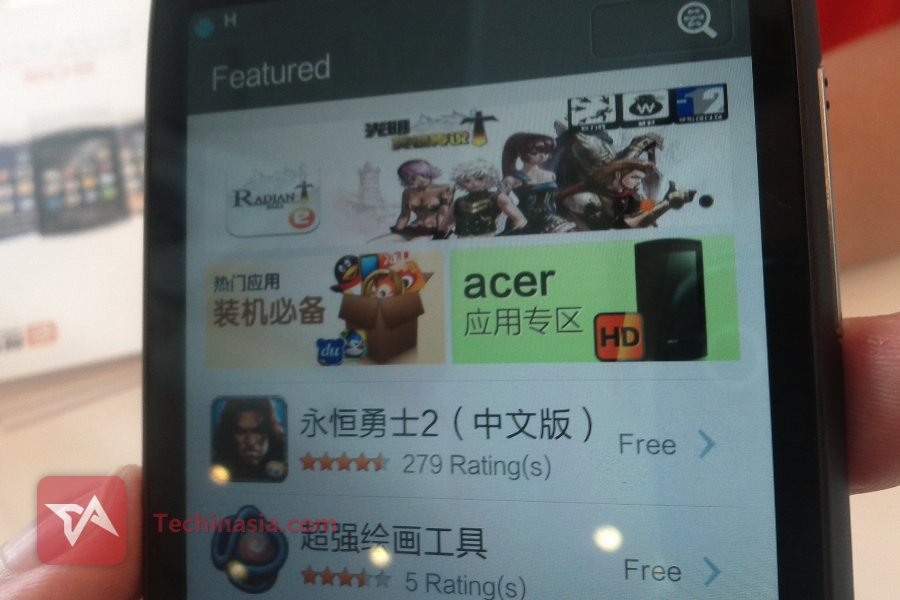
The cancelled Acer A800. Is this Google's actual beef: That Aliyun can run and benefit from Android apps? (Image: Techinasia.com staff). Click to enlarge!
If it’s the latter case of Google taking umbrage, then it’s a grim turn of events for anyone working on Android-based or Android-associated platforms. This is where the afore-mentioned Open Handset Alliance (OHA) comes in. This Android-focused agreement covers dozens of telcos, phone makers, chip makers, and more. But if the OHA is being used as a carrot-and-stick by Google – in the absence of a legal framework for preventing many forms of building on top of Android, even if it’s in a way that Google dislikes – then it’s effectively assembling an ad-hoc monopoly of hardware partners. That can serve has a way to beat down OHA partners from other projects which are not close enough to Google’s vision of Android. We’d argue that that’s what we’ve just seen develop this weekend, with Acer (a OHA member) forced to postpone/cancel its launch of the Aliyun-powered Acer CloudMobile A800 phone.
I don’t think Google is in any way scared of Aliyun as a mobile platform – one million in sales in the space of nearly a year suggest that various other forms of Android (yes, there are many – I wonder which others Google disapproves of?) are massively outselling the two Aliyun OS phones launched so far.
In response to Rubin’s latest missive (above), Alibaba’s John Spelich says:





Stay updated on the go with our mobile app.
Get latest insights with smoother, more personalized experience through TIA mobile app.











📅 Upcoming Events
22 October 2026
Payoneer x CSPN Summit 2026