 Imran Khan · · 5 min read
Asia is leading the ‘smart city’ charge, but we’re not there yet

Singtel Innov8 has launched the Innov8 Connect program which aims to bring startups and Singtel together to create innovative solutions for business challenges faced by the Singtel Group. This is the first article of a two-part series. This week, we look at how Asia is tackling urban planning challenges.
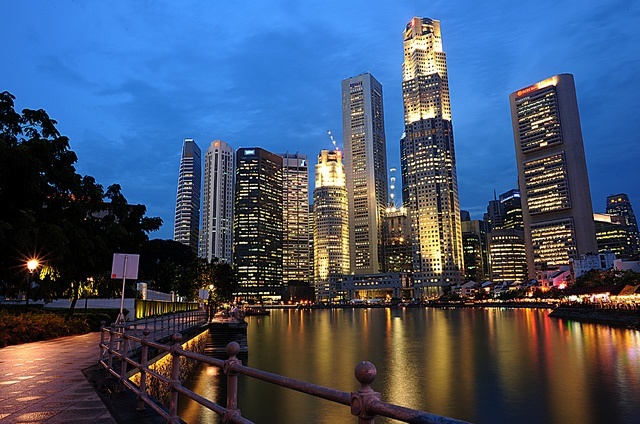
Photo credit: Anthony Munoz
Asian cities have a problem.
Beijing’s smog is at red alert levels. Chennai’s been underwater for most of December. Jakarta’s traffic is notorious.
Asia’s emerging cities have been reactive, rather than proactive, when it comes to building infrastructure. To counter this, ‘Smart Cities’ has been a buzzword for a few years now, with India looking to build 100 such cities in the near future.
While Chennai’s situation has thrown the spotlight on just how much work needs to be done, Asia is expected to take the lead in the building of smart cities over the next century. With a predicted 62 megacities (cities with more than 10 million people) by 2025, up from the current 32, Asia has no choice but to figure out the best way to use technology to help their citizens live better lives.
What is a smart city?
It’s quite a broad term, but most people agree that cities need to tick three boxes to be called smart:
- Use of technology to deliver services.
- Use of technology to reduce costs for service providers.
- Use of technology to allow citizens to improve the running of the city.
Singapore is probably the most famous example of a smart city, with the government pushing massive technology adoption. When it comes to infrastructure though, can we expect Jakarta to have free flowing traffic? Chennai to have a more efficient drainage system? Beijing to have clean air?
Clearing the roads
Traffic congestion is one of the worst side effects of any growing city. With limited funds and space, managing the movement of humans has become a crucial issue which has knock-on effects on human health, pollution, and the handling of natural disasters. How does technology fit into the picture?
One of the main ways that cities are looking to clear the roads is to crunch more data. CCTVs, traffic signals, flow of traffic, and other data sources all combine to give city councils a better idea of where the main pain points are for their citizens. Traffic speed and volume are analyzed, giving a real-time picture of what traffic looks like at any point of the day in the city.
One of the big benefits is that a fix like this does not need a huge amount of extra investment; it makes do with existing infrastructure, streamlines the data, and pulls the relevant insights from it.
IBM is currently working on making this more accessible, and Singapore’s Smart Mobility 2030 is probably the best example of a city putting things in place to build a smarter network.
Are building smart cities from scratch the solution?
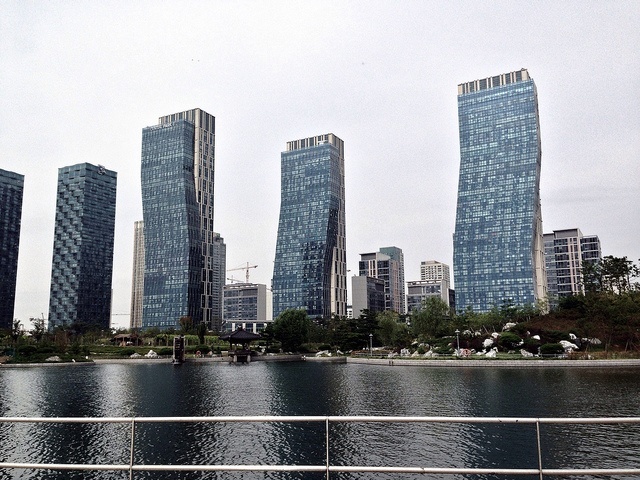
The view from Songdo’s Central Park. Photo credit: Dongho Kim
Songdo, in South Korea, is a smart city built from the ground up. It is grand in both scale and ambition, and in many ways is an experiment that is being closely watched by most other countries in Asia and around the world. The city features some of the most cutting edge technology in urban development and planning, including:
- The city is built around the airport, to reduce travel times (it is 15 minutes from Seoul’s Incheon airport, closer than Seoul itself).
- Built-in sensors on streets and buildings to monitor and manage human traffic.
- Up to 40 percent of the city will be green space.
- Pipes connecting offices and apartments which manage and recycle waste.
The city itself is expected to be finished by 2018, but the cost? An estimated US$35 billion. The 10-year project is expected to be one of the most expensive development projects ever undertaken.
Similar to this is the zero-carbon Masdar City project, being built close to Abu Dhabi in the United Arab Emirates. Masdar City is designed to be the flagship project for Abu Dhabi’s move towards a more sustainable and less oil-dependent future, and the city does have some unique aspects:
- A 45-meter wind tower, based on traditional Arabian wind tower designs, keeps the street levels 15 to 20 degrees celsius cooler than the surrounding area
- Solar panels adorn the roofs, powering most of the city
- The city is mostly car-free, and driverless electric pods transport users back and forth
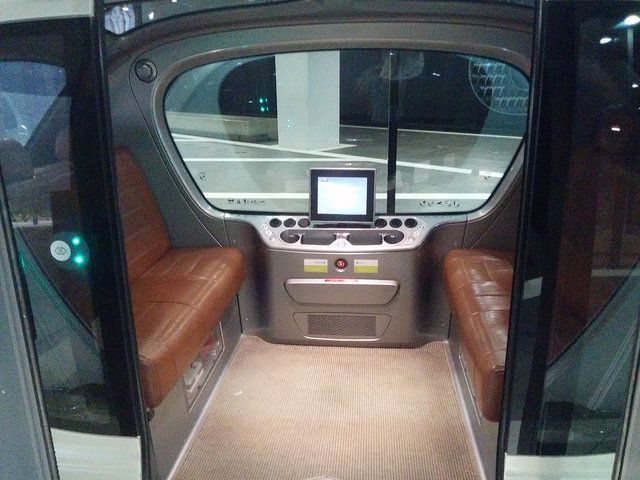
Driverless electric cars in Masdar City. Photo credit: Michael Bumann
Much like Songdo, the smart city is still being constructed, with a continuously shifting deadline (now predicted to be finished somewhere between 2020 to 2025) and a cost that sits somewhere close to US$16 billion.
Making cities smarter
Songdo and Masdar City are two examples of governments trying to build a smart city from scratch, at great cost. They don’t exactly make for easily applicable and replicable answers to questions that require robust solutions.
Even if both cities are fully built and functional, they will be home to less than a million people each, and very limited in their reach. Can driverless electric pods help ease Jakarta’s clogged roads and millions of vehicles? Can these solutions help Chennai better manage its rainwater in a city of close to 5 million people? Can renewable energy and green spaces help Beijing’s 20 million residents breathe easier?
Smart cities are still limited in their scope, and cities are looking to build a broadband infrastructure first, bringing the government and their people online. But cities like Songdo and Masdar City act like massive petri dishes, a laboratory testing facility the size of which the world has never seen.
Asian cities are still a long way from reaching that utopian goal, but with such efforts being spearheaded across the region, along with cities like Singapore, Seoul, Tokyo, and Hong Kong featuring high on global smart city lists, it’s only a matter of time before Asia takes the lead in providing global smart city solutions.
Singtel Innov8 Connect is a new program that brings startups and Singtel together to create innovative solutions for business challenges faced by the Singtel Group. Through this program, selected start-ups will receive up to S$75,000 (US$52,100) to test and validate their solutions with Singtel. Successful solutions may lead to commercialization with the Singtel Group, providing startups access to the Group’s customer base, which includes both enterprises and consumers and over 575 million mobile customers across Asia, Australia and Africa.
The first set of business challenges are focused in 10 areas including enterprise cloud, smart and safe city and customer experience. The program is now open for submissions and closes on 14 February 2016.
Interested startups around the world are invited to apply at https://innov8connect.com.
Stay updated on the go with our mobile app.
Get latest insights with smoother, more personalized experience through TIA mobile app.
Recommended reads
 Bad road habits meet their AI reckoning
 Digitizing airport operations for faster flights
 The price isn’t right: Oil spike fuels risks in SEA’s tech scene
 Indian healthtech firm to raise $10m in fresh funds
 Post-pandemic, here’s how digital healthcare is transforming SEA
 Roadblocks stall Singapore’s driverless car dreams
 Fixing doctor burnout with AI is harder than it looks in SEA
 Grab to open up in-house mapping solution as B2B service
 London bans India’s Ola over safety concerns
 Tesla faces $2.2m fine in South Korea for overstating driving range




Editing by Terence Lee and Erik Crouch
(And yes, we’re serious about ethics and transparency. More information here.)





📅 Upcoming Events
22 October 2026
Payoneer x CSPN Summit 2026