- Insights This article was written by a TIA community member. Insights pieces undergo the same rigorous editorial process that newsroom-produced articles have.
 Hugo Messer · · 7 min read
Why the Lean Startup is not just a method, but a way of life for entrepreneurs
One of the hardest parts of entrepreneurship is getting started. Many people aspire to build their own company one day, but never even get their concept off the ground. Or, in some cases, they start, face barriers, and quit.
One of the problems is that we see entrepreneurship as a big thing. We tell each other that entrepreneurs need to face so many hardships and risks and that we need a big idea, vision, money, and partners. We tell ourselves that if we don’t have these, we can’t start.
I’ve been an entrepreneur for over a decade. I did an MBA and learned everything about strategy, planning, and big enterprises. When I was younger, I thought I’d be the next Bill Gates. This is the source of the above “big thing” problem: we look at the role models and success stories, and we think that’s what we want. But this thinking makes starting up look like a daunting task.
Last week, my wife asked me “What do you want to achieve with your new company, what are your goals?” I said, “I don’t know.” Ten years back, my stomach would have ached at that answer. All the gurus have taught us that we need to have answers, we need to have a big vision, know our USPs, and have clarity about the end game. Today, I am comfortable with “I don’t know.”
Lean startup applied to services
I went to a workshop last year in Amsterdam at The School of Life. The facilitator had one idea that triggered the actions I took next. He said that if you wanted to find out what to do next in your life, you just had to start an experiment — whatever it may be. If you plan to be a coach, then just start right away. Invite a couple of friends or colleagues and offer them free coaching. Ask them for feedback, see what you do or don’t like, and iterate from there — change paths or keep going. I think that’s how the lean startup idea can be applied to life and to setting up a service business.
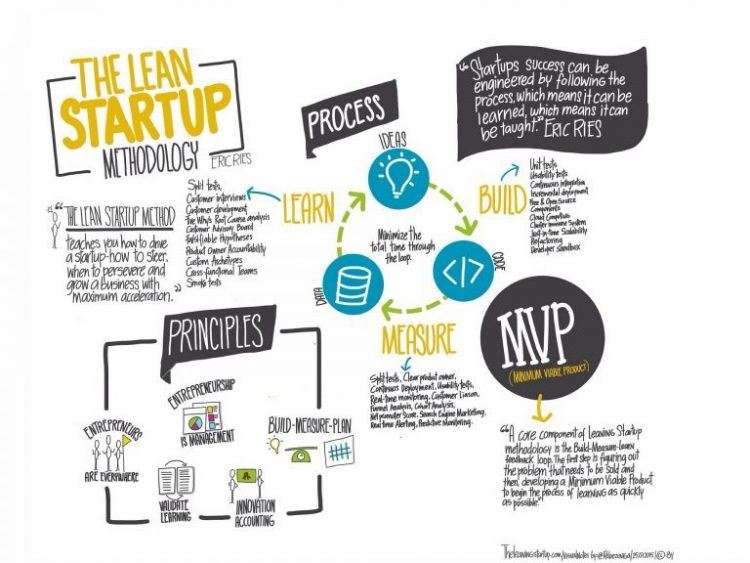
According to Wikipedia, lean startup is:
“A methodology for developing businesses and products. The methodology aims to shorten product development cycles by adopting a combination of business-hypothesis-driven experimentation, iterative product releases, and validated learning. The central hypothesis of the lean startup methodology is that if startup companies invest their time into iteratively building products or services to meet the needs of early customers, they can reduce the market risks and sidestep the need for large amounts of initial project funding and expensive product launches and failures.”
The method is based on validated learning, which means you gather data to support your assumptions. For me, personally, the application of this idea can be made much broader. The method speaks about “build-measure-learn” loops, but the “build” could be substituted with “act” or “start,” for example, while “measure” could be substituted with “observe.” Your loop could also be “options-experiment-insights” as shown below.

Photo credit: Lean Change Management.
To start a new service, you invent an MVP (you “productize” your service). In the coaching example, this might be a description of your coaching offering — maybe a discovery session to find out the challenges your coachee is facing. Then you apply the build-measure-learn loop. You build a description of your productized service, which can be an email with text. Email it out to friends or colleagues who might be interested. You can then measure the feedback by doing a retrospective after the session or send a survey. Learn from the feedback and either improve your service offering or change it — and then you go again.
Lean startup for products
Products are often harder to start than a service. The good news is that most products can be started as a service. I didn’t have that insight when I applied the lean startup methodology to build an online marketplace for software teams. I began by building an MVP, then I sought two co-founders. In a way, it worked. And in a way it didn’t.
The main reason (looking in hindsight) is that we built too much too quickly. I thought I had generated enough feedback to make the right decisions, but it appeared we overlooked a couple of things. Generating feedback for a product idea is more complicated than for a service business.
Lean startup applied to life
I don’t know





Stay updated on the go with our mobile app.
Get latest insights with smoother, more personalized experience through TIA mobile app.