 Mike Aquino · · 2 min read
Visual: The clunky affair of cross-border payments
Charts and visuals, only for subscribers
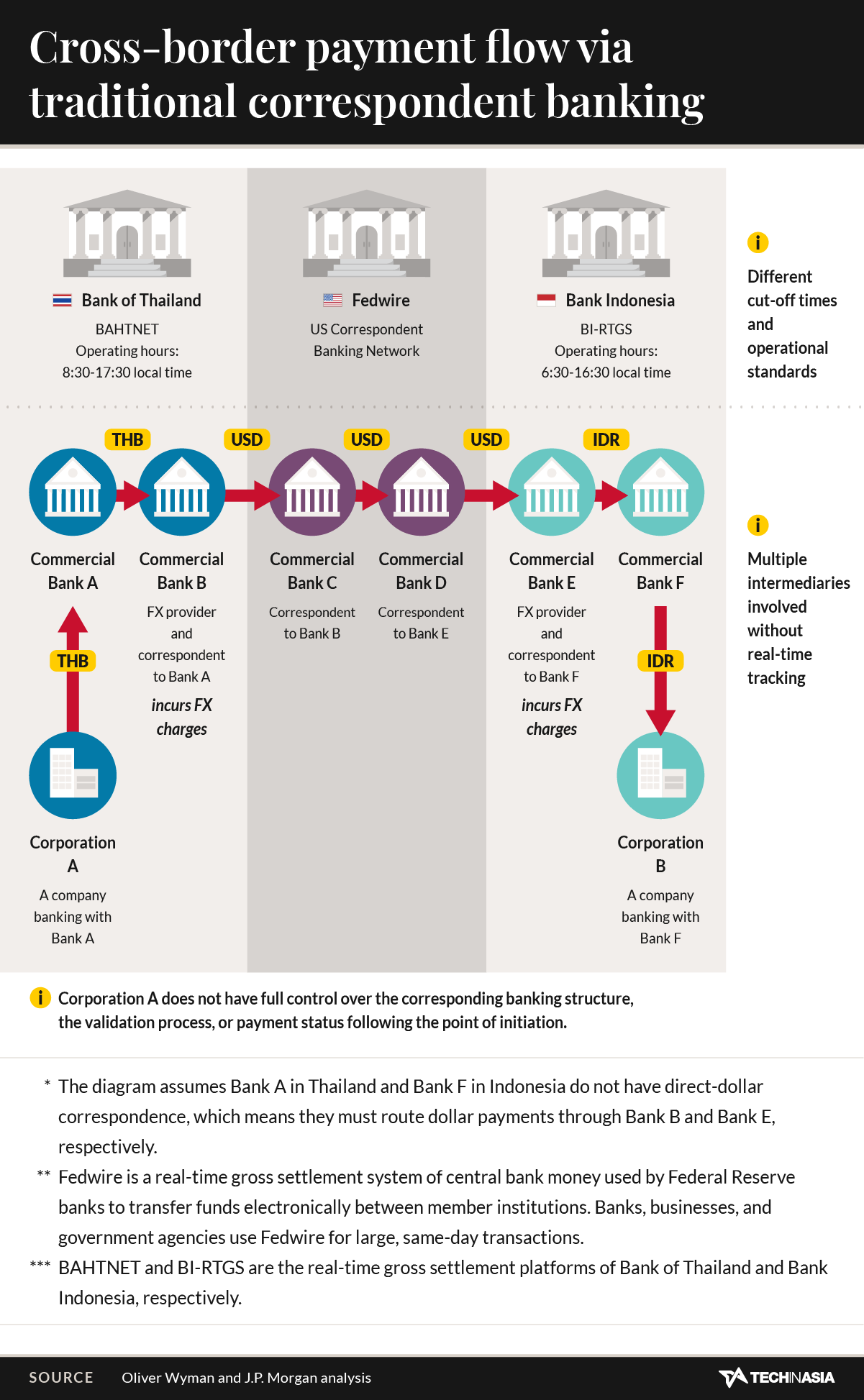
Global cross-border payment flows are expected to reach US$156 trillion by 2022, with a compound annual growth rate of 5%, according to Ernst and Young.
This growth flies in the face of the existing – and outdated – infrastructure used to process the bulk of cross-border payments today.
Most cross-border clearing and settlements made today are coordinated by the Society for Worldwide Interbank Financial Telecommunications (SWIFT) system, a messaging network connecting a web of correspondent banks around the world.
In 2020 alone, SWIFT transmitted some 9.5 billion FIN messages – which encompass transactions from retail payments to securities settlements – between banks and financial institutions in over 200 countries and territories.
When someone sends Thai baht from Thailand to Indonesia, for instance, the money goes through a sequence of intermediaries.
Money flows through accounts that a bank holds in foreign currency, or “nostro accounts.” The routing process may involve numerous correspondent banks, each one charging a small processing fee, adding to the cost of the transaction.
A recent Oliver Wyman paper estimates that cross-border transactions cost the recipient an average of US$27 in fees to process.
“Currently, clearing is mostly executed in the Western Hemisphere, which is in a different time zone, resulting in transactions taking more than a day or even as long as a few days to clear,” Soon Chong Lim, DBS’ global head of transactions services, tells Tech in Asia.
“When you have an error, you have a long remediation process. So there’s a lot of friction associated with errors,” he adds.
Despite the limitations of the process, businesses have had little alternative to turn to in the past decades.
“The complexity of the infrastructure is just not keeping pace with innovation,” Jason Ekberg, a partner at management consultancy Oliver Wyman’s corporate and institutional banking practice, tells Tech in Asia.
Attempts are being made to remedy this problem. Today’s blockchain networks already enable cross-border money flows that cost just a few cents per transaction – but these are mostly restricted to digital tokens.
Traditional banks aren’t staying put, however. They’re developing networks – blockchain and otherwise – that are compatible with fiat currency, allowing instant and low-cost payments across borders.
Credits
Share, tag us, and land on our Wall of ❤️ !
Stay ahead in Asia’s tech landscape
This is premium content. Subscribe to read and use our charts, graphics, and other visuals legally
The infrastructure for cross-border money transfers is due for a shake-up. Here’s a look at how it works, and why it’s so cumbersome.
We know this is not ideal. ⌛ Sign up in 20 seconds. Cancel anytime.
Our subscriber community includes professionals from these companies:





Stay updated on the go with our mobile app.
Get latest insights with smoother, more personalized experience through TIA mobile app.