 Nicole Jao · · 3 min read
The tech heavyweights that have shaped China’s financial industry
Charts and visuals, only for subscribers
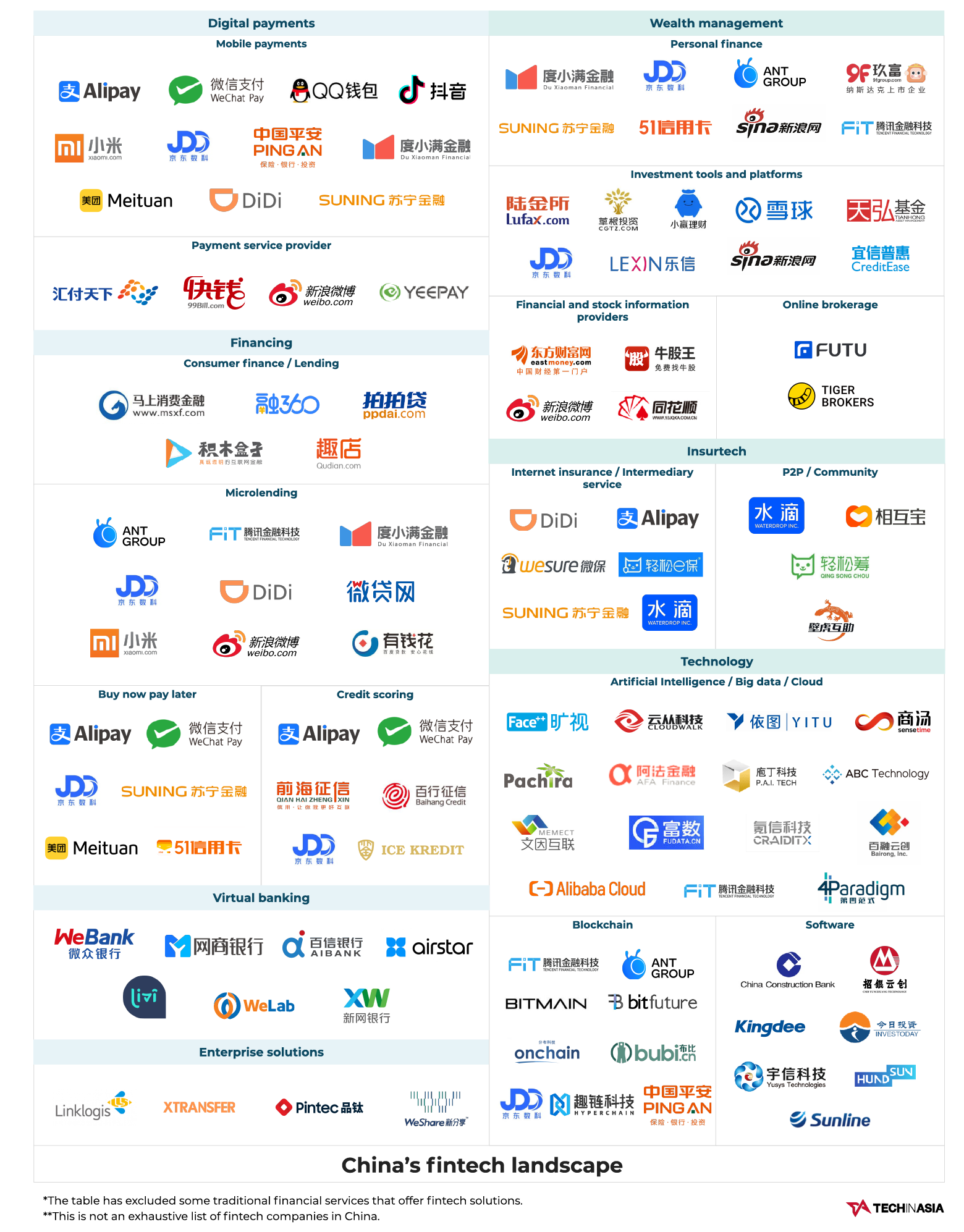
It took less than a decade for China’s fintech industry to flourish into one of the largest in the world. Many of its homegrown giants wield influence beyond the local market, extending into countries in Southeast Asia and other regions.
Competition in the fintech space is ramping up as established players – including Alibaba affiliate Ant Group as well as the financial arms of Tencent, Baidu, Xiaomi, and JD.com – move into more verticals.
Some of these companies are also active investors in fintech startups across Southeast Asia. For example, Ant has backed e-wallet services in Singapore, Indonesia, Thailand, Vietnam, and Myanmar. WeChat Pay operator Tencent has also funded fintech providers in the region.
Next-generation tech startups like TikTok owner ByteDance and rival video-streaming app Kuaishou are reportedly following the same playbook by venturing into payments.
Major tech-incubated companies such as Ant and Ping An Insurance-backed Lufax completed mega fundraising deals worth US$14 billion and US$1.3 billion, respectively, in 2018 – a year that saw fintech investment deal values reach a record high.
Regulators also play a significant role in the surges and ebbs of fundraising, perhaps in China more than anywhere else.
Fundraising activities in the country intensified in 2016, partly because of the online lending boom. Chinese regulators sometimes take the wait-and-see approach to encourage fintech innovations. Loose regulatory oversight is one of the reasons why online peer-to-peer (P2P) lending as well as mobile payments and crypto assets mushroomed within a short period of time.
In recent years, China has tightened rules to curb growth in some areas. For example, financial regulators cracked down on the P2P lending sector as the country sought to de-risk the financial system after a series of scandals and defaults. At the end of last year, the central bank announced that all P2P lenders had been phased out. Similarly, the regulators’ iron fist landed on cryptocurrency trading in late 2017.
Since 2018, the environment for tech companies has become more difficult. The sector is seemingly undergoing a “capital winter,” with fundraising activities slowing down as trade tensions with the US continue to escalate. Then Covid-19 struck last year, and the pandemic further diminished investor appetite for China’s fintech space.
The ongoing campaign to clamp down on big tech isn’t making fundraising easier for these heavyweights, either. Earlier this year, China finalized anti-monopoly rules targeting its largest companies, including those in fintech. Such regulatory pressure is expected to whittle down the dominance of Ant’s Alipay, Tencent’s WeChat Pay and other fintech platforms. In November 2020, Chinese regulators suspended Ant’s planned initial public offering, which was set to be the world’s largest flotation at US$34.4 billion. It would have given the fundraising numbers a considerable boost.
Ant’s halted IPO, however, appears to have been a boon for fintech players in Southeast Asia as investors shifted their attention away from China. Singapore, the region’s fintech hotspot, has seen a jump in fundraising activities over the past five years. Moreover, increased regulatory scrutiny on fintech has driven businesses such as online lenders and crypto asset companies to emerging markets in Southeast Asia that are more lenient.
In this landscape report, we map out the key players in China’s fintech space, look at how investments are trending, and provide data on the funding rounds that we’re aware of.
Here’s a look at how funding in the space has been going lately:
Credits
Share, tag us, and land on our Wall of ❤️ !
Stay ahead in Asia’s tech landscape
This is premium content. Subscribe to read and use our charts, graphics, and other visuals legally
China has fostered fintech majors like Alipay and WeChat Pay, but a funding drought and tighter rules have sent players reeling – some harder than others.
We know this is not ideal. ⌛ Sign up in 20 seconds. Cancel anytime.
Our subscriber community includes professionals from these companies:





Stay updated on the go with our mobile app.
Get latest insights with smoother, more personalized experience through TIA mobile app.