 Miguel Cordon · · 3 min read
The players jostling in Singapore’s crowded fintech space (update)
Charts and visuals, only for subscribers
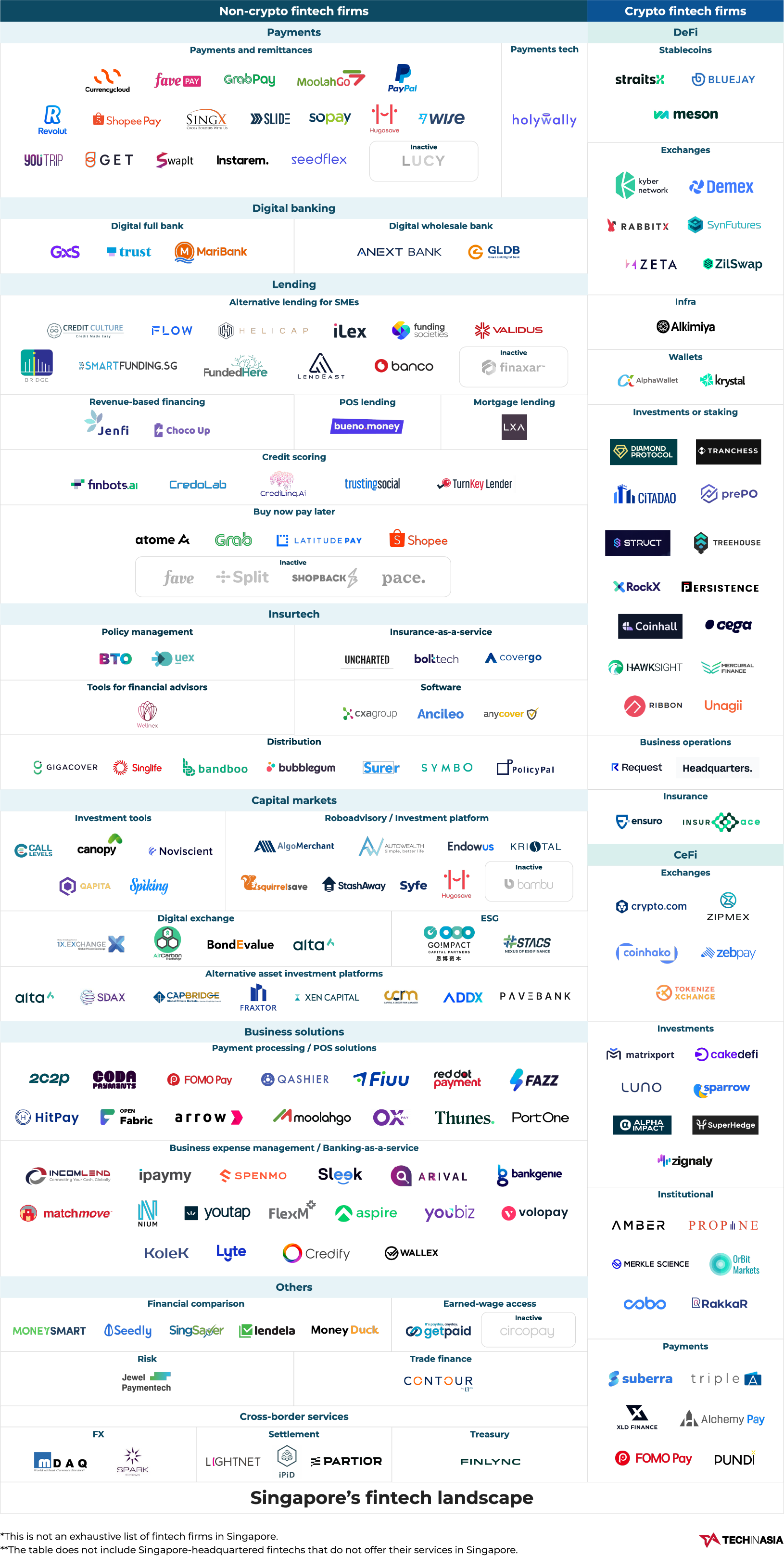
This is an updated version of the article that was published in January 2023. Since then, we’ve added newly funded players to the list.
After reaching a high in 2022 both in terms of deal value and deal count, funding dropped significantly for Singapore’s fintech industry in 2023.
According to Tech in Asia data, funding into fintech startups in the city-state went down by 35% to US$1.49 billion in 2023 from US$2.31 billion in 2022.
While the number of deals in 2023 matched 2021’s levels, last year’s deal value was still 27% lower.
That said, fintech – alongside other consumer tech platforms like ecommerce – continued to be a top investment choice in Singapore last year, accounting for half of overall startup deal values, according to an Enterprise Singapore report.
See also: Fintech and ecommerce lead the way in SEA’s turbulent tech year
The downtrend in funding appears to be extending into 2024 as well, with Tracxn recently reporting that Southeast Asian fintech startups saw a 13% decline in funding for the first quarter of this year, primarily driven by a drop in late-stage investments.
2023 also saw unprofitable firms shut, and others making pivots. Last December, B2B fintech player Bambu shut down after the company failed to hit a profitability goal by year-end, Ned Phillips, founder and CEO of Bambu, told Tech in Asia.
Meanwhile, Grab recently announced plans to discontinue its GrabPay Card offering in June and instead focus efforts on other financial services such as its buy now, pay later (BNPL) and the GrabPay Wallet, which have “much higher adoption.”
See also: Digital wealth platforms report growing AUM, but have yet to see profits
Digital banks make moves
In 2023, digital banking majors invested in building out their presence in Singapore. Most of the biggest funding rounds were strategic investments from parent firms into their respective digital banks.
The largest round was Ant Group’s US$188 million injection into Anext Bank. The bank – which services local and regional MSMEs, particularly those dealing with cross-border transactions – received a further US$148 million from its parent firm in March 2024.
Not far behind was Sea Group’s US$172.5 million investment into MariBank. As of February this year, MariBank – which offers savings, business loans, as well as investment products – has crossed S$200 million (US$149 million) in assets under management.
Troubles in BNPL
Future potential
Share, tag us, and land on our Wall of ❤️ !
Stay ahead in Asia’s tech landscape
This is premium content. Subscribe to read and use our charts, graphics, and other visuals legally
Funding into fintech startups in the city-state went down by 35% to US$1.49 billion last year, according to Tech in Asia data.
We know this is not ideal. ⌛ Sign up in 20 seconds. Cancel anytime.
Our subscriber community includes professionals from these companies:





Stay updated on the go with our mobile app.
Get latest insights with smoother, more personalized experience through TIA mobile app.