 Stefanie Yeo · · 9 min read
The playbook for unlocking Indonesia’s AI potential

Indonesia stands on the cusp of technological transformation. Sovereign AI could add US$140 billion to the nation’s economy by 2030, which in turn would be a key stepping stone in its broader “Golden Vision 2045,” a long-term strategy for robust economic growth and development.
The successful adoption – and integration – of AI in Indonesia is also a critical step in powering its growth as a digital economy. The government has begun laying the groundwork for this, with the announcement of its AI roadmap.
According to Edwin Hidayat Abdullah, director general of digital ecosystems at Indonesia’s Ministry of Communication and Digital Affairs, “This AI roadmap is built upon human-centered and balanced pragmatism.” He made this remark at the Tech in Asia and Dana AI@Work Lab event, which was held in Jakarta on October 21.
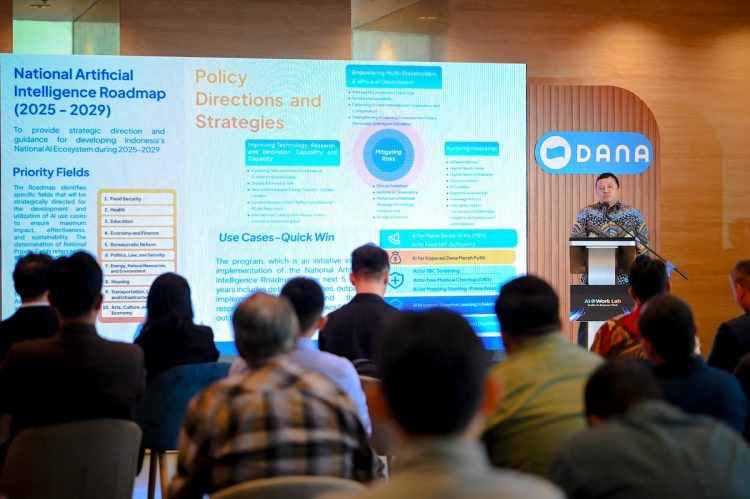
Edwin Hidayat Abdullah, director general of digital ecosystems at Indonesia’s Ministry of Communication and Digital Affairs, speaking at the AI@Work Lab event / Photo credit: Dana
While AI will optimize the nation’s economic development, human well-being will be the central focus. This ensures that technological advancement translates into tangible benefits for all citizens and aligns with Indonesia’s core values.
However, making this vision a reality requires significant effort and collaboration across the economy.
The AI@Work Lab event, held in partnership with financial services firm Dana, aimed to facilitate dialogue between private- and public-sector players and lay the foundations on how Indonesian organizations can best navigate this question of AI adoption and enablement.
Through the event and its ecosystem-wide learnings, Dana is now contributing to the development of a national AI Enablement Playbook, a resource to support Indonesia’s digital acceleration at scale.
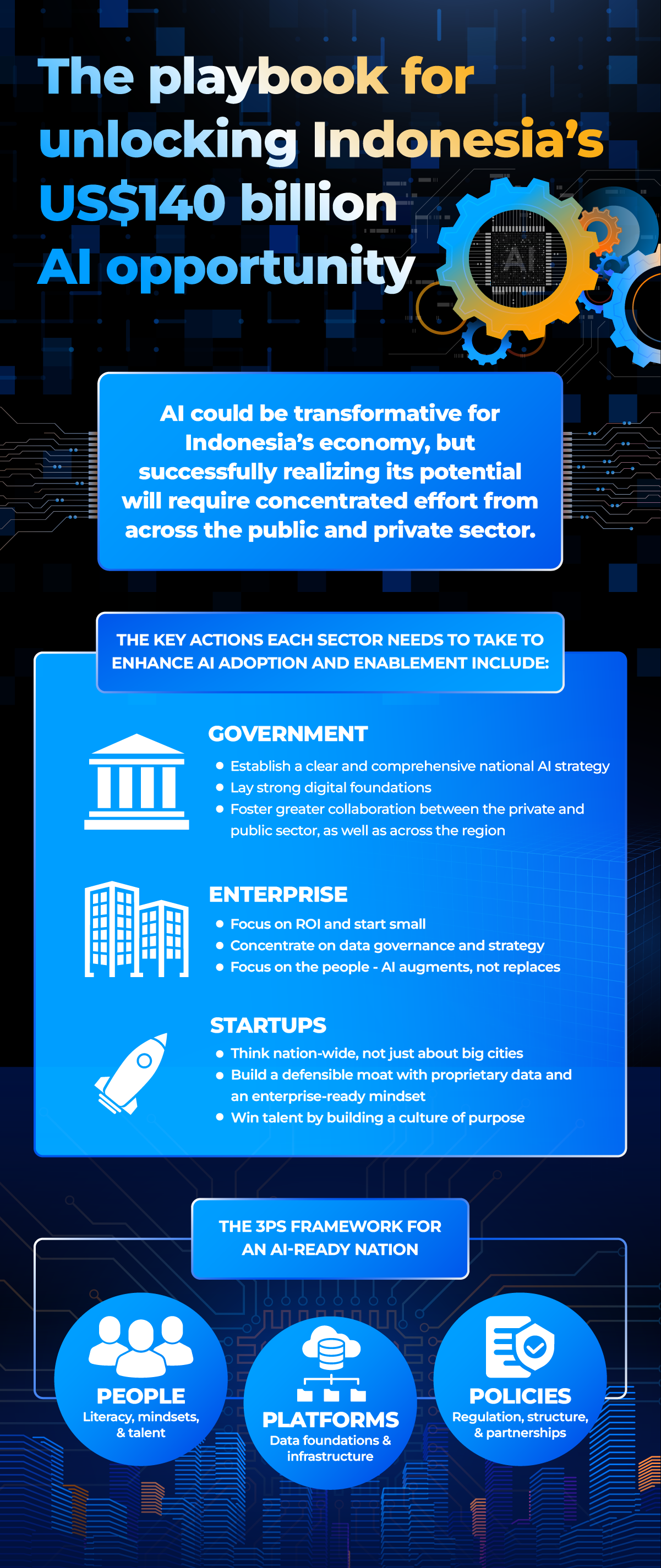
This playbook, which addresses the question of AI enablement from three key perspectives – governments, enterprises, and startups – offers suggestions on what needs to be done and best practices to unlock AI growth across Indonesia.
Download the AI Enablement Checklist to find out where you are in your AI readiness journey
Governments
Governments play a pivotal role in driving AI adoption and enablement by forming the bedrock necessary to encourage development in the sector. They lead the way and set the tone for the entire economy.
“I strongly believe that with collaboration between governments and tech companies and a clear roadmap, [Southeast Asia] can develop one of the smartest and most adaptive AI operating systems in the world,” said Daniel Pei, principal solutions architect at Tencent Cloud International, on a panel at AI@Work Lab.
To achieve this, the discussions at the event suggested three main areas of focus:
Establish a clear and comprehensive national AI strategy
Governments should prioritize finalizing and releasing national AI roadmaps and the accompanying regulations covering ethics, safety, and security. This will form the groundwork for other organizations to take steps toward AI adoption.
“This policy must guide how AI can be maximized, not just for economic growth, but to create an inclusive environment and reduce inequality,” said Hidayat in his speech.
In Indonesia, however, the government pushed back the launch of its long-awaited AI regulation to early 2026, even amid calls for the policy to be fast-tracked. Government institutions have been advised against deploying AI before these rules are established, which in turn leads to a hesitancy around the use of AI that cascades through the ecosystem.
It is therefore crucial to establish top-down guidance to drive adoption at a higher level.
Lay strong digital foundations
Fundamentally, using AI technologies requires a host of infrastructural support. Telecommunications infrastructure, computational power, and even consistent electricity supply is necessary for Indonesians – especially those outside of Tier 1 cities – to reap the benefits of AI. Beyond that, AI adoption also requires the right data and strong talent.
Speaking on a panel at the event, Sonny Hendra Sudaryana, director of digital ecosystems development at Indonesia’s Ministry of Communication and Digital Affairs, put forward the “4Cs” framework as a central focus for the ministry.
Click on the icons to learn more.
Foster greater collaboration across the board
The government will also play a major role in creating opportunities for both emerging and established private-sector players to work with government entities to drive tangible impact. By creating clear guidelines and regulation, it will set the stage for these partnerships.
The government also needs to foster greater collaboration regionally, working with other Southeast Asian nations to open doors to new possibilities.
Click on the icons to learn more.
“Each country in Southeast Asia has its own realities. Different languages, infrastructures, and policy priorities,” said Rocky Liu, regional solution architect director for South Pacific and Japan at Alibaba Cloud, on a panel at the event.
“Looking ahead three to five years, if we can strengthen national and regional AI interoperability, the region could truly become a global hub for emerging market innovation.”
Enterprises
Once enterprises adopt AI, that will facilitate broader AI enablement, particularly considering the wide-reaching impact that these organizations have across the ecosystem. Still, given their size, these firms need to take a measured and structured approach to using AI.
The discussions at AI@Work Lab suggested three areas enterprises need to look at to ensure AI adoption in their organizations is seamless.
Focus on ROI
Most companies fumble by creating AI projects with vague promises of increasing efficiency. Instead, they need to demonstrate AI’s ability to serve as a profit center, turning cost centers such as customer service into revenue-generating opportunities through activities such as upselling and personalization.
Another common mistake is to “go big or go home” with AI projects. Enterprises need to start with low-risk but high-impact projects in areas like customer service or code development to build internal trust and demonstrate value quickly.
Data governance and strategy is key
“Data is becoming very important,” said Dana CEO Vince Iswara at the AI@Work Lab event. “Don’t think of it as ‘rubbish in, rubbish out,’ as that’s very negative – think of it as ‘diamonds in, diamonds out.’”
Prioritizing a clean, real-time, and well-structured data foundation will be the cornerstone for successful AI projects. Data silos also need to be addressed so that AI can make a broader impact across an organization.
Another challenge many companies come across is “BYOAI” (bring your own AI), where employees use commonly available AI tools without any corporate oversight.
Enterprises need to establish a clear, company-wide AI strategy and provide employees with approved tools to use. Otherwise, workers will use their own AI resources, which can lead to massive risks such as data leaks and model poisoning.
People matter
Impact and technology aside, getting buy-in from employees for AI adoption initiatives is essential.
Enterprises must emphasize from the start that the role of AI is to augment, not replace humans.
Each AI initiative also needs to address the unique concerns at each level of the organization. For instance, show C-level executives a clear path to results, simplify procurement and integration for middle management, and demonstrate to ground-level implementers how AI will make their jobs better and not make them redundant.
Having “AI champions” who understand the technology and can support colleagues and team members in navigating these AI-driven initiatives will encourage further adoption and will be crucial in the success of AI projects.
Assess your AI readiness – download the AI Enablement Checklist
Case study: Dana Indonesia
Dana Indonesia has been at the forefront of AI adoption and innovation, using the technology to work more efficiently. Here’s a look at some of its successful AI initiatives:
Click on the arrows to go through the slideshow and learn more about Dana’s use of AI
Here are Dana’s best practices:
Click on the arrows to go through the slideshow and learn more about Dana’s best practices
Startups
Startups sit at the front lines of innovation and can leverage AI to solve pressing problems that do not yet have solutions. However, the ongoing funding winter, heightened scrutiny, and stiff competition in the AI sector mean that startups will need to work a lot harder to establish themselves.
“We need to rethink how we can restore investor confidence and create sustainable startups – not just new ones, but those that can scale and survive,” said Sudaryana from the Ministry of Communication and Digital Affairs.
Crucially, startups will need to ensure that they set themselves up for success by focusing on these three areas:
Focus on the local and underserved
Given rising competition in the AI sector, startups need to go where they can make the most impact: meeting the needs of local and underserved communities.
The opportunity lies in solving problems in Tier 2 and Tier 3 cities, as global giants, who have significant capital and resources, typically already address issues in major urban areas. The “white space” lies in creating AI solutions for the challenges faced in smaller cities and by the blue-collar workforce. Some segments investors have cited include:
- Predictive maintenance for machines in factories, fisheries, or farms
- AI solutions for talent sourcing and recruitment in blue-collar industries
- AI solutions to digitalize small business such as warungs
Additionally, startups need to prioritize solutions over technology and understand their place in the ecosystem. AI is simply a means to an end – the startups that succeed will be those that creatively use AI to invent new business models, not those that use AI just for the sake of doing so.
Most startups will be users of existing AI platforms, so their unique value must come from their application, not from building the core technology itself.
Right foundations, right mindset
Fundamentals matter more than ever in the current investment climate.Good governance and laying a strong foundation will put you in a favorable position when speaking to investors and partners.
Beyond having solid business basics, startups will also need to ensure that they are building resilient business models and companies. In this case, technology alone won’t be enough – proprietary and unique data will be a big differentiator.
Additionally, startups must have a clear plan to bridge the gap from a working demo to a secure, enterprise-ready product. This is often where companies struggle the most, so having the right technology, resources, and talent to achieve this will be crucial for business success.
Win talent with a culture of purpose
Startups will struggle to compete for talent against established organizations and tech giants. However, a competitive salary is just the starting point when it comes to attracting, and retaining top talent.
Due to their size and scale, startups can much more easily connect their everyday work to their larger, more impactful mission. Employees are often much closer to the ground and can witness firsthand the difference their work makes to the lives of customers and the community.
Creating a culture of purpose will be essential for motivating employees and managing the challenges of a fast-paced startup environment. The next big wins for Indonesia will not come from addressing problems in Jakarta but from solving pain points around supply chain or payroll in cities like Balikpapan and Parepare.
A framework for success
Ultimately, each sector of Indonesia’s tech and business ecosystem has much to do to drive greater AI enablement and adoption in the country. The shift required for Indonesia to unlock its AI opportunity will require organizations to tackle the question of AI enablement through Dana’s proposed 3Ps Framework:
Click on the icons to learn more.
“AI enablement is not about adopting the latest tools. It’s about embedding AI in your organizational DNA – across people, platforms, and policies – to turn experiments into impact,” said Dana’s Iswara.
With comprehensive effort, support, and collaboration from all sectors of the ecosystem, Indonesia will be able to unlock the opportunities of AI to power a truly golden future.
Dana aims to improve the financial well-being of Indonesians through financial technology innovations. It is also committed to its mission of transforming society to adopt a healthy financial lifestyle and to bridge financial inclusion in creating a cashless Indonesia.
Through the AI@Work Lab event, Dana aimed to facilitate key dialogue between private and public sector players, laying the foundations for a playbook on how Indonesian organizations – be it government, enterprise, or startups – can best navigate this question of AI adoption and enablement.
Download the Tech in Asia x Dana AI Enablement Checklist to find out where you are in your AI readiness journey.
This content was produced by Tech in Asia Studios, which connects brands with Asia’s tech community. Learn more about partnering with Tech in Asia Studios.
Stay updated on the go with our mobile app.
Get latest insights with smoother, more personalized experience through TIA mobile app.
Editing by Winston Zhang and Jaclyn Tiu
(And yes, we’re serious about ethics and transparency. More information here.)