 Lokesh Choudhary · · 4 min read
Mapping the key genAI chip and components makers in SEA
Charts and visuals, only for subscribers
In today’s generative AI race, one proverb stands out: “During a gold rush, sell shovels.”
While companies like OpenAI, Google, Meta, Baidu, and several others are mining gold, AI chipmaker Nvidia is the leading shovel seller.
The US$2.1 trillion chipmaker recently unveiled the world’s most powerful AI chip that can perform tasks 30x faster than its predecessor. This is expected to give the company a stranglehold over the market and has even pushed other chip manufacturers – Intel, Qualcomm, and Google – to form a coalition to take on Nvidia.
Before Covid-19, most of the AI chips and semiconductors were manufactured in Taiwan. But the US-China trade war, pandemic-induced demand and supply fluctuations, and the US government’s Chips Act have triggered an unprecedented upheaval within the global semiconductor industry.
With the Chips Act, the US government plans to increase chip manufacturing in the country, while banning the exports of particular hardware to nations like China. The US is also trying to reduce its reliance on Taiwan in chip manufacturing.
This led to the “China plus one” and “Taiwan plus one” production strategies, which involve companies setting up manufacturing facilities outside of the two countries to reduce their reliance on these regions.
Many are now eyeing Southeast Asia as a place to manufacture AI chips and semiconductors.
Last December, Nvidia’s founder and CEO, Jensen Huang, said that Malaysia could become a hub for AI manufacturing in Southeast Asia as the need for AI data centers grows. A supplier of Nvidia, Taiwan-based Kinsus Interconnect Technology, is also setting up a pilot manufacturing plant in the country.
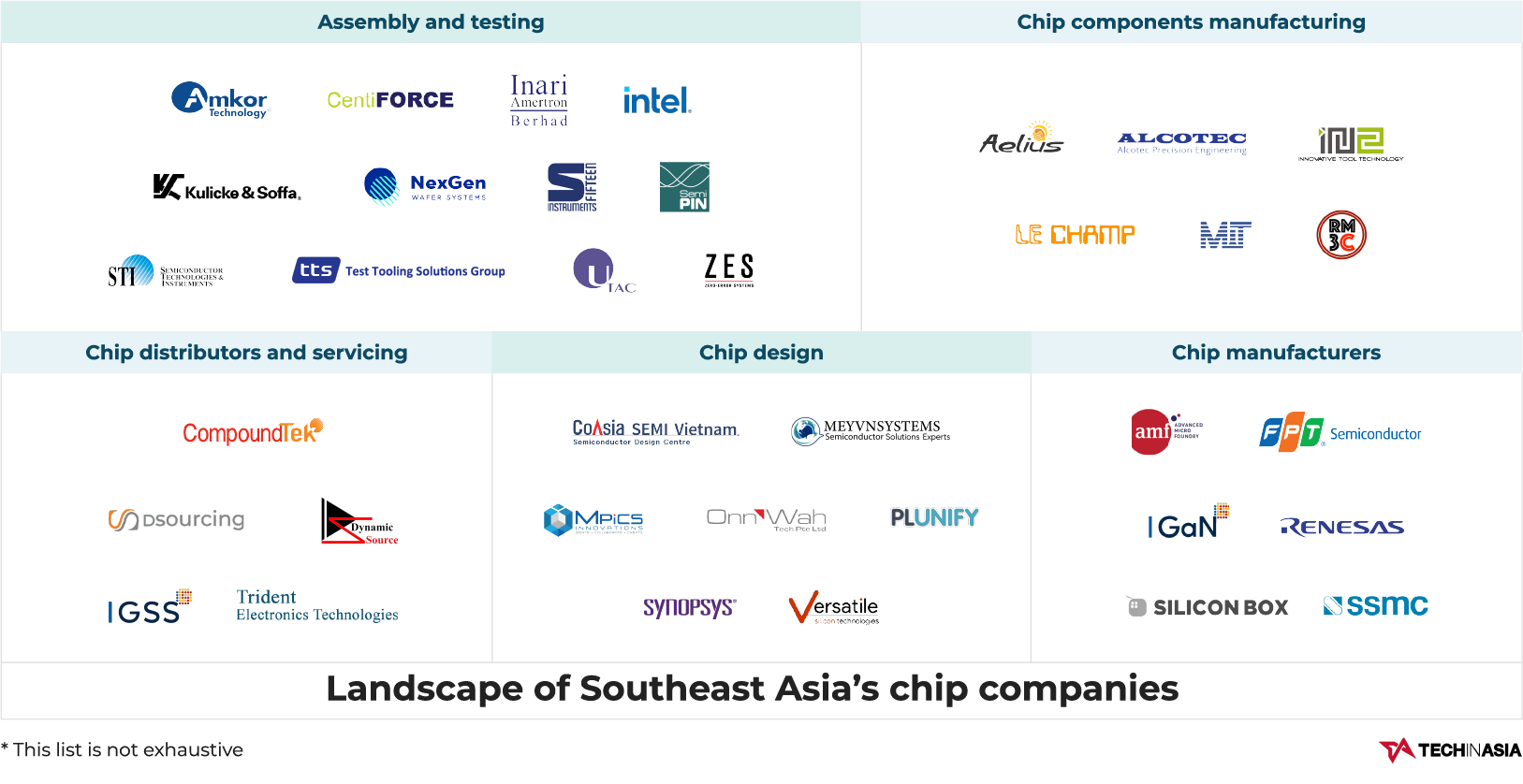
With this in mind, Tech in Asia created a list of companies in Southeast Asia that are directly or indirectly involved in the production of AI chips and associated hardware.
Tech in Asia’s data shows that a majority of these firms operating in the region work in verticals that support AI chip production – from assembly and testing to distribution.
For instance, Singapore-based Plunify is an IT company that uses machine learning, data analytics, and cloud computing to help with semiconductor chip design. Meanwhile, NexGen Wafer Systems, another Singapore-based business, manufactures and services semiconductor processing equipment.
Of the 37 companies active in the region, only six of them manufacture chips.
One of the largest firms operating in the assembly and testing segment is Kulicke & Soffa. Founded in 1951 in Singapore, the company designs, manufactures, and sells semiconductor packaging and electronic assembly solutions.
Share, tag us, and land on our Wall of ❤️ !
Stay ahead in Asia’s tech landscape
This is premium content. Subscribe to read and use our charts, graphics, and other visuals legally
With over 35 companies in Southeast Asia operating in the AI chips space, the region is an attractive destination for chipmakers like Nvidia and others.
We know this is not ideal. ⌛ Sign up in 20 seconds. Cancel anytime.
Our subscriber community includes professionals from these companies:





Stay updated on the go with our mobile app.
Get latest insights with smoother, more personalized experience through TIA mobile app.