 Samreen Ahmad · · 4 min read
Mapping Singapore’s leading D2C brands
Charts and visuals, only for subscribers
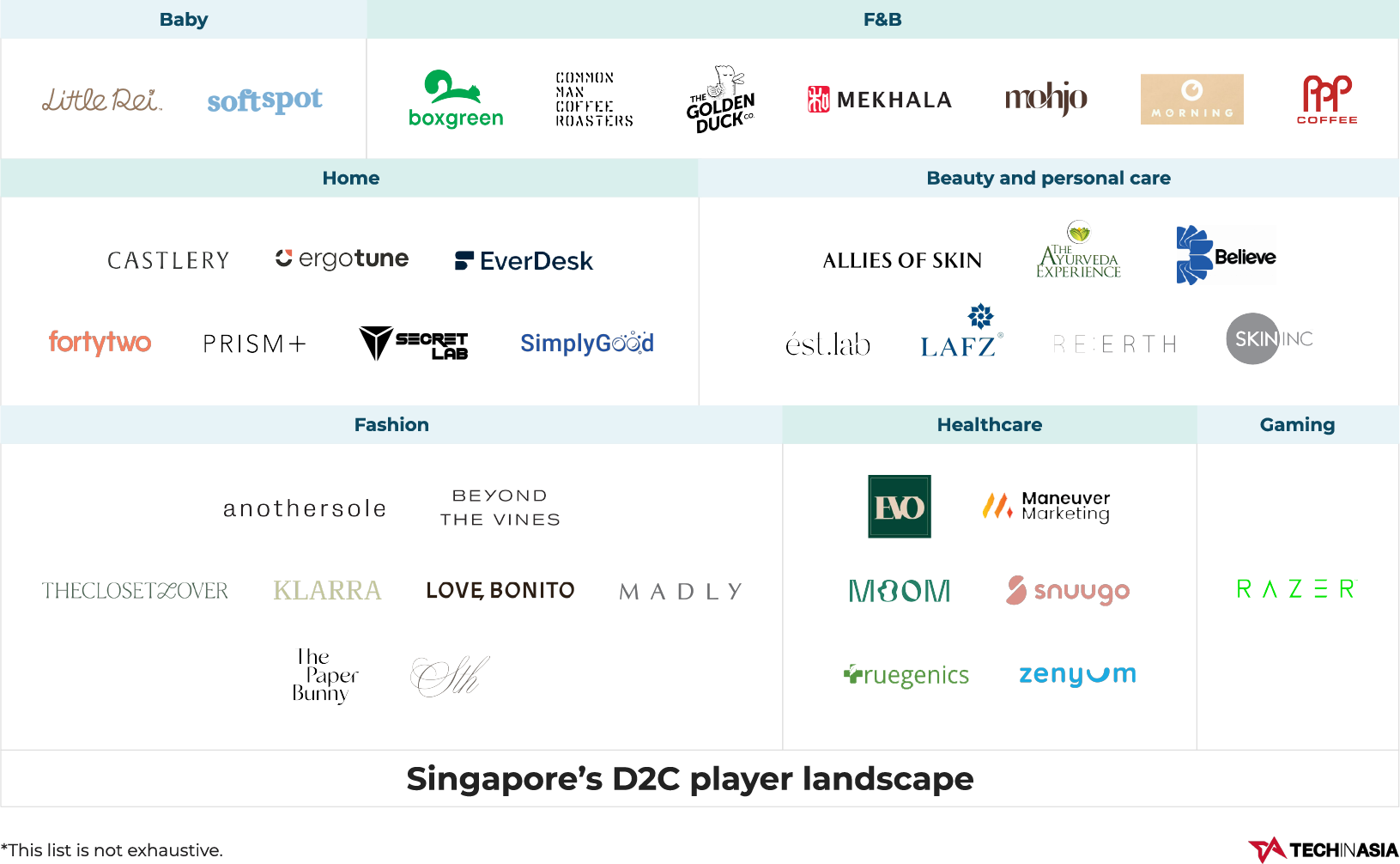
The average Singaporean spends US$785 on online shopping, more than twice the amount spent by consumers in other Southeast Asian countries.
But the Singapore market on its own is miniscule. For direct-to-consumer (D2C) startups based in the city-state to thrive, they will need to find a bigger audience overseas.
This comes as VC funding into Singapore’s D2C sector has reduced from a high of US$61.4 million in 2022 to US$27.7 million in 2023, according to data platform Tracxn. Such a reversal aligns with the overall downward trend in funding.
Nevertheless, “there has been growing interest in D2C brands among investors,” Neha Singh, co-founder of Tracxn, tells Tech in Asia.
This funding lull is, however, likely to continue in 2024. So far this year, only one Singaporean D2C startup – Allies of Skin – has raised funds. It secured a significant US$20 million from Meaningful Partners to fund an expansion to the US.
Eyeing offshore markets
Allies of Skin is just one example of a homegrown Singapore D2C brand planning to expand stateside. Other Singaporean brands such as Skin Inc and Re:erth are also aiming to capture their share of the world’s largest consumer market. On a volume basis, over 65% of Skin Inc’s products, including those in beauty boxes, are sold in the US.
For Singapore D2C brands, the next destination for expansion does not seem to be other Southeast Asian markets. Instead, they often look to more developed ones that are similar to Singapore such as the US, according to Jia Jia Chai, CEO and co-founder at ecommerce roll-up company Rainforest. He points out the premium price points of D2C products in Singapore as the reason.
“Very few D2C brands will launch in Singapore and then go to Indonesia or Philippines or Vietnam as a next market simply because the product sets are very different,” says Chai.
See also: Castlery reaps fruits of US gambit in FY 23 as revenue grows 63%
Furniture company Castlery is one of the success stories of Singapore D2C companies in the US. In its financial year ending March 2023, the firm’s revenue increased 63% to US$180 million compared to FY 2022 – an improvement the company attributed to strong momentum in the US.
Hurdles to US expansion
At some point, investors and founders of a D2C startup will want to monetize the value of their shares, and going public is one way for them to do so.
While America’s US$200 billion D2C market offers a vast customer base for Singaporean brands looking to expand, there are significant challenges associated with going public in this market.
Chai points out that to list in the US, a company needs to be very large in scale in terms of market cap, typically in the range of US$2 billion to US$3 billion or more.
Beauty blends with health
Share, tag us, and land on our Wall of ❤️ !
Stay ahead in Asia’s tech landscape
This is premium content. Subscribe to read and use our charts, graphics, and other visuals legally
For Singapore’s D2C brands, the next choice for expansion doesn’t seem to be other Southeast Asian countries but more developed markets like the US.
We know this is not ideal. ⌛ Sign up in 20 seconds. Cancel anytime.
Our subscriber community includes professionals from these companies:





Stay updated on the go with our mobile app.
Get latest insights with smoother, more personalized experience through TIA mobile app.