 Qishin Tariq · · 6 min read
Mapping SEA’s key digital banking players (update)
Charts and visuals, only for subscribers
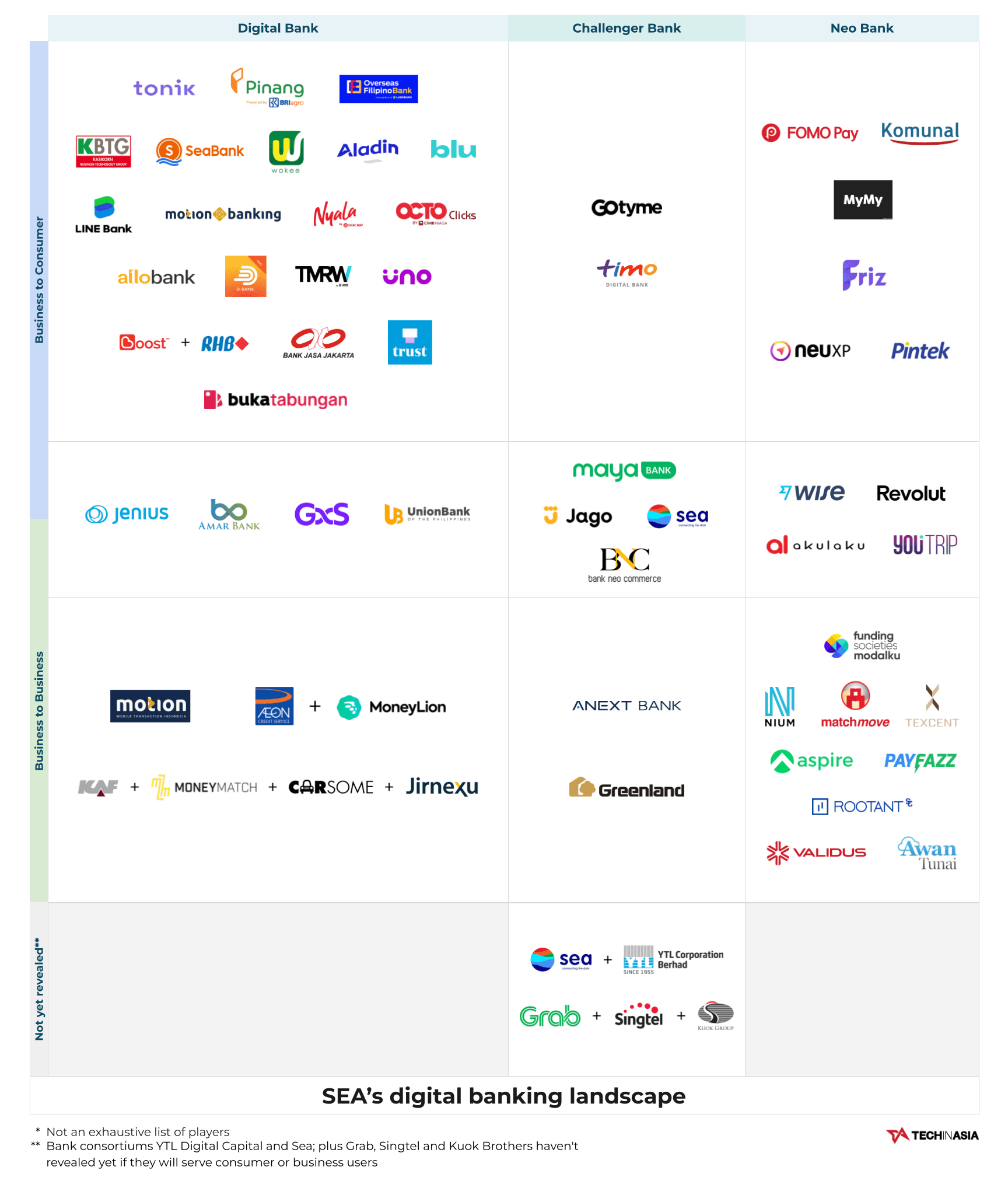
This is the latest version of the article that was published on June 8, 2022. Since then, we’ve added our analysis of the latest developments in the sector as well as new players to the list.
More players are pushing into Southeast Asia’s crowded digital banking scene.
This week, GXS Bank – the digital bank backed by the Grab and Singtel consortium – launched in Singapore.
Standard Chartered Bank, meanwhile, has rolled out two digital services of its own: Trust Bank, which it launched in partnership with FairPrice Group in Singapore, and BukaTabungan, which it released in tandem with Indonesian ecommerce firm Bukalapak. The latter service connects Bukalapak’s users with Standard Chartered’s banking services.
In Southeast Asia, the widespread availability of mobile internet – around 88% of internet users access the web on smartphones – has brought many essential services quite literally to the palm of people’s hands.
This trend extends to banking services, with Singapore and Indonesia reporting that 65% and 71% of their respective populations use mobile banking. In contrast, only 8% of people in Singapore and 9% in Indonesia would bank in person at a physical branch.
In line with these statistics, many financial institutions are pushing into mobile services through digital banks – an umbrella term for firms that offer traditional banking services via the web or mobile.
Meanwhile, fintech startups are either independently obtaining banking licenses or collaborating with incumbents.
Southeast Asia’s digital financial services market is estimated to grow from US$11 billion in 2019 to US$38 billion by 2025.
As the region’s digital banking scene heats up, Tech in Asia maps out the region’s emerging ecosystem in this visual story.
The rise of digital banking in Southeast Asia
Digital banks have traditionally been offshoots of conventional banks.
In 2000, ING Direct and Japan Net Bank, the first digital banks in the Asia Pacific, were introduced in Australia and Japan, respectively. That was years before the likes of Alibaba and Tencent’s WeBank rolled out digital banking services in China.
ING Direct’s free online banking service, which was ahead of its time when it was established, has become the template for similar services offered by US banks. Japan Net Bank’s around-the-clock services via the web also primed the growth of online businesses and demand for online settlements.
Same goal, different approaches
A license to bank
The incumbent strikes back
Credits
Share, tag us, and land on our Wall of ❤️ !
Stay ahead in Asia’s tech landscape
This is premium content. Subscribe to read and use our charts, graphics, and other visuals legally
Southeast Asia’s digital banking scene is on an uptick, with new licensees in Malaysia joining the fray, along with newly launched players in Singapore.
We know this is not ideal. ⌛ Sign up in 20 seconds. Cancel anytime.
Our subscriber community includes professionals from these companies:





Stay updated on the go with our mobile app.
Get latest insights with smoother, more personalized experience through TIA mobile app.