 Shadine Taufik · · 4 min read
Mapping SEA’s electric vehicle players
Charts and visuals, only for subscribers
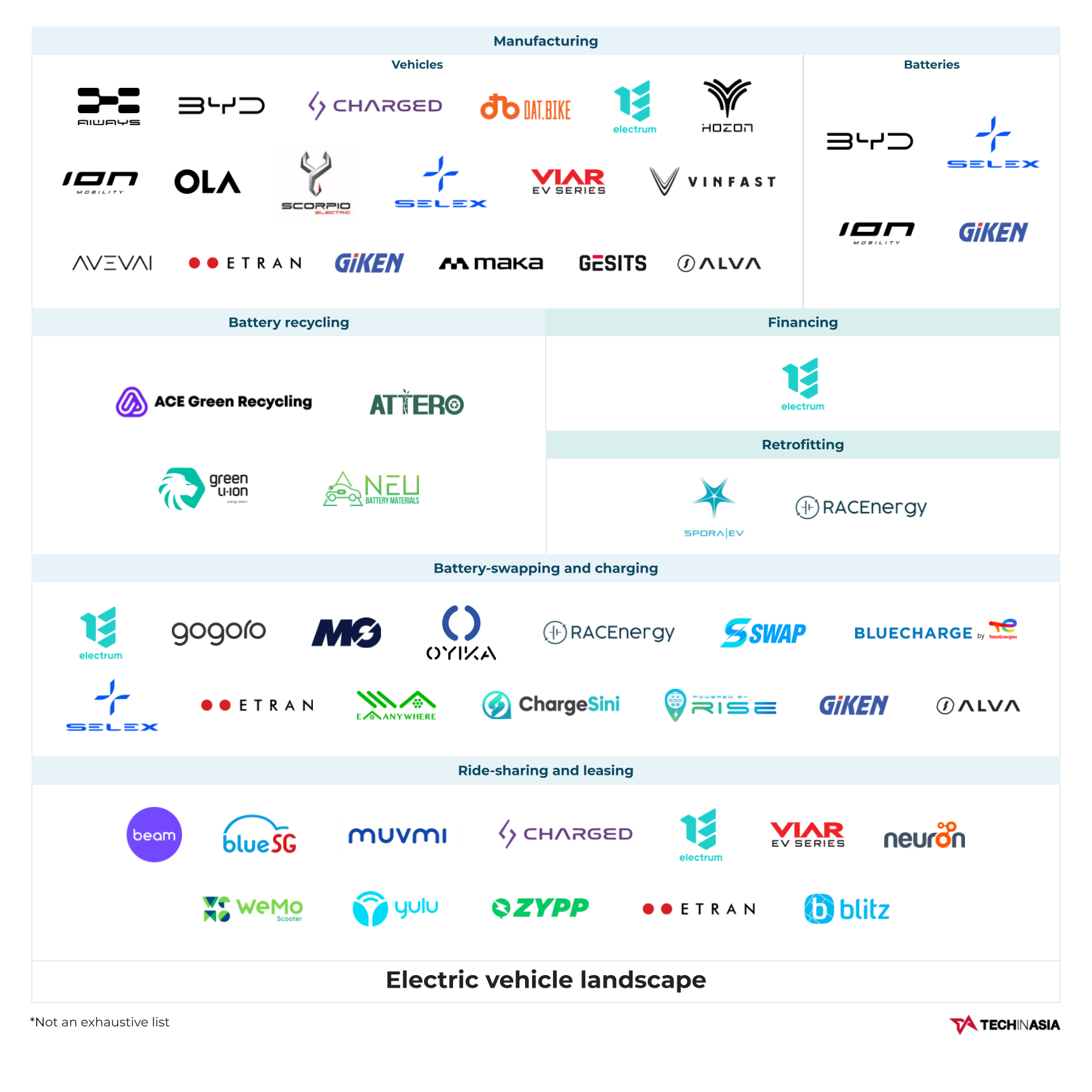 Here are some caveats about the data before we dive in:
- The data was compiled from Tech in Asia’s database.
- The list excludes traditional automotive firms that are manufacturing electric vehicles.
- The data includes startups headquartered outside Southeast Asia but with a presence in the region as well as those that have talked about plans to enter the market.
- The list is indicative, not exhaustive.
Southeast Asia’s electric vehicle industry has been led by overseas traditional automotive brands, with giants Wuling and Volvo being two of the three top-selling brands in 2022, as per a Counterpoint Research report. Wuling’s Air EV was the best-selling model across the region last year.
That said, it was Vietnam’s VinFast that recorded the largest EV sales for Southeast Asia last year. Two of its offerings, the VF 8 and the VF e34, were among the three best-selling EV models in the region in 2022.
However, it’s not just electric cars that make up this industry – an ecosystem is needed to support their operation. Infrastructure such as battery swapping and charging need to be as ubiquitous as petrol stations to allow for longer-range rides.
With the growing sales of EVs, recycling for lithium-ion batteries also needs to be accounted for. This is where many startups in Southeast Asia come in.
EV adoption is likely to look different in the region compared to the US, Europe, or China.
Though manufacturers outside Southeast Asia may have the upper hand in electric four-wheelers, the market for electric two- and three-wheelers is still hotly contested by regional firms. Motorbikes, tuk-tuks, and other two- and three-wheelers account for around 80% of all vehicles – electric and otherwise – operating in Southeast Asia.
Given the demand for electric two-wheelers, startups such as Ion Mobility, Dat Bike, and Viar have emerged in the last few years.
That said, the second-most popular vertical for EV startups in the region is battery charging and swapping. Companies such as Taiwan-based Gogoro have made inroads in the market with its partnership with Gojek in 2021. The battery-swapping firm went on to list itself on the Nasdaq last year.
According to a McKinsey report, the ASEAN markets will need a total of 95,000 public AC and 40,000 DC charging points to support the forecasted number of registered EVs in the region by 2030.
Countries are already making deals with local companies to meet this infrastructure demand. Recently, Singaporean startup Charge+ won a government tender to install 4,000 EV charging stations in the city-state.
Electrum, a joint venture between Gojek and TBS Energi Utama, aims to set up charging stations in Indonesia. It also manufactures vehicles and currently provides an electrified fleet of motorbikes to Gojek.
Besides infrastructure, one of the biggest challenges faced in EV adoption is the high upfront cost of purchasing vehicles. This makes leasing options, such as those offered by Charged Asia or Blitz, a popular startup business model in the region.
Share, tag us, and land on our Wall of ❤️ !
Stay ahead in Asia’s tech landscape
This is premium content. Subscribe to read and use our charts, graphics, and other visuals legally
Though Thailand is the region’s biggest market for EVs, Singapore is home to the largest number of startups in the industry.
We know this is not ideal. ⌛ Sign up in 20 seconds. Cancel anytime.
Our subscriber community includes professionals from these companies:





Stay updated on the go with our mobile app.
Get latest insights with smoother, more personalized experience through TIA mobile app.