 Scott Shuey · · 5 min read
Mapping SEA’s digibanks: expanding despite slow profits
Charts and visuals, only for subscribers
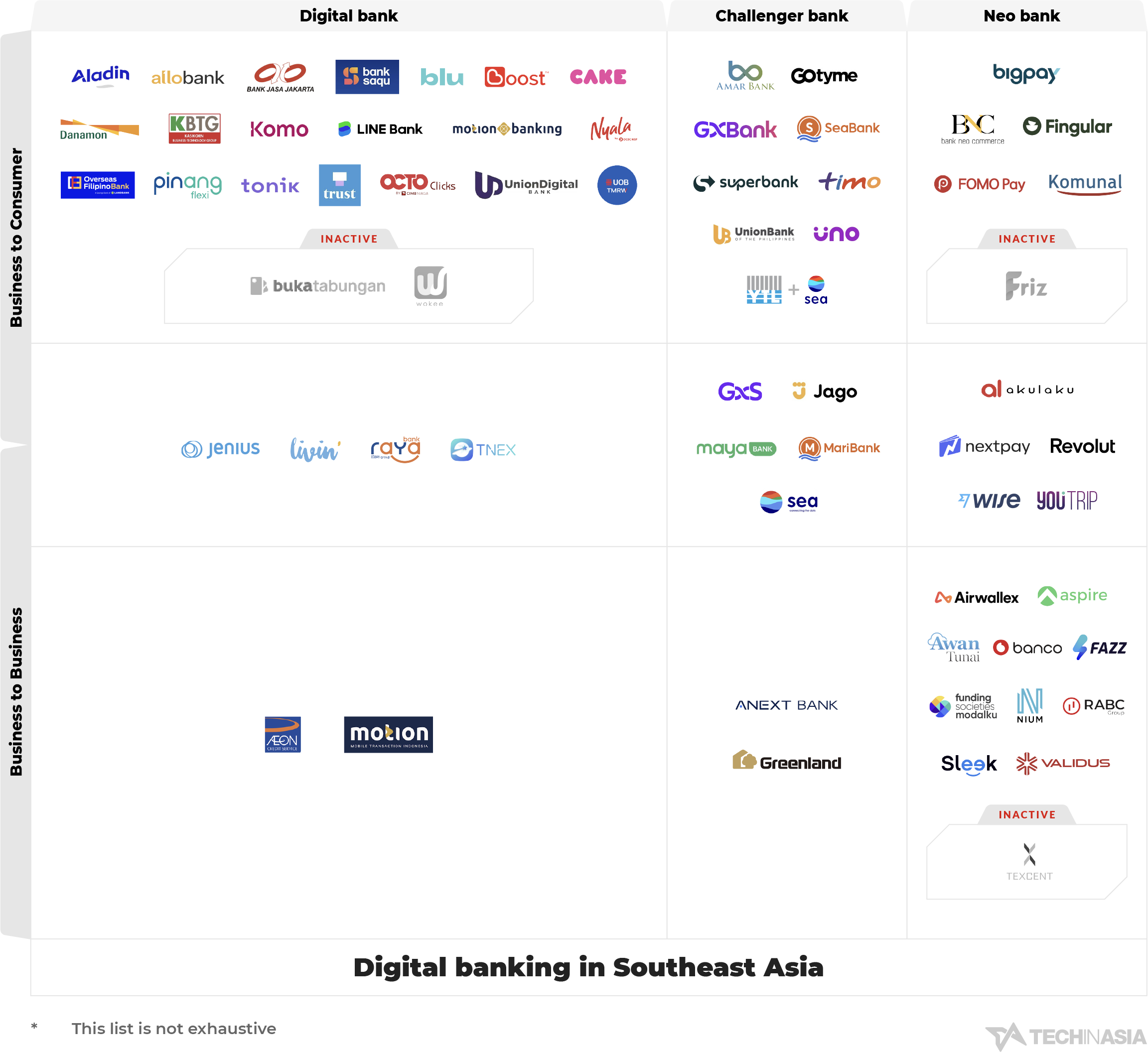
This is the latest version of the article that was previously updated on November 23, 2023. Since then, we’ve added several startups and new funding rounds to the list.
Only five years ago, digital banks were a novelty in Southeast Asia.
Now – thanks in part to the Covid-19 pandemic and increased licensing from regional governments – there are almost 55 digital banks operating in Singapore, Malaysia, Indonesia, the Philippines, and Vietnam, according to data from Tech in Asia.
That number is likely to increase. In August, the Philippines lifted a moratorium that limited the number of digital banks in the country to six. This would allow up to four more digital banks to operate in the country.
After a long period of assessment, Thailand, too, is expected to grant three “virtual” banking licenses in 2025, with the expectation that they will become operational by 2026.
According to a report by Google, Temasek, and Bain and Company, digital lending is the biggest revenue driver in Southeast Asia’s digital finance sector, accounting for 65% of all digital finance revenue so far this year. Between 2022 and 2024, digital lending revenue also grew by 35%.
Globally, net interest income – the spread between what banks earn from loans and what they pay out in interest – from digital banks touched US$1.5 trillion in 2024 and is expected to reach US$2 trillion by 2025. By comparison, traditional banks earned US$7 trillion in net interest income in 2024.
Digital, challenger, or neobanks?
In Southeast Asia, standalone, online-only banks backed by major traditional banks are the most common, with 26 operating in the region. For categorization purposes, we’ve classified these as “digital banks” in our main graphic.
These players differ from challenger banks, which are standalone, online-only banks that are operated by non-banking entities. Such entities could be consortiums or other venture capital-backed firms. Both digital and challenger banks are required to have specific licenses in most countries.
Neobanks, meanwhile, are fintech companies that offer banking services, such as payments or lending. Although they may hold payment or other types of licenses, these entities are not licensed as bank. BigPay and Fomo Pay, for instance, both hold licenses from the Monetary Authority of Singapore to conduct cross-border money transfer services.
On the whole, the sector has been stable. Only two digital banks in our digital and challenger categories shut down since 2020, when the first digital banking licenses were first introduced in the region.
Wokee, a digital bank app offered by Indonesia’s Bank KB Bukopin, was deactivated in November 2023, when all accounts were transferred to KBstar, an app for Bank KB Bukopin.
In a statement explaining the transition, Bank KB Bukopin’s deputy president director Robby Mondong said KBstar has more complete, safer, and easily accessible features.
Two of three Malaysia digital banks still in limbo
Challengers for digital banks
Neobanks pivot
Funding challenge
Share, tag us, and land on our Wall of ❤️ !
Stay ahead in Asia’s tech landscape
This is premium content. Subscribe to read and use our charts, graphics, and other visuals legally
Digital banks in Southeast Asia struggle with profits, but that isn’t deterring new launches in Thailand and the Philippines.
We know this is not ideal. ⌛ Sign up in 20 seconds. Cancel anytime.
Our subscriber community includes professionals from these companies:





Stay updated on the go with our mobile app.
Get latest insights with smoother, more personalized experience through TIA mobile app.