 Qishin Tariq · · 4 min read
Mapping Southeast Asia’s key wealthtech players
Charts and visuals, only for subscribers
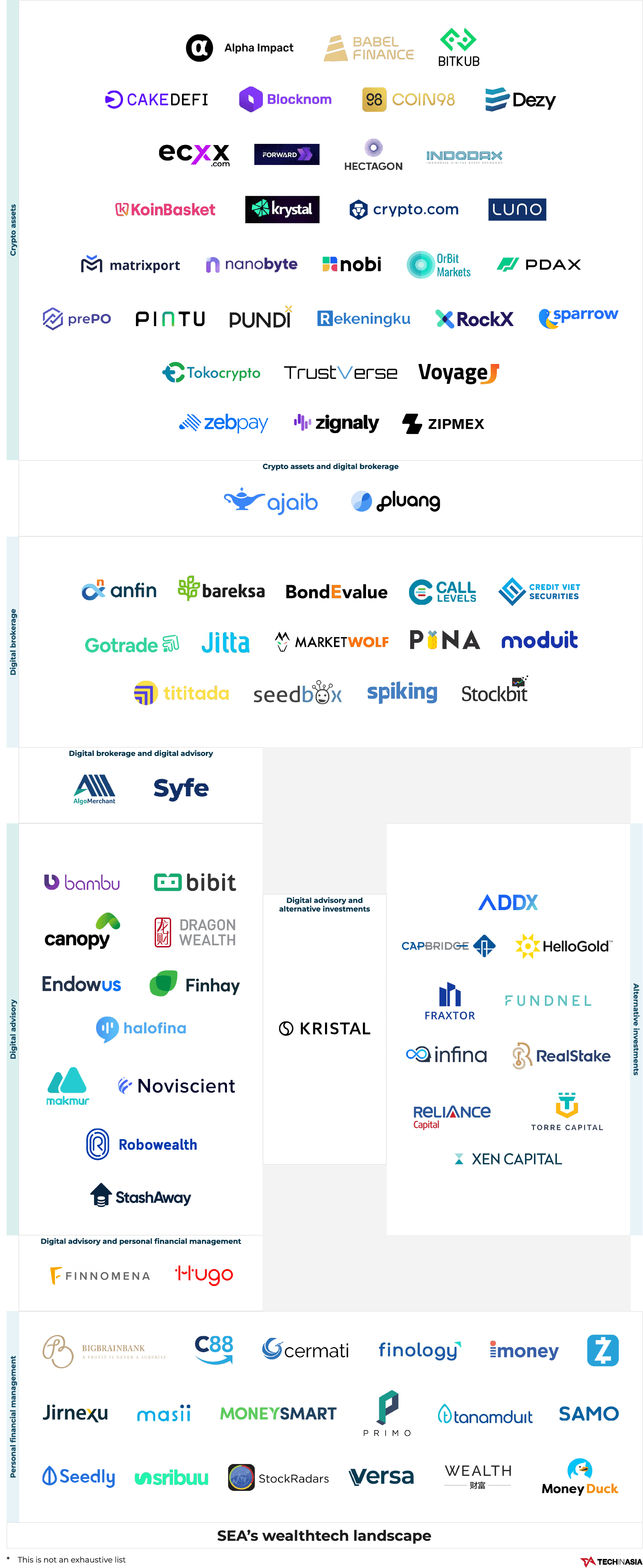
Wealthtech firms – fintech startups that are modernizing wealth management with tech solutions – have been rapidly gaining traction with consumers and investors over the last few years.
Compared to payments or lending, however, wealthtech has remained a relatively nascent space within the financial services industry, having seen limited adoption and digitalization. That, however, appears to be changing.
A recent report by KPMG Singapore and fintech firm Endowus found that venture capital investment in the global wealthtech industry tripled between 2017 and 2021, hitting a record US$8.8 billion.
Within Asia, Singapore has become a focal point of wealthtech investment, owing to its established reputation as a financial hub and the country’s strong regulatory support. The report found that between 2016 and 2021, the number of high-net-worth and ultra-high-net-worth individuals in the city-state grew 126% and 158%, respectively.
While investments into the industry in Asia nearly doubled from US$1.1 billion in 2017 to US$2.2 billion in 2021, investments in Singapore alone rose from US$23 million to US$161 million in the same period. That marks a 7x increase.
In this story, we divide wealthtech startups into five categories based on their services. These include:
- Digital brokerages – These are trading platforms for investors to buy and sell assets like equities, bonds, derivatives, exchange-traded funds, or futures. Users can do this passively using algorithmic trading, where a program places trades based on a defined set of instructions. Examples include stock trading app MarketWolf and financial intelligence platform Jitta.
- Digital advisories – These startups are portfolio management and financial planning services that use machine learning-based algorithms to customize and execute an investment portfolio. This also includes robo-advisory and robo-retirement tools. Examples include robo-advisor Syfe and mutual fund robo-advisory Bibit.
- Alternative investments – Companies in this category are trading platforms for retail investors that give their users access to private markets typically for institutional and accredited investors. This includes real estate, private equity, and hedge funds. Examples include private market exchange ADDX and real estate co-investment platform Fraxtor.
- Personal financial management – These are services that help customers manage their finances through education and comparison tools, as well as features for budgeting, goal setting, expense tracking, portfolio aggregation, and retirement planning. Examples include financial comparison aggregator iMoney and expense tracking app Sribuu.
- Crypto assets – These companies are trading platforms for investors to buy, sell, or use crypto assets. Examples include digital asset investment app Pintu and digital asset exchange Zipmex.
For now, Asia still lags behind mature wealth management markets like Switzerland, Australia, the US, and the UK, where many wealth managers operate on a “fee-only” structure. This means they accept fees only from their wealth management clients and are independent of the product providers they work with.
In contrast, over 95% of advisors in the region still receive fees from product providers as well as clients, Endowus CEO Gregory Van noted at a press event last week. The shift toward an independent, fee-only model, however, is “undeniable,” Van said.
Over the years, technology has also made wealth management services and other such products more accessible for retail investors and has reduced the fees associated with investing.
Private market exchange ADDX, for instance, uses blockchain and smart-contract technologies to reduce minimum investment sums in private equity, hedge funds, and pre-IPO companies from US$1 million to US$10,000. This gives retail investors easier access to private market options that previously only institutional investors could afford.
Beyond Singapore, Indonesia is also a bright spot, with online brokerage firms there accounting for a significant portion of venture funding in 2021. Among them, stock and mutual fund investment platform Ajaib is one of the most prominent, hitting unicorn status after raising US$153 million in October 2021.
Credits
Share, tag us, and land on our Wall of ❤️ !
Stay ahead in Asia’s tech landscape
This is premium content. Subscribe to read and use our charts, graphics, and other visuals legally
Asia’s wealthtech scene is on the rise, with Singapore taking the lead in investments and deal numbers.
We know this is not ideal. ⌛ Sign up in 20 seconds. Cancel anytime.
Our subscriber community includes professionals from these companies:





Stay updated on the go with our mobile app.
Get latest insights with smoother, more personalized experience through TIA mobile app.