 Simon Huang · · 4 min read
The key players in Southeast Asia’s growing edtech scene
Charts and visuals, only for subscribers
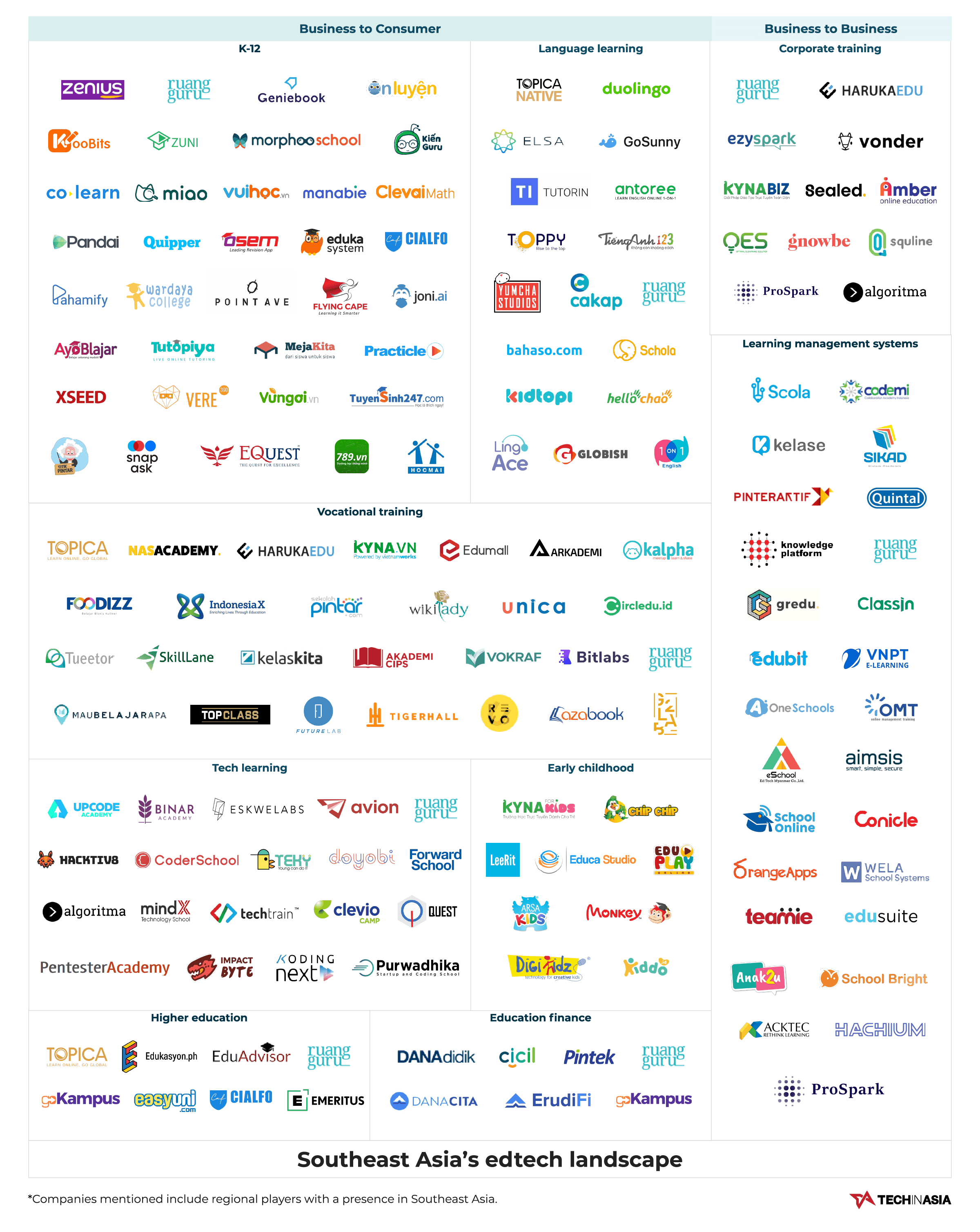
With a population of over 675 million people and growing, Southeast Asia has the potential to be one of the world’s largest markets for education technology.
Ruangguru, Indonesia’s biggest edtech startup, stands out from among its peers in the region for attracting the most funding. Its massive US$150 million round in 2019 was followed by US$55 million in new funding this year.
Through various technology-based learning services, Ruangguru helps students in the K-12 segment improve their performance on standardized tests. The company is now “closing in on the $1 billion valuation mark,” according to a report from DealStreetAsia.
Next on the list is Vietnam’s Topica Edtech, which raised US$50 million in a series D round in 2018. The company caters to older students by providing online services such as degree programs, language courses, and vocational training.
Several early-stage firms in Southeast Asia are also worth noting.
Singapore-based LingoAce, an online Mandarin learning platform for students between 6 and 15 years old, secured US$13 million in 2020 from investors including Shunwei Capital and Sequoia India.
Another early-stage success is NPX Point Avenue, a hybrid learning-focused platform with K-12 bilingual private schools as well as K-12 hybrid academies in Hanoi, Ho Chi Minh City and Da Nang in Vietnam. It raised US$12 million in series A funding earlier this year.
Where are investors placing their bets?
With interest in edtech on an uptick, investors are voting with their money. In recent years, there has been a surge in both the number and value of deals in Southeast Asia.
Deal value in the region peaked in 2019, largely due to Ruangguru’s blockbuster US$150 million series C round that year.
Since 2019, Indonesia, Vietnam and Singapore have dominated in terms of overall deal value. The first two countries have huge internal markets: Indonesia alone, for instance, has 53 million students in the formal K-12 system, according to the World Bank. Meanwhile, Singapore is a hub for investment in Southeast Asia.
Yet Topica is a reminder that even a well-funded startup serving a sizable market can face obstacles. Tech in Asia previously reported on the company’s recent challenges, including a change in CEO and laying off a majority of its staff to better manage operating costs.
Stacking up against China and India
Indian edtech startups look abroad
Credits
Share, tag us, and land on our Wall of ❤️ !
Stay ahead in Asia’s tech landscape
This is premium content. Subscribe to read and use our charts, graphics, and other visuals legally
Southeast Asia’s edtech sector is attracting more investment, but it’s still dwarfed by China and India.
We know this is not ideal. ⌛ Sign up in 20 seconds. Cancel anytime.
Our subscriber community includes professionals from these companies:





Stay updated on the go with our mobile app.
Get latest insights with smoother, more personalized experience through TIA mobile app.