 Tay Tian Wen · · 4 min read
How India’s tech titans square up against Chinese peers
Charts and visuals, only for subscribers
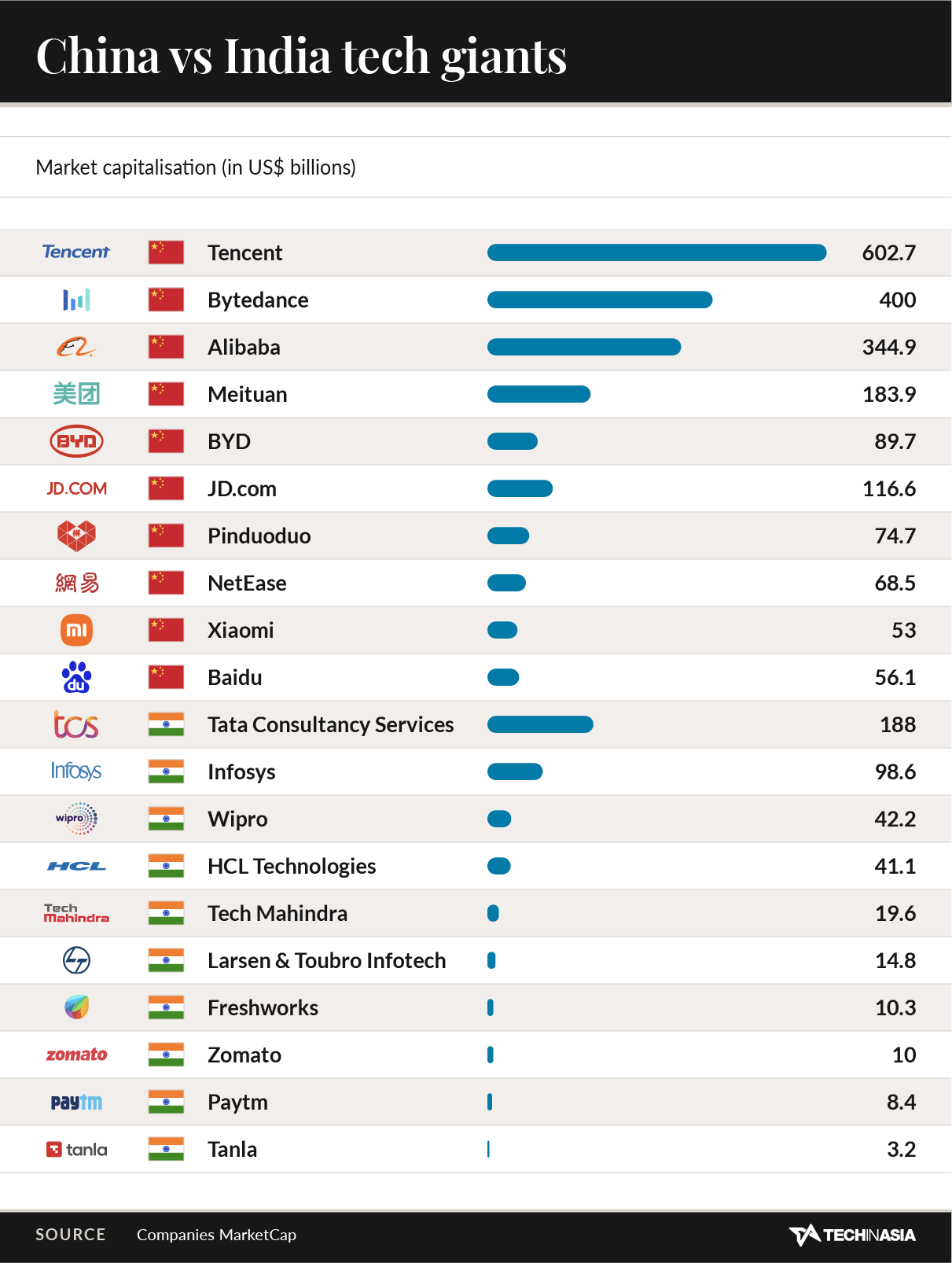
Image credit: Timmy Loen
Hours before India’s inaugural national startup day, the country’s prime minister, Narendra Modi, declared that startups were “going to be the backbone of a new India.”
Modi’s exuberance comes as India’s startup ecosystem reaches new heights. In a recent speech, he noted that the number of startups based in India had skyrocketed from to 60,000 from less than 500 in 2017. Last year, the country also welcomed 42 new unicorns.
While India now mints new unicorns almost as quickly as China, there’s still a gulf between the startup ecosystems of the two neighbors.
Not quite toe to toe yet
Unlike China, many of India’s top tech companies today are spin-offs – like Tech Mahindra and Tata Consulting – from large, family-owned conglomerates. All of these firms were established between 1968 to 2000.
These spin-offs all operate in the IT services sector and are the largest Indian tech companies by market value. Tata Consulting, for example, largely provides tech consulting and business process outsourcing services.
Despite their age, India’s top 10 tech companies’ combined valuation trailed their Chinese peers’ as a percentage of their home countries’ gross domestic product between 2016 to 2020. India nearly closed the gap with China in 2018, when the latter was locked in a trade war with the US.
In absolute terms, the combined valuation of the top 10 Chinese tech firms is over fourfold that of their Indian peers.
The contrast is even more stark when we look at the fifth to tenth largest Indian tech companies, which mostly comprise recent entrants like food delivery firm Zomato and digital payments provider Paytm. Here, Chinese tech companies’ combined valuation is more than sevenfold that of their Indian counterparts.
What’s holding India’s tech scene back?
Essentially, India sets itself apart from China in two ways: a leaderboard dominated by stalwart tech spinoffs that don’t pull their weight in market value and a late boom in significantly smaller unicorns. But what explains these issues for the world’s fifth-largest economy?
For one, large spinoffs like Tata Consulting and Tech Mahindra have been slow to pivot away from low-value legacy businesses that scale linearly. To grow them, employee headcounts must tick up.
Making India Tech 2.0 work
Share, tag us, and land on our Wall of ❤️ !
Stay ahead in Asia’s tech landscape
This is premium content. Subscribe to read and use our charts, graphics, and other visuals legally
Legacy businesses still dominate Indian tech, but the government is turning its attention toward younger upstarts.
We know this is not ideal. ⌛ Sign up in 20 seconds. Cancel anytime.
Our subscriber community includes professionals from these companies:





Stay updated on the go with our mobile app.
Get latest insights with smoother, more personalized experience through TIA mobile app.