 Samantha Cheh · · 6 min read
Agents of change: how Mindverse is democratizing genAI


Image generated using Midjourney.
As generative AI (genAI) becomes mainstream, we’re not only learning more about it can transform daily work but also seeing how it can go wrong. Take the example of a US lawyer who used ChatGPT to write a legal filing, He later found out that the AI tool had made up legal cases, resulting in “legal gibberish” that got him in trouble with the courts.
This example illustrates the tendency of genAI tools to produce false information is called “AI hallucination.” It also shows how there are still many hurdles to the effective use of this tech for business.
To truly take advantage of its potential, businesses need to think of AI as more than just a chatbot, says Felix Tao, co-founder and chief executive of Singapore-based Mindverse. Instead, AI can be regarded as “autonomous agents with their own specialty, knowledge base, and ways of thinking or memorization,” says Tao, whose company specializes in “embodied AI” or virtual assistants.
Three stages of AI
Currently, most businesses are working with what’s known as “narrow AI,”, where the tool is specifically trained to handle a limited task like image or facial recognition. Tao believes that genAI is the second step, as it has been trained on huge amounts of data to produce content such as text, images, video, and computer code.

Felix Tao, co-founder and chief executive of Mindverse / Photo credit: Mindverse
However, that doesn’t mean that genAI is anywhere close to human intelligence, as the tech still can’t act autonomously, Tao notes. The “human touch” is what sets generative AI apart from the third step in its evolution: artificial general intelligence (AGI) or “strong AI,” which is capable of abstract and creative thinking.
“Humans want to work with humans, not models,” he says. “We don’t want something that just generates data, we want a tool that understands our needs.”
In short, AGI is the ultimate goal, but the tech still has many infrastructural and technical challenges to overcome.
The problems with genAI
According to Tao, people are probably more familiar with AI’s infrastructural problems like privacy rights and computational power. But there are many technical issues standing in the way of businesses adopting genAI in a meaningful way.
Click on the boxes to learn more about the different challenges
For one, companies often struggle with the trade-off between flexibility and control when it comes to genAI models.
“LLMs are trained on public data on the web, so they hallucinate,” Tao explains. “In a business scenario, this is an issue because we need the information to be factually correct, up to date, and precise.”
However, companies generally struggle to build specialized tools because of issues with connecting their internal data with AI models. Even working with existing LLMs is challenging as most don’t connect to domain data – and for those that do, the training process can be slow and painstaking.
Secondly, most genAI tools are stuck at basic content creation or task automation. To go beyond this, AI models need to have “a planning layer or reasoning ability to constrain and guide the LLM’s underlying behavior,” Tao says.
However, he highlights that most people don’t factor in the need to incorporate reasoning abilities into their AI models. Overlooking this ultimately hinders the technology from becoming more useful.
A new brain center for business
Mindverse was founded in 2022 to help bring that reasoning ability to genAI via “AI agents” trained for specific goals or contexts. With the company’s proprietary MindOS offering, customers can quickly build virtual AI agents through a marketplace of templates that can be borrowed or adapted to with specialized skills.
These AI agents also have customizable personalities, quirky avatars, customizable chains of thought, and – crucially – autonomous problem-solving abilities. Using their own data, individuals and businesses can train these agents to develop logic and follow procedures as a series of interconnected tasks. After this process, the AI agents can solve comprehensive problems in one step.
For example, an investment analyst can build a personal AI assistant that can manage their schedule and emails as well as produce comprehensive industry reports using the data it was trained on. A business owner could also directly connect an AI agent to the back-end data, giving it an in-depth understanding of the company’s product inventory – just like a human salesperson would.
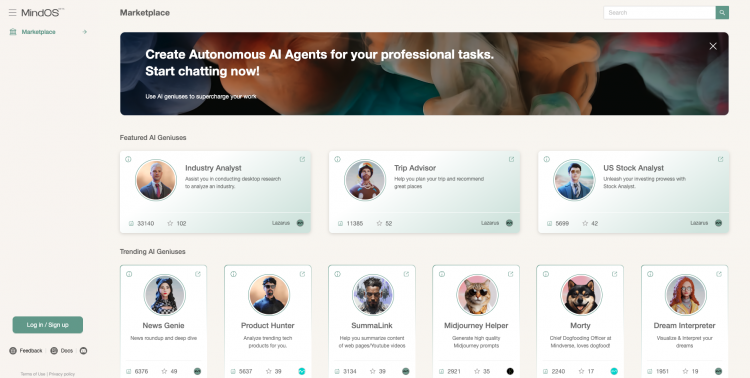
The MindOS marketplace / Photo credit: Mindverse
Through the chat function, an AI agent can provide recommendations or insights such as product comparisons and details, and even respond to users’ screen activity. Its skills can be customized by industry, so an AI agent in a travel-booking business can support itinerary planning or hotel reviews.
Mindverse has also launched a new feature called Canvas, which enables human-AI collaboration across different web pages and documents.
Tao envisions a future where MindOS becomes a kind of “professional social network”: one’s personal AI assistant can collaborate with professional AI agents from all industries to provide you with content and services.
“We want to fill the gap for different people to build their own agents, and also users who are looking for agents to help them in their daily work,” explains Tao.
A core tenet of Mindverse’s mission is to democratize generative AI – but without the hefty price tag. To eliminate the tedious task of training a model, the company implements a “drag-and-drop” function that allows companies to inject their domain data into the AI in the form of internal documents, APIs, and datasets. These form an information foundation that an AI agent can use to learn skills and “self-construct,” says Tao.
This is also why MindOS was designed with a “no code/low code” approach, which means AI can be trained through conversation rather than code. By allowing customers to develop their AI models with just domain data, MindOS’s AI agents have a much lower risk of hallucinating, creating an added layer of security for customers while also building the specialized AI tools that have eluded businesses for so long.
Shifting focus
For Tao, zeroing in on AI’s value creation instead of its faults is a crucial mindset shift that businesses need to make if they want to harness the power of genAI.
“You want to truly give people control of AI because that’s how you can build trust in AI,” he says.
For him, Mindverse’s mission to democratize AI plays a crucial role in building public trust by providing that “control” and demystifying the tech’s full potential. However, the flip side of making AI more accessible is that businesses themselves need to rethink their traditional ways in order to expand the space in whichAI can take root.
As AI gradually becomes part of everyday life, Tao predicts that AI as AI becomes part of everyday life, it will introduce a new way of thinking about digital technology while simultaneously transforming how societies operate.
“Every part of how you run a business or how you do daily tasks will have some AI involvement,” he says. “Each company will likely have AI and humans running organically together. That will be the glue for the whole of society.”
Mindverse’s MindOS is a groundbreaking AGI platform that aims to democratize generative AI tools by allowing individuals to create, share, and develop their own AI beings.
If you’re interested in building your own customizable AI being, MindOS has entered its Open Beta phase. You can create an account for free via its website.
This content was produced by Tech in Asia Studios, which connects brands with Asia’s tech community. Learn more about partnering with Tech in Asia Studios.
Stay updated on the go with our mobile app.
Get latest insights with smoother, more personalized experience through TIA mobile app.
Editing by Stefanie Yeo, Winston Zhang, and Jaclyn Tiu
(And yes, we’re serious about ethics and transparency. More information here.)