 Iqbal Farabi · · 3 min read
Jakarta Votes: Can Social Media Analytics Offer More Insights than Pollsters?
Jakarta’s governor election is the talk of the week for a great many Indonesians. When I wrote about a politics-oriented social media analytics site recently, I started to wonder how would such services’ results compare to conventional pollsters. I tried to dig a little through surveys released by both sides and in this post you will see my findings.
Quick count results of Jakarta’s governor election have surprised many conventional pollsters as it differs so much from their own survey results from before the actual election. Based on news released by Centro One and Detik, I compiled a comparison of pre-election survey results and quick count results conducted by three popular pollsters in Indonesia, namely Lingkaran Survey Indonesia (LSI), IndoBarometer, and Jaringan Survey Indonesia (JSI) in the graph below:
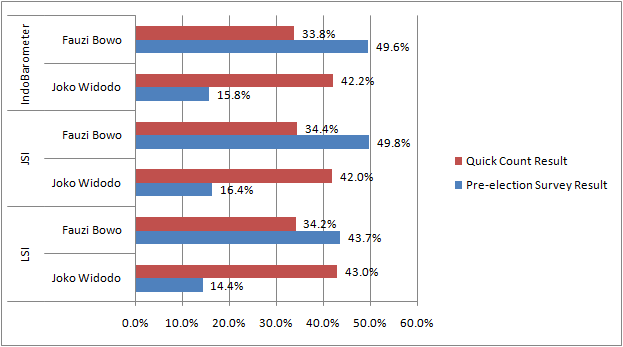
We can see a significant difference between pre-election survey results and quick count results released by all the pollsters. These results have caused some local pundits to question the credibility of said pollsters.
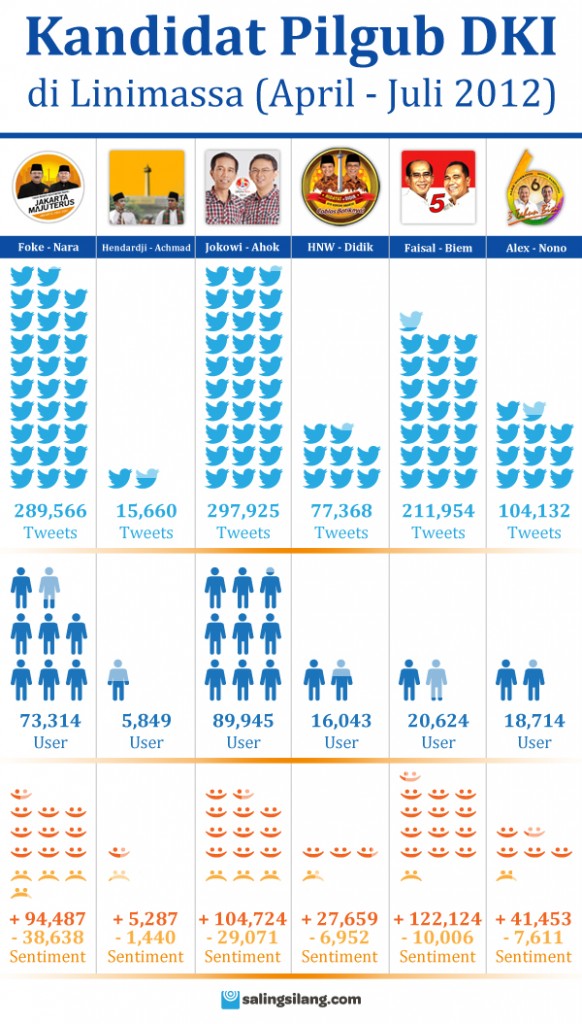
Meanwhile, the rise of social media in Indonesia has produced several social media analytics services such as Saling Silang, NoLimit, and Politicawave. Next up, I dug through pre-election social media statistics from Saling Silang and Politicawave. In this infographic that Saling Silang claims to have been recorded between April and July, it shows that Joko Widodo has indeed leapfrogged Fauzi Bowo in term of his number of followers, tweets, and online positive sentiment:
In exclusive data shown to us by Politcawave – that was compiled before the election – it shows that Joko Widodo tops Fauzi Wibowo in terms of share of awareness (click it to enlarge):
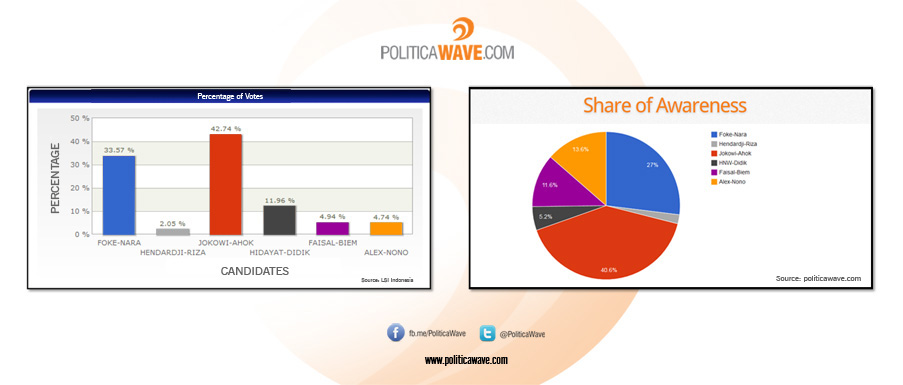
(Click to enlarge!)
I will admit that it will be naive to start saying social media analytics have finally trumped conventional pollsters. Especially given that there are still too many parameters shown by social media analytics services that are not so easy to digest by common people, or at least by me. How do we relate between the number of tweets for certain candidates and his/her electability? What does it mean to have a greater share of social media awareness? What does the share of awareness really mean? Despite all of this, it is encouraging to have social media analytics services that can boldly compete with conventional pollsters – and this time prove to be more accurate.





Stay updated on the go with our mobile app.
Get latest insights with smoother, more personalized experience through TIA mobile app.






📅 Upcoming Events
22 October 2026
Payoneer x CSPN Summit 2026