Developing a growth framework for your product managers


“It’s not easy finding good product managers because the field is so young,” said Dian Rosanti, head of product management for the consumer platform at Gojek, during a session for Product Development Conference 2019.
“We also don’t know what a good product manager looks like.”
To solve this issue, Gojek developed a growth framework to put product managers’ efforts and determine their capabilities into context.
There are five main steps to it:
- Understanding product managers’ challenges
- Defining first principles after step 1
- Designing the framework to resolve the challenges in step 1
- Developing tools and processes to support the framework and solutions
- Building teams to ship the framework and overcome challenges
To understand the challenges, companies need to research and identify the problems that product managers face. This shouldn’t be generalized across the entire organization, and firms should dig deeper to a more granular level.
Once those challenges have been identified, companies need to work out how to tackle them. For example, Gojek found that there was no clear way to know which skills were important to developing product managers’ careers. To solve this, companies need to be flexible and accept that there can be a variety of ways to determine how good a product manager is.
“We wanted to recognize that there’s different ways to grow and paths to take,” said Rosanti.
With this in mind, companies can start designing their framework. In Gojek’s case, it settled on four main categories: product strategy and execution, domain expertise, organizational and people development, as well as community and leadership.
Based on each category, the framework should then set clearly defined and precise milestones for product managers to be graded on, earning points based on each milestone they reach. The total number of points across all milestones is then tabulated, and a separate table is used to peg point totals to overall performance grading for each product manager.
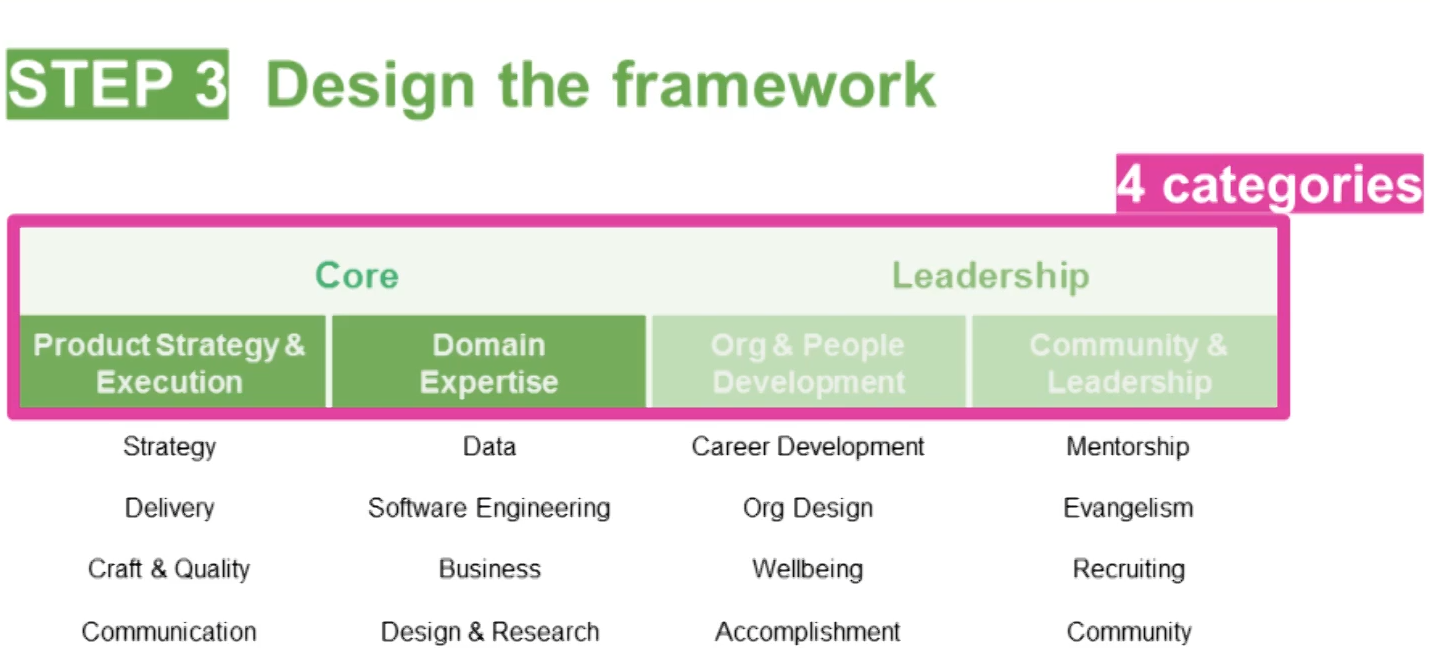
Photo credit: Gojek
It’s important to assign weights to each metric to avoid cases where a product manager may hyperfocus on a less important area while ignoring core metrics. Additionally, the overall performance grade should only serve as a benchmark for company leaders – at the end of the day, determining a product manager’s final grade and compensation should still be settled by a panel and their manager.
With the framework settled, companies need to develop tools and resources to support it – such as setting up a panel to calibrate results – and put the right people in charge of developing and maintaining the framework.
Gojek listed down a total of 16 areas in which a product manager can be assessed. But like Rosanti said, there’s so many skillsets a product manager can pick up to develop great products for their company.
With this in mind, Tech in Asia is hosting Product Development Conference (PDC) again this year to help every product professional gain relevant skills and knowledge. We’ve got topics covering things like product strategy, growth, AI, as well as data. And that’s just the broad scope of it.
To become a well-rounded, capable product manager, sign up for PDC 2023.
Stay updated on the go with our mobile app.
Get latest insights with smoother, more personalized experience through TIA mobile app.