Jonathan Chew · · 6 min read
Unlocking the potential of massive IoT for Asia’s smart cities

With any technology, it’s easy to be enamored by all the advanced use cases we can discover. In the internet of things (IoT), complex, low-latency devices – such as those that can monitor a patient’s heart and alert their caregiver in an instant should problems arise – sound like an exciting prospect.
But with IoT, just being cutting-edge won’t cut it if you don’t have the sizable scale necessary to back it up. This is what separates critical IoT from massive IoT, says Henri Bong, CEO and founder of UnaBiz, a provider of massive IoT services.

Henri Bong, CEO and founder of UnaBiz / Photo credit: UnaBiz
While critical IoT focuses on developing advanced technology and hardware, massive IoT deals with large-scale production and deployment of hardware in the hundreds of thousands or even millions. It could be something as simple as temperature sensors and controllers that need to be implemented in buildings across a city.
As Asia moves towards heavy digitalization, massive IoT is expected to play a vital role in the way governments and industries work, paving the way for a more efficient future.
Massive IoT presents a lucrative opportunity, with the global market for the tech is projected to reach US$121.4 billion by 2026.
In Asia, IoT spending has remained strong, with estimates putting it at a compound annual growth rate of 11.7% over the 2020 to 2024 forecast period in APAC.
It’s no surprise that Asia is banking so heavily on IoT. Southeast Asia, in particular, could regard IoT as being incredibly useful as countries in the region grapple with rapid urbanization, new infrastructural needs, and questions of sustainability amid burgeoning population growth.
Massive IoT will also play an important role as Asia develops smart cities, with the formation of the ASEAN Smart Cities Network and action plans being implemented over the next few years.
Getting massive
Despite a strong head start and backing for IoT, several hurdles still stand in the way of truly digitalized smart cities in Asia. Chief among them is the question of scale, which is what separates massive IoT from critical IoT, according to UnaBiz’s Bong.
He added that a decade ago, “reporters and analysts were saying there would be billions of sensors deployed in the next five to 10 years.” But that was an overestimation, as sensors today number only in the millions.
During the initial years of IoT development, many providers focused on the critical IoT aspect instead of scaling into the numbers expected of massive IoT. Much effort was also spent on defining applications and testing the technology itself as the industry rapidly generated new ideas.
The IoT industry “lost around five years” during this initial iteration process, recalls Bong. Many projects were stuck in the proof-of-concept stage and never really took off as providers didn’t have any budget left to move on to massive deployment.
“If you have a million customers in Tokyo, you can’t say you only want to test 10,000 units,” he points out. “You have to go through the steps of massive deployment. If you don’t do it, you will never benefit from it.”
While this is not a significant issue today, Bong observes that other hurdles still plague the adoption of massive IoT, such as perceptions of the initial capital investment required to embark on a project at this scale.
He also noted that since few providers offer capabilities to scale into the millions, many potential adopters do not know the real cost of reaching this level. As a result, they often end up overestimating the initial capital investment, which discourages them from pushing ahead with adoption.
The fact that massive IoT is a relatively new technology also leads to some amount of risk aversion, especially when dealing with the requisite huge numbers.
“Early adopters usually face higher risks of failure,” Bong says. “This is especially true for companies without research and development capabilities because it is a hefty investment to adopt new technology. They would rather wait for use cases to be more mature before adoption.”
Putting massive IoT into action
But the pandemic has lit a fire under many businesses and institutions, such as Temasek Polytechnic, which now understands the need for a digital transformation.
The polytechnic recently engaged UnaBiz to develop smart toilets capable of counting the number of users to trigger on-demand cleaning. It also implemented a smart facilities management system, with occupancy sensors that can analyze how meeting rooms and classrooms are used.
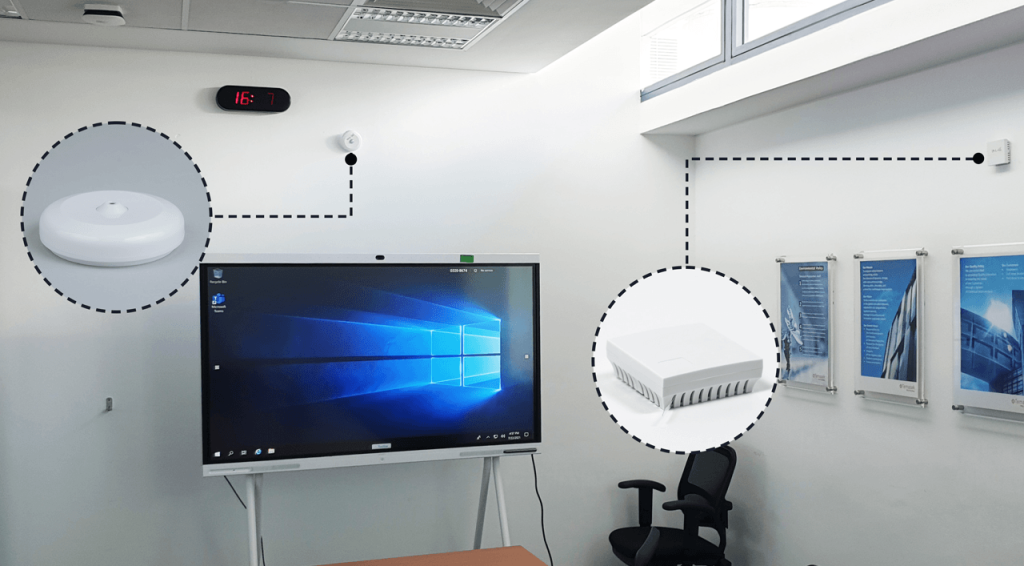
UnaBiz’s occupancy sensors in Temasek Polytechnic / Photo credit: UnaBiz
To help potential customers overcome the challenges associated with adopting massive IoT, UnaBiz places a strong emphasis on “less is more,” even as others in the industry pushed for more solutions and more tech in their products, which became counterproductive as it made IoT intimidating for potential customers.
Going the other way, UnaBiz provides customized, fit-to-purpose solutions for its partners. The rationale behind this approach is practicality: With fewer features, products like sensors and meters could last much longer by saving on battery life, which in turn can save companies time and money in the long run.
“Changing 200 units of sensors is fine. When you have to change 1 million sensors in a year, that’s a huge budget,” Bong says. Such was the case for one of UnaBiz’s partners, Japan-based Nicigas, which partnered with the IoT provider to digitalize the collection of liquid petroleum gas (LPG) consumption data across 900,000 residential gas meters in 2020.
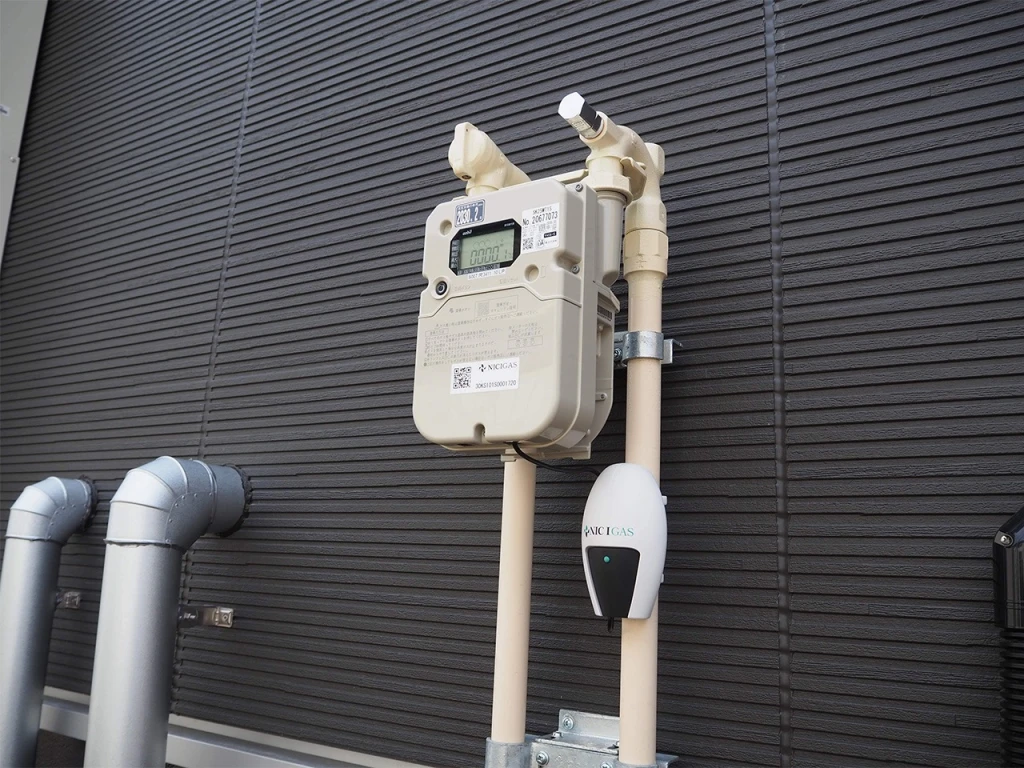
The gas meter UnaBiz developed for Nicigas / Photo credit: UnaBiz
According to Nicigas, the IoT control units provided by UnaBiz could also potentially be fitted on 24 million residential LPG meters in Japan as well as installed in public utility infrastructures to manage water and electricity consumption.
The gas supplier initially inquired about adding more features to the meter, such as real-time feedback, but doing so would decrease the battery life to three years. But after Bong explained that having fewer features would extend the battery life to 12 years, Nicigas chose that option instead.
Moving towards sustainability
Bong believes that the adoption of IoT is looking bright, with UnaBiz receiving up to 10x more leads than it had just two years ago. Moreover, governments today have a better understanding of IoT and prioritize digitalization even more now.
With the worst effects of climate change yet to come, the CEO also sees an accelerating demand for massive IoT in the agriculture sector.
For now, UnaBiz is focused on lowering the barrier to entry even further by adopting a software-as-a-service model and paving the way for better sustainability by developing more socially and environmentally responsible products.
“It’s not about saving money anymore – it’s about saving your carbon footprint,” Bong says. “This is more important than the dollars and cents we’ll save in IoT digitalization.”
UnaBiz is a provider of massive IoT services that specializes in product design, manufacturing, and cloud platform services. It has worked with companies across the world including Nicigas in Japan and Konvoy in Australia, providing their partners with massive IoT solutions of more than a million sensors.
Find out more about UnaBiz on its website.
This content was produced by Tech in Asia Studios, which connects brands with Asia’s tech community. Learn more about partnering with Tech in Asia Studios.
Stay updated on the go with our mobile app.
Get latest insights with smoother, more personalized experience through TIA mobile app.
Recommended reads
 Indonesian AI startup goes global
 Forrest Li on scaling Sea, building smarter bots, and founder grit
 An AI assistant that joins sales calls and scores team skills
 SGX’s CEO says it doesn’t need a unicorn to win
 SMEs want AI too, but not the kind Big Tech is selling
 Oatside’s alt-milk rise hits a profitable gear
 Alibaba’s financial health in 12 charts
 Asia’s telcos bundle AI into mobile plans. Will it pay off?
 M-Daq chases bigger clients as revenue falls, losses grow
 VC tracker: Accel raises US$3.5b, including US$550m for India





Editing by Nathaniel Fetalvero and Eileen C. Ang
(And yes, we’re serious about ethics and transparency. More information here.)