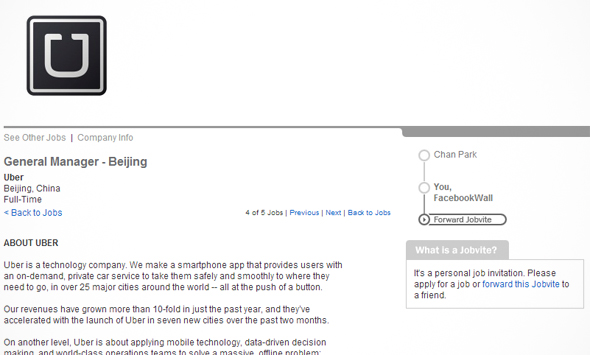
Just months after launching in Singapore, Uber, an online private car hire service, is kickstarting a major push into Asia. Already, the company has placed job postings seeking general managers, with logistics and community management roles available in certain countries.
At least 7 cities will soon see Uber’s black luxury cars on its roads, and these are: Seoul, Beijing, Shanghai, Hong Kong, Taipei, Bangalore, and Auckland.
The general manager will be responsible for developing and growing Uber’s business, requiring him or her to take charge of customer support, local marketing, supply chain management, yield management, social media, and public relations.
While Uber has not officially disclosed its timeline for regional expansion, Taiwanese tech blog Inside noted that the company has already created an Uber Taipei Twitter account. The writer further indicated that Uber has already partnered with at least one local car leasing company, and that it is set to launch in the city in a few weeks.
Spearheading Uber’s expansion efforts in the region are Sam Gellman and Tomas Campos.
Founded in San Francisco, Uber is a startup that fuses mobile technology, car transportation, and logistics to offer private cars at cheaper rates than traditional industry players.
The process is designed to be seamless: Users book a car through a mobile app, hop on and leave the vehicle without needing to hand over cash — payment is done automatically through a credit card deduction.
With USD 37M in Series B funding from Menlo Ventures, Jeff Bezos, and Goldman Sachs, Uber has rapidly expanded to 29 cities, with most of them found in Europe and the United States. Excluding Sydney, Singapore is Uber’s first stop in Asia Pacific, with its high cost of car ownership making it an attractive market for the company.
Uber has so far demonstrated a willingness to localize its offerings. In Sydney, for example, the company has tried out water taxis and is considering making it a permanent feature.
While Uber has faced regulatory roadblocks in the past, it appears to be winning battles in key cities. UberTaxi, which uses the company’s technology and business model for taxis in New York City, has begun operating again after a ban was lifted.
So far, Uber does not seem to be facing regulatory issues in Singapore and Australia.
We have reached out to Uber for comments.





Stay updated on the go with our mobile app.
Get latest insights with smoother, more personalized experience through TIA mobile app.











📅 Upcoming Events
22 October 2026
Payoneer x CSPN Summit 2026