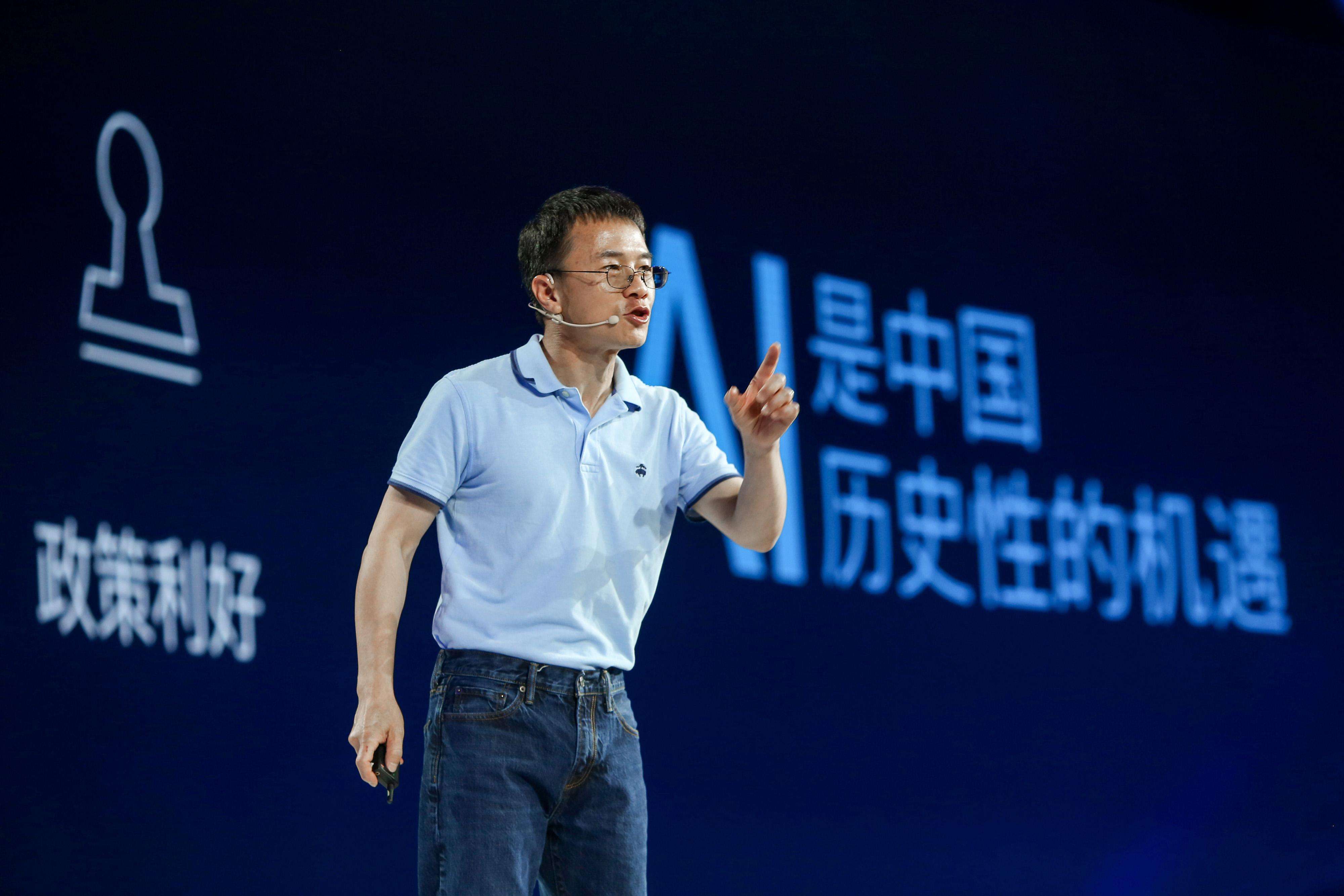
Qi Lu speaking at Baidu AI Developer Conference in July, 2017. / Image credit: Baidu
On May 18, Baidu announced that its chief operating officer Qi Lu, a former Microsoft executive, would be resigning in July after a year and a half in the post.
Lu said in a company statement that he would retain his role as a vice president on Baidu’s board, though he could no longer work full-time in China “due to personal and family reasons.”
Some consider the shakeup a blow for Baidu. Shares of the Beijing-based firm plunged on the day Lu’s departure was announced. Credit Suisse downgraded its rating for Baidu’s stock, citing Lu’s role as “instrumental to Baidu’s transition to becoming an ‘all in AI’ company.”
This was echoed by Wang Yanbin, founder of a Chinese AI startup. He tells Tech in Asia that AI projects, unlike those based on “basic” information technology, involve longer-term development cycles.
“The loss of core talent will usually interrupt the execution and progress of AI projects,” he says.
Others point out that while Lu’s role was crucial, the impact of his departure will only be temporary. “Baidu’s AI venture is an ongoing, collective effort rather than a one man show,” Zheng Liyao, co-founder of Chinese AI research institute GGAI, tells Tech in Asia.
For example, Baidu had begun working on autonomous driving back in 2013. And although Lu oversaw on-the-ground implementation of Apollo, the firm’s open self-driving platform, CEO Robin Li claims that he first proposed the concept in the summer of 2016.
Lu’s arrival
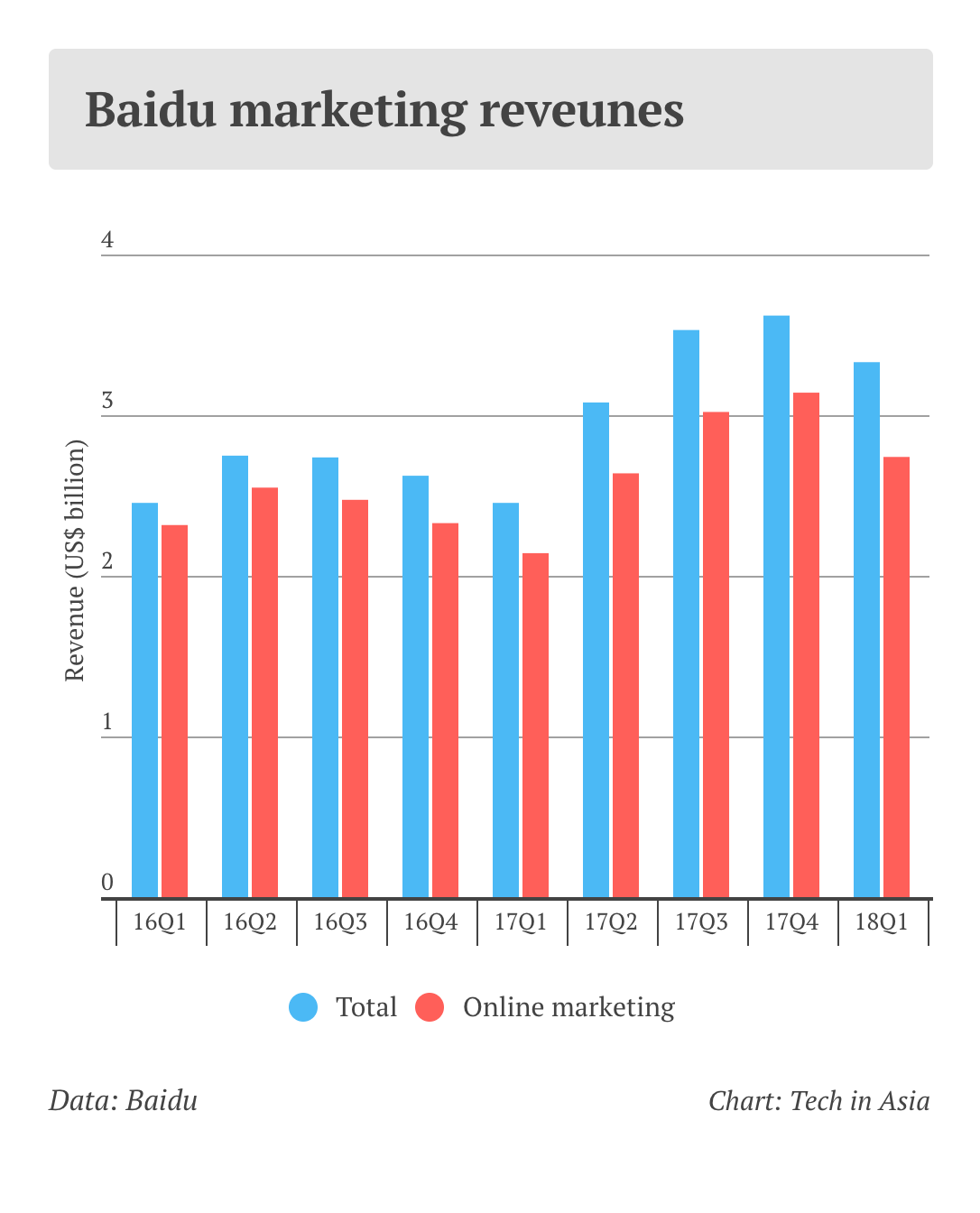
Lu joined Baidu in 2016 in the aftermath of a damaging scandal, where a student died after purchasing dubious medical treatment advertised alongside Baidu’s search results. The incident triggered a massive public outcry and a government crackdown on Baidu’s in-search healthcare advertising. Online marketing has been a core revenue driver for Baidu in recent years.
At the time, Baidu’s AI pivot was already underway, with star hires such as Andrew Ng, former head of Google Brain, and Jin Wang, former director for Google’s Shanghai research center.
“But most of Baidu’s AI efforts were staying at the conceptual, technological level prior to Lu’s presence,” argues Zheng. “The greatest contribution Lu brought to Baidu is the commercialization of AI.”
For one, Lu consolidated what used to be “fragmented” AI units under three overarching umbrellas: the intelligent driving group (IDG); the Apollo-led artificial intelligence group (AIG); and the smart living group (SLG) – managed directly by Lu himself – with an open platform for smart gadgets and Baidu’s own hardware. The restructuring was aimed at smoothening cross-department collaboration.
What’s next





Stay updated on the go with our mobile app.
Get latest insights with smoother, more personalized experience through TIA mobile app.








📅 Upcoming Events
22 October 2026
Payoneer x CSPN Summit 2026