 Elaine Ramirez · · 8 min read
Startup plants forests with crowdfunding, mobile game

In an era when even the Pope laments the globe’s environmental ruin, Tree Planet is trying to make the world a little greener.
The Korean startup, co-founded in 2010 by CEO Kim Hyung-soo and directors Jeong Min-cheol and Kim Jae-hyun, raises funds through mobile games and a crowdfunding platform with the aim, as its name suggests, of planting trees around the world. The social venture has found a way to win over consumers, nonprofits, and corporate sponsors while tackling hunger in South Sudan, desertification in China, and concrete jungle grayness in Seoul.
Having planted 500,000 trees in 80 forests in 10 countries, Tree Planet is succeeding in making the earth more sustainable – along with its business. Backed by local seed investor Crevisse Partners and accelerator SparkLabs Korea, it raked in over US$1 million in total income in 2014, and says it has turned a profit every year.
CEO Kim says that even though big businesses with heavy corporate social responsibility budgets have more muscle to plant trees, Tree Planet will win out because it takes the time to get to know the local community.
“Many big companies have CSR and give money all over the world, but for their employees, it is just a job,” he tells Tech in Asia. “But Tree Planet goes there to meet the NGO and [affected] families, and we all go together to plant the trees. We eat and drink together and become friends […] They sense whether our emotions are true or if it is just a job. So Tree Planet will grow because we share the emotion and thinking [with the people we help].”
Game on
Kim says he was motivated by the motto of his school, Handong University: “Why not change the world?” After five years of environmental filmmaking, Kim, a media content major, wanted to get people to stop just watching and start doing.
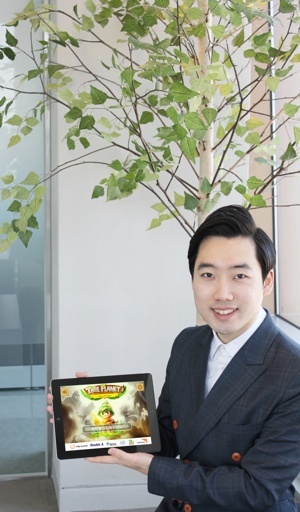
Tree Planet CEO Kim Hyung-soo.
While many social ventures were saving polar bears and cute endangered species, he saw trees as the root of the ecosystem, and a resource that was quickly vanishing. He teamed up with Jeong, his old military buddy (duty is mandatory in Korea), and Kim, Jeong’s high school friend, to create a virtual game that would make it fun for users to make a difference in the real world.
Tree Planet was conceived around the same that Farmville was blowing up Facebook feeds around the world. With Samsung introducing its first Galaxy smartphone the previous year, sales of smartphones in Korea were exploding. Meanwhile, Korea’s government, in the thick of its “green growth” initiative and preparing to host the G20 summit in Seoul, was very attentive to how global leaders would perceive the country’s push to be more eco-friendly, director Jeong recalls.
There lies the opportunity for the trio of founders to pitch their idea to the Korean government, which became Tree Planet’s first sponsor, to develop their mobile app in time for the summit. Behind the scenes, the startup also formed partnerships with corporate sponsors like Toyota Korea, Hanwha Group, and Korean government agencies, seeking to ramp up their green branding by buying in-game ads. Then it teamed up with NGOs such as World Vision on the ground to handle local logistics and educate villagers on how to turn seedlings into fruit-bearing trees.
“It really connected with our idea. Green growth, social ventures, young entrepreneurs, smartphones – all the factors made for really nice timing,” Jeong notes. The startup planted its first forest in 2010 in the Demilitarized Zone – the fortified stretch of no-man’s land between the two Koreas – and its first forest overseas in Indonesia the following year.
The Tree Planet game, now with 1.05 million downloads on Android and iOS, lets players raise a baby tree a la 1990s hit Tamagotchi – feed and water it, play with it, complete mini games, and attend to it two to three times a day. Growing a sapling into a full-grown tree takes two hours across an average of three to seven days. As if that weren’t cute enough, when the real seedling gets planted, users get regular “Dear Mom” status letters from their baby trees via email, which makes it a hit with the 18-24 female crowd. (Guys are skeptical that the company is really planting trees, Jeong says, so all users get the “Dear Mom” letter regardless of gender).
Star funding
Social commerce (ad)venture





Stay updated on the go with our mobile app.
Get latest insights with smoother, more personalized experience through TIA mobile app.










📅 Upcoming Events
22 October 2026
Payoneer x CSPN Summit 2026