
V-cube is a Japanese company that provides visual communications — basically video and web conference solutions — for enterprises. It was founded in October 1998 by Naoaki Mashita first as a web and mobile consulting and development studio.
In 2004, V-cube ventured into developing its own consumer apps and even had an L.A office. Back then Mashita said it was extremely difficult to have virtual meetings between the U.S and Japan teams. There just weren’t any good video or web conferencing products available on the market. Instead of hoping for one, Mashita and his team decided to build one themselves for their own use. It turned out to work very well for them.
Going full throttle in visual communications
In the same year, in 2004, V-cube realized that its customers were also facing the same problem of not having a user-friendly and reliable solution to hold virtual meetings with overseas team members. Seeing the opportunity, Mashita started to introduce V-Cube’s own in-house conferencing solution to its clients. The feedback was great.
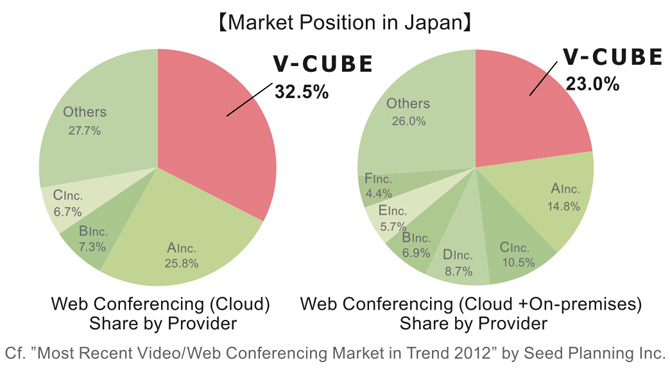
Soon after, V-cube turned into a full-fledged visual communication company, focusing just on providing video and web conferencing solutions for enterprises. That decision proved to be right. Today, V-cube is one of the leading visual communication companies in Japan. Citing data from Seed Planning’s Video and Web conferencing 2012 report, V-cube ranks first in the Japanese web conferencing industry, with 32.5 percent of the market share.
Despite web conferencing being its biggest revenue generator with over 3,000 clients, V-cube also provides visual communications solutions for other functions like:
- Web seminars
- Online support and maintenance
- Online sales
- E-learning
- Tele-healthcare and distant counseling
V-cube visual communications solutions are browser-based so they don’t require any installation on the users’ end. It is also compatible across all major operating system including, Windows, Linux, Macintosh, Android, and iOS.
Asian style communication
The reason V-cube was able to beat its overseas competitors is that it understood the Asian culture better. Mashita said that in America and Europe, conferencing involves mainly text and voice. There’s no real need to “meet or see” the person online.
On the other hand, in Asia, it is important to first “meet” the clients. Thus, doing face-to-face conferencing is an important core. By understanding this important cultural difference, V-cube gained a huge advantage over Western competitors like Cisco and Microsoft. Mashita claims that all 47 Japanese prefectures are using V-cube virtual conferencing solutions.





Stay updated on the go with our mobile app.
Get latest insights with smoother, more personalized experience through TIA mobile app.













📅 Upcoming Events
22 October 2026
Payoneer x CSPN Summit 2026