- Insights This article was written by a TIA community member. Insights pieces undergo the same rigorous editorial process that newsroom-produced articles have.
 Tim Romero · · 7 min read
How this Japanese founder created smart LED shoes and is planning to scale it
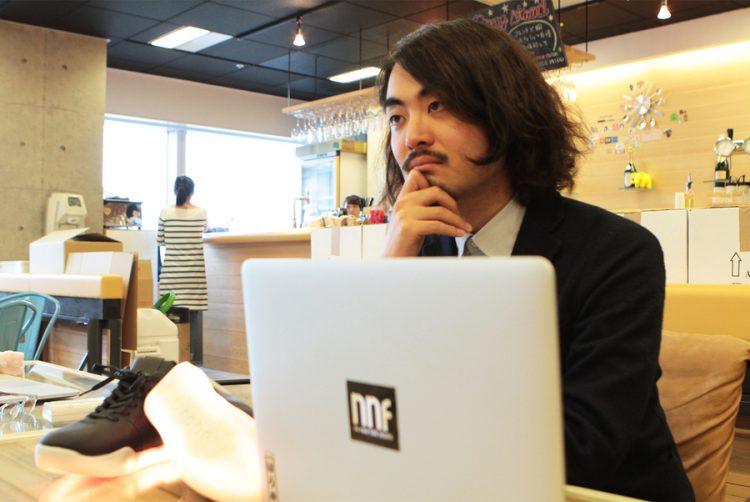
A photo of Yuya Kikukawa.
This article is part of Tech in Asia’s partnership with Disrupting Japan where we publish the revised transcripts from the show’s podcast interviews with Japanese entrepreneurs. This is heavily revised from the original transcripts. For the full interview, go here.
Most good startups are obvious. You can understand right away the problem they are solving for their customers and how they’re doing it. Naturally, that makes it easier for customers to buy. On the other hand, there are startups that are still struggling to find product-market fit.
And then, there are products like Orphe, LED-emblazoned, wifi- and social sharing-capable dancing shoes. Yes, it sounds like something you would find on Indiegogo. But when I sat down with Yuya Kikukawa, founder of No New Folk Studio and creator of Orphe, it became clear that this was not some quirky side project or some overfunded crazy hardware startup.
We talked about the original inspiration for the shoes and how it is being used in Japan. We also dove into its technology. Here’s our discussion.
Can you describe what Orphe is exactly?
Orphe is kind of the world’s first smart LED shoes. Smart means it has a computer inside of the sole, and at the same time, there are about 100 full-color LED lights. The computer can control each pixel, so the user can change the color through the smartphone application. The idea for this product is combining musical instrument functions and LED shoes.
The shoes have nine-axis motion sensors: three accelerometers, three gyroscopes, and three compasses.

Photo credit: Orphe’s website.
How does Orphe work?
Our main target customers are dancers and performers. Orphe can react with performance motion like dance steps. There were already some users before Orphe wearing LED shoes and dancing, but the shoes didn’t react with motion and music. Our shoes can send information and their lights can be controlled with a step.
There’s also a social sharing component. Users can download the lighting pattern from the cloud, but the motion sharing is not open yet. It is an important idea because we are a more open platform now. For example, we are developing the system to enable sharing of sensor data.
Do you have global competition now?
In the genre of smart shoes, there are some startups. For example, Under Armor is making smart running shoes that have a sensor in the sole. There are also other competitors. But we’re more targeted at performance arts, at least for the moment.
How did you go from wanting to make musical instruments to making musical shoes?
In graduate school, I majored in industrial art design and studied designing musical interface in a laboratory. At that time, I came across the idea of mixing light and sound in one musical interface. So, PocoPoco, an instrument, is one example. It is black and box-shaped and it is like a sequencer to make loop music. Just by pushing the buttons, it makes some loop sounds and lights up at the same time. It has a haptic interaction. Haptic means it has a solenoid magnetic power actuator.
After the prototype, we made a video about it and it got good feedback from around the world. So after that, I thought of commercializing the product, but there’s a problem in design, which is very costly. We realized it’s not good to turn it into a business. So, I thought of a product that is good for merchandise.
It’s hard to get people to make music on something new. What do you think?
Can you tell us about the prototype for Orphe?
What were the challenges of going into production?
What is your team like?
How are you going to make sure that the shoes are not just another fad?
If you can make things better for startups in Japan, what would you change?
Final thoughts





Stay updated on the go with our mobile app.
Get latest insights with smoother, more personalized experience through TIA mobile app.











📅 Upcoming Events
22 October 2026
Payoneer x CSPN Summit 2026