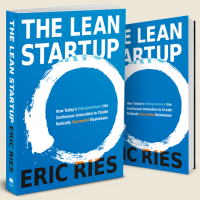
 Drawn from his blog “Startup Lessons Learned” and sharing his experiences as the former CTO of IMVU, The Lean Startup is Eric Ries’s (@ericries) effort, in his own words, to change how startups are built. Whether you are a business person or technologist, the book “The Lean Startup” is a must-read for any entrepreneur.
The lessons on how to build a minimum viable product, iterate base on customer feedback and metrics and pivot when all else fails will guide the entrepreneur and hold them accountable in their attempt to change an industry.
In the vein of Peter Drucker, who wrote that entrepreneurship is risk management, Eric Ries began the book with the note that the lean startup method is for entrepreneurs and the people who hold them accountable. The five key principles which set up the entire book are:
1. Entrepreneurship is everywhere and isn’t limited to people who work in startups. In his definition, he broadened the definition to anyone who works within any human institution designed to create new products and services under conditions of extreme uncertainty, which implies that the approach he is advocating works in a company of any size of any sector or industry, and that includes multi-national enterprises.
2. Entrepreneurship is management. This sets up the notion that the entrepreneur needs a different kind of management for an environment that is specifically geared to its context of extreme uncertainty.
3. Validated Learning. Eric Ries argued that startups exist to learn how to build a sustainable business and the learning can be validated scientifically by running frequent experiments that allow them to test and find out how the market reacts to their products. In fact, that approach pervades the book.
4. Build-Measure-Learn. This concept explains that a startup’s fundamental activity is to turn ideas into products, measure how customers respond and then learn whether to pivot or persevere, and how the lessons from all successful start-ups can be directed to grow the feedback loop.
5. Innovation accounting. Ries strongly believe that the survival of a startup can be better enhanced by focusing on the boring stuff: How to measure progress, set up milestones and prioritize work. It provides a possible way for how investors and entrepreneurs themselves can evaluate the progress of a start-up.
With the five principles in mind, the author takes the reader through the rest of the book in three parts: “Vision”, “Steer” and “Accelerate”. He buids his case with several interesting case studies including his time in IMVU.
For example, Intuit demonstrated with Snaptax that they can build a good product even though they are a big organization. They found their own way to break the Innovator’s dilemma. Snaptax was able to solve an interesting problem of allowing users to finish their entire tax returns on a mobile phone. Other stories included Zappos, Facebook and Path.
In “Vision”, the first part of the book, Ries builds the case for the discipline of entrepreneurial management. The author identifies who the entrepreneur is, the definition of a startup, and offers a new way for startups to gauge that they are making progress with a method called validated learning.
The key, according to Ries, is that start-ups need to devise scientific hypotheses on their product and find out how a sustainable business can be built in the process.
On “Steer”, the second part of the book, the author brings up the concept of building the minimum viable product to test the assumptions and an accounting system to evaluate whether entrepreneurs are making progress. He offers the a decision making method to help entrepreneurs to decide if they should pivot or persevere.
In “Accelerate”, Eric explore techniques that help lean startups accelerate through the build-measure-learn feedback loop as quickly as possible while the start-ups scale.





Stay updated on the go with our mobile app.
Get latest insights with smoother, more personalized experience through TIA mobile app.