Self-driving vehicle technology and driver assist functions are all the rage in the automobile tech industry, but Tesla is one of the few companies already offering a robust “autopilot” service to customers. And while the tech has done some amazing things, it has also been involved in a few accidents, including at least two fatalities.
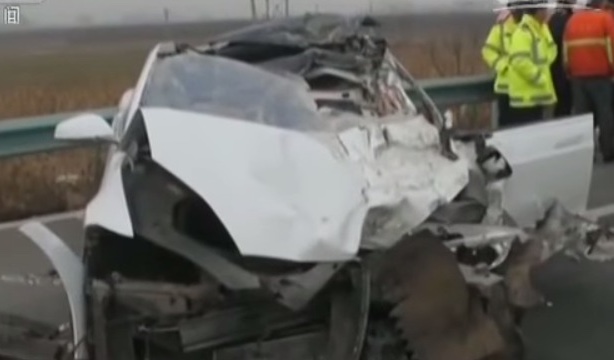
An American accident this summer saw a speeding Tesla motorist killed when the vehicle collided with a turning truck, but the world’s first autopilot fatality may have happened in China. On January 20, 23-year-old Gao Yaning crashed a Tesla Model S into a street-sweeping vehicle on a highway south of Beijing. The accident became a hot topic in the Chinese media after state news organization CCTV reported on it last week.
It’s not clear whether Autopilot was engaged when Gao crashed; Tesla has told the media that it was unable to determine the cause. The vehicle, Tesla says, was too damaged to salvage any data or logs. Tesla also says it tried to work with the victim’s family to determine the cause of the crash, but the family declined to cooperate.
Chinese police concluded that Gao was at fault for the accident, but Gao’s family says otherwise, and has filed suit against the Tesla dealer. Gao, they say, liked activating Autopilot, and a dash cam video from the crash appears to show he had it activated. Gao’s father told state media that there’s so little variance in the car’s lane position in the video that the car must have been in Autopilot.
The video also shows that the car evidently makes no attempt to brake or turn before hitting the street sweeper.
Assigning blame for the accident is complicated. On the one hand, it seems quite likely that Gao did have the Autopilot activated, and that it failed completely to identify a huge obstacle in the roadway. On the other hand, Tesla’s Autopilot feature is in beta, and the car’s manual does note that drivers should keep their eyes on the road because Autopilot can have trouble detecting obstacles, especially in highway situations. It’s unlikely that Gao, an experienced driver with professional experience driving for the military, would have crashed the car on his own. But it’s also almost certain that Gao wasn’t paying as much attention as he should have been, and wasn’t using Autopilot in the manner Tesla describes in the user manual.
The fact that Gao probably wasn’t following the user’s manual will, to some, free Tesla from any blame for the accident. But in China, there are questions about how much culpability Tesla has given the way its product is marketed. The company briefly removed its Chinese translation for Autopilot from its website earlier this year after another accident led to criticism about misleading advertising – the Chinese translation of the term suggested the car was “self-driving.” Tesla’s Chinese website now calls Autopilot “automated assisted driving,” but that change was made well after Gao’s family bought the Model S, and indeed well after he crashed it.
True, Gao wasn’t driving like the user manual suggested he should. But the Model S user manual is 190 pages long; can Tesla truly expect owners to read it cover-to-cover before heading out onto the road? Some would argue that Tesla ought to make Autopilot’s limitations clearer in its promotional and marketing materials. And it’s possible that even more broadly, all the hype in the tech industry about self-driving cars has given some consumers a trust and belief in the technology that isn’t (yet) warranted.
Whatever you believe, the accident – and its high profile coverage in the Chinese press over the past week – isn’t great news for Tesla. In the comments on stories about Gao’s accident, users are debating how promising this sort of technology can be in the near future, though many are also blaming Gao, suggesting he was playing on his phone or fell asleep.
As one user put it: “When you’re driving a car, either trust yourself or take a taxi. Trusting a machine? That’s asking for trouble.”





Stay updated on the go with our mobile app.
Get latest insights with smoother, more personalized experience through TIA mobile app.












📅 Upcoming Events
22 October 2026
Payoneer x CSPN Summit 2026